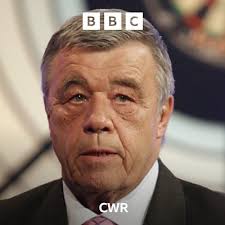
But who was the man behind the scoreboard? How did a former amateur darts player from Hull become the face of one of ITV’s most enduring game shows and the voice of the BBC’s World Darts Championship for nearly four decades?
This is the story of Anthony John Green—a tale of sporting excellence, tragic loss, and the unique magic of a man who turned a pub game into a national treasure .
Table of Contents
ToggleThe Calm Before the Oche
Long before the studio lights of Bullseye or the hushed tension of the Lakeside Country Club, Tony Green was simply a lover of the game. Born in 1939 in Hull, Yorkshire, Green’s affinity for darts was not born in a television studio but on the chalky floors of workingmen’s clubs.
Unlike many of his peers who stumbled into broadcasting, Green had the eye of a player. He was a respectable amateur competitor who understood the geometry of the board and the psychological torture of the “double.” This perspective would define his commentary style. He never felt the need to scream or hype; he believed the drama of the game—a player sitting on 32 with a championship on the line—was enough. His job, as he saw it, was simply to illuminate the path .
In 1978, the BBC took a gamble on darts. The sport was transitioning from a smoky pastime to a televised spectacle. They needed voices to guide the audience through the revolution. They hired two very different men: Sid Waddell and Tony Green. While Waddell became the “Voice of Darts” for his colorful outbursts (“When Alexander of Macedonia was 33, he cried salt tears…” etc.), Green became the anchor. As the BBC’s primary commentator for the BDO World Darts Championships from 1978 to 2016, Green was the master of the “low-key big moment” .
He was behind the mic for history. In 1990, as Paul Lim stepped up to the oche, Green watched the Singaporean player produce perfection. As Lim hit treble 20, treble 19, and double 12 for the first ever nine-dart finish in World Championship history, Green’s commentary was a masterclass in letting the pictures do the talking. He didn’t yell; he simply registered the magnitude of the moment, allowing the roar of the crowd to provide the emotion. It was the sound of a man who knew he was witnessing history and trusted the audience to feel it .
“Super, Smashing, Great” – The Bullseye Dynasty
If the BBC darts made Tony Green a respected voice, ITV’s Bullseye made him a national institution. When the show launched in 1981 (originally hosted by Jim Bowen), it was a bizarre, brilliant gamble. It mixed the high-skill pressure of professional darts with the low-stakes charm of a general knowledge quiz. It featured contestants who were usually factory workers or retired miners, playing for “what you see on the screen.”
Green’s role on Bullseye was unique. He wasn’t the host; that was the fast-talking, slightly cheeky Jim Bowen. Green was the referee, the scorer, and the straight man. While Bowen joked with the contestants about “Brucie” bonuses or the speedboat they weren’t going to win, Green stood at the scoreboard, chalking up the scores with a dry, sometimes weary, expression.
He was famous for the specific vernacular of Bullseye. The show’s signature rule was encapsulated in a phrase Green uttered dozens of times per episode: “Keep out of the black and into the red, nothing in this game for two in a bed.”
For the uninitiated, this was the gospel of Bullseye. In the gambling round, if a player landed their darts in the same wedge (a “bed”), it didn’t count. They had to hit different segments. Green’s monotone delivery of that rule became a catchphrase that transcended the show .
He also delivered the show’s most devastating line. When a contestant failed to hit their required double to win a major prize (perhaps a terribly beige three-piece suite or a Sinclair C5), Green would look up, shake his head slightly, and say, “But look at what you could have won.”
It was cruel, brilliant, and quintessentially British. Tony Green’s delivery was never mocking; it was genuinely sympathetic. He was the voice of fate, and he felt sorry for you.
The chemistry between Bowen and Green was the engine of the show. Bowen was the chaotic comedian who would shout “You can’t beat a bit of bully!” while Green was the calm mathematician, ensuring the game was played fairly. At its peak, Bullseye pulled in audiences of over 20 million viewers. It was a ratings juggernaut that turned Sunday tea-time into a ritual .
The Comeback and The Final Goodbye
Bullseye ended its original run in 1995, but the love for the show never died. The revival of popular culture in the 2000s saw Bullseye return. In 2006, Challenge TV brought the format back with comedian Dave Spikey hosting. While the host changed, the producers knew one thing for certain: you cannot have Bullseye without Tony Green. He returned to his scorer’s position, proving that the glue holding the chaos together was always his steady presence .
Behind the scenes, however, Green was fighting battles that the public never saw. In 2010, he took a career break to undergo treatment for tongue cancer. It was a grueling fight, but true to his resilient Yorkshire character, he beat it and returned to the microphone .
His resilience was tested again in later years. In 2024, it was announced that Green had passed away following a long battle with Alzheimer’s disease . The news was broken by Andrew Wood, the creator of Bullseye, on the show’s official Facebook page. The tributes that followed were a who’s who of British darts.
Bobby George, the flamboyant King of Bling, noted that Green wasn’t just a commentator but a good dart player and a genuine icon . Perhaps the most poignant tribute came from player Steve Beaton. Beaton revealed that it was Tony Green who gave him his nickname, “The Bronzed Adonis.” “He gave me my nickname,” Beaton said. “Such a nice guy. RIP my friend” .
These tributes highlighted a man who was universally loved. In a sport rife with egos and rivalries (particularly the schism between the BDO and PDC), Tony Green was a neutral Switzerland. He was respected by the old guard and the new generation alike because he treated the game—and the players—with dignity.
Why We Still Miss Him
In the current media landscape, sports coverage is dominated by shouting matches, VAR controversies, and hot takes. Tony Green belonged to a different school: the school of quiet authority.
There is a specific generational grief attached to his passing. For anyone who grew up in a working-class home in the 80s, Bullseye was the sound of safety. It meant the roast dinner was digesting, the bath was running, and the school week hadn’t started yet. Tony Green was the auditory cue for that moment of rest.
When Jim Bowen passed away in 2018, Green tweeted a simple, heartbreaking farewell: “Lost a legend today, but most of all a friend. RIP Jim x” . Upon Green’s own death six years later, the circle was complete. The scoreboard is now closed. The oche is empty.
Tony Green leaves behind a legacy measured not just in 180s or nine-dart finishes, but in the smiles he brought to the faces of millions. He was a commentator who understood that sometimes, less is more. He was a scorer who knew that the numbers on the board mean nothing if the audience isn’t having fun.
As we look back at the reruns on Challenge TV or the clips on YouTube, we will hear his voice. It will echo through the decades, reminding us to keep out of the black and into the red.
So, raise a glass (or perhaps a dart) to Tony Green. He didn’t just call the game; he made the game feel like home. And for that, we say: Super, smashing, great.
Conclusion
Tony Green was more than just a scorekeeper or a commentator; he was the quiet heartbeat of a golden era of British entertainment. In an industry that often rewards volume and spectacle, Green proved that dignity, precision, and a gentle sense of fairness were far more enduring. He guided us through the drama of world championships without ever stealing the spotlight, and he turned the simple act of chalking numbers on a board into an art form.
Today, as darts fills massive arenas with flashing lights and roaring crowds, the echo of Tony Green’s calm voice remains a reminder of where it all began—on a cozy studio set, with a few pints, a bit of banter, and the hope of hitting that double. He was, and always will be, the man who told us what we could have won. And in his life and career, we all won something truly special