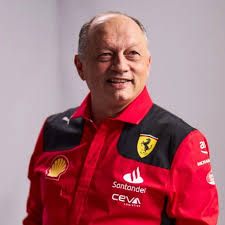
But something profoundly different—and perhaps profoundly more dangerous for the rest of the Formula 1 grid—has been happening in the garage since January 2023. His name is Frederic Vasseur, and he doesn’t scream.
As Ferrari barrels toward the revolutionary regulations of 2026, the paddock is witnessing a masterclass in psychological engineering. The Frenchman is not just rebuilding a car; he is deconstructing a neurosis. Through the eyes of his champions, the innovation of his engineering team, and the cold, calculated logic of his management style, a new Ferrari is emerging: one that smiles, one that risks, and one that finally looks ready to win.
Table of Contents
ToggleThe ‘Anti-Binotto’: A Cultural Exorcism
To understand the scale of Vasseur’s mission, one must look at the carcass of the past. The 2022 season was a trauma. Ferrari started with the fastest car on the grid, a machine that seemed destined to break Red Bull’s stranglehold. But as the pressure mounted, the team folded. Strategic blunders, mechanical fragility, and a palpable atmosphere of panic turned certain victory into a heartbreaking collapse. By the time Mattia Binotto resigned, Ferrari wasn’t just losing; it was psychologically broken.
Enter Vasseur. Unlike the highly technical, insular Binotto, Vasseur arrived from the midfield battlegrounds of Sauber. He was not a “Ferrari lifer” steeped in the internal politics; he was an outsider. And his first job was not to build a faster car—it was to fix the heads of the people building it.
For decades, Ferrari operated under a “culture of fear,” albeit unofficially. In a startlingly honest reflection on the 2026 season, Vasseur revealed the shocking reality he found upon arrival. “The first thing that struck me when I joined the group was the distance we had on every single topic, simply because we didn’t want to expose ourselves,” he admitted to The Race .
He described engineers so terrified of making a mistake that they over-engineered for safety. To “be sure,” they would add a kilo of weight here, or half a liter of fuel there, just to avoid the risk of failure. “When you put everything on the table,” Vasseur calculated, “it was two tenths [of a second lost]”. In a sport where races are won by hundredths of a second, the team was beating itself before it even turned a wheel, paralyzed by the fear of looking stupid in front of the tifosi.
Vasseur’s prescription was radical: permission to fail. He is systematically eradicating the “defensive” driving style of the engineering department . “If you have something to propose, be open. We never blame anyone if a proposal doesn’t work,” he states . This shift from “surviving” to “exploring” is the quiet revolution happening in Maranello.
The ‘Macarena’ Wing and the Art of Daring
The results of this psychological shift are now visible on the track. As the 2026 season unfolds, the SF-26 has become the most talked-about car on the grid, not just for its speed, but for its audacity. The paddock has nicknamed one of Ferrari’s rear-wing innovations the “Macarena” wing—a movable aerodynamic flap that looks unlike anything else on the grid .
This is not random tinkering; it is a manifesto. For years, Ferrari followed the “Red Bull clone” methodology, watching what the champions did and copying it with a slight Italian flair. Under Vasseur, Ferrari is dictating the trends. The exhaust flaps, the aggressive rear-end solutions—these are the physical manifestations of a team that no longer fears the unknown.
Vasseur is keen to keep the ego in check, however. His mantra for the technical department is brutally pragmatic: “The goal is not to innovate for the sake of innovating. The goal is to win. Innovation only makes sense if it works” .
He has changed the Key Performance Indicator (KPI) of the department. It is no longer enough for the aerodynamicists to say “we added downforce” or for the engine department to say “we added power” in isolation. The only KPI that matters is the lap time. This holistic, zero-excuses approach forces the “silos” at Ferrari to talk to each other. If adding downforce means adding weight that kills speed on the straights, it’s worthless. Vasseur has made the engineers look at the car as a living, breathing entity rather than a collection of parts to be defended .
The Driver Whisperer: Managing Egos with a Smile
Perhaps the greatest testament to Vasseur’s unique talent is the harmony inside the cockpit—a space that, in Ferrari’s history, has usually been a war zone. Managing Charles Leclerc is one thing; managing Lewis Hamilton is quite another.
When Hamilton made the seismic shift from Mercedes to Ferrari in 2025, the world expected fireworks. Two alpha drivers, one historic team, the pressure of Italy. Yet, under Vasseur, the atmosphere has been described as “family-like.”
Leclerc, who has seen more team principals than podiums in his early career, put his finger precisely on why Vasseur works. “Fred has always had very cold blood in those moments,” Leclerc explained, referencing the high-pressure implosions of the past. “He helped the team to be a little bit more lucid. That’s the biggest thing Fred has brought to the team” .
Leclerc admits that the “beauty of Ferrari” is its emotional intensity, but it can “harm us” during tough times. Vasseur acts as the thermostat, turning down the heat so the engineers can think clearly. But he is not a robot. Leclerc reveals a secret weapon: Vasseur’s sense of humor. “Whenever we have team dinners, we are having a good time, and it really feels like a family,” Leclerc notes .
For Lewis Hamilton, who left the Mercedes “machine” where he won six titles, the transition could have been jarring. Instead, Hamilton sees a mirror image of his most successful partnership—not in style, but in substance. Asked if Vasseur reminds him of Toto Wolff, Hamilton was definitive. “No, completely different,” he said. But he noted the common thread: “They’re both massive racers” .
Hamilton praised Vasseur’s ability to “figure out how people work best, how to get the most out of someone” . Vasseur gives his stars freedom. He doesn’t micromanage their driving; he manages the environment. He removes the noise so that a 40-year-old seven-time champion and a 28-year-old homegrown hero can coexist and push each other.
Pressure is a Privilege
One of the most endearing traits of Vasseur—and one that confuses his rivals—is his persistent smile. In a paddock filled with stone-faced political operatives, Vasseur looks like he is genuinely enjoying himself. Some critics have mistaken this for a lack of intensity. They are wrong.
In a candid interview, Vasseur addressed this directly. “I’m not sure it would go faster if I didn’t smile,” he quipped . He rejects the trope of the angry boss. “You can do things very seriously… I know every member of the team works like crazy, 24/7… you sometimes have to be a little more relaxed. But that doesn’t mean we don’t take things seriously” .
This “no-nonsense” approach, as pundit Karun Chandhok calls it, is visible in his race management . After a dominant win in Mexico (a rare feat for modern Ferrari), Chandhok approached Vasseur buzzing about the Constructors’ Championship. Vasseur shut it down instantly. “No, we’re not going to talk about it. We’re going to talk about Brazil. One by one. That’s all I care about” .
This is the Zen master of Formula 1. He is process-driven, not outcome-driven. By refusing to look at the trophy, he makes the trophy more likely to arrive.
The 2026 Gamble: A Blank Canvas
As the 2026 season progresses, the true test of Vasseur’s reign is unfolding. This year represents a full regulatory reset. When Vasseur arrived in 2023, he inherited Binotto’s car. Now, with the SF-26, he has finally put his stamp on the engineering structure, notably by promoting Loic Serra to Technical Director and allowing a “blank page” design .
The early signs are mixed but promising. While some rivals may still have a pure pace advantage, Ferrari has the most innovative development curve. “The capacity of the team to grow, to understand where to improve… will count more than the contingent situation,” Vasseur argues . He is playing the long game, betting that a team that learns to crawl quickly will eventually sprint faster than one that walks safely.
Frédéric Vasseur is proving that leading Ferrari requires less fire and more ice. He has diagnosed the patient not as lacking horsepower, but as lacking resilience. He has traded panic for process and replaced fear with ambition. He knows that the tifosi demand victory, but he is smart enough to know that you cannot drive the car looking only in the rearview mirror at your past mistakes.
By smiling, by joking, and by keeping his “cold blood,” Vasseur is doing what no engineer alone could do: he is making Ferrari think clearly again. And in a sport decided by milliseconds, a clear mind is the fastest machine of all.
References
Speedcafe.com. (2025). Hamilton, Leclerc back Vasseur’s Ferrari renewal.
Ferrari.com. (2026). Scuderia Ferrari Team: Frédéric Vasseur.
Automoto.it. (2026). F1. Ferrari 2026, Vasseur: Innovazione ha senso solo se funziona.
Automobilemagazine.com.tr. (2026). Vasseur pushes for innovations: “Before we were too defensive.”
Crash.net. (2025). Fred Vasseur’s “no-nonsense” approach praised.
Grande Premio. (2026). Chefe explica abordagem ousada da Ferrari na SF-26.
Motorsport.com. (2024). Vasseur : “Pas sûr que ça irait plus vite si je ne souriais pas”.
GPblog.com. (2025). Ferrari’s emotional nature needs ‘cold-blooded’ Vasseur, Leclerc insist
Conclusion: The Quiet Architect of a New Era
Frederic Vasseur may never be remembered as the loudest team principal in Ferrari’s storied history, but he may prove to be the most effective. In an environment historically defined by pressure, passion, and panic, Vasseur has introduced something radical: calm. By replacing a culture of fear with one of calculated risk, by transforming defensive engineers into bold innovators, and by managing two superstar drivers not with iron fists but with humor and trust, he has quietly rewritten the DNA of Scuderia Ferrari.
The trophies are not guaranteed. The 2026 regulations will test every team to its limit. But for the first time in years, Ferrari enters the fight not hoping to survive, but expecting to compete. Vasseur understands that championships are not won by the team that fears failure the least—they are won by the team that recovers from it the fastest. And in that race, with their smiling, cold-blooded Frenchman at the helm, the tifosi can finally believe again