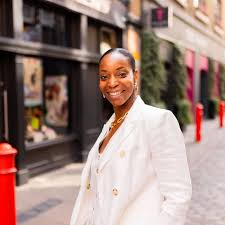
Campbell, an MBE, the Co-CEO of Belu Water, the Chancellor of the University of Westminster, and a former independent candidate for Mayor of London, is building a new playbook. She is a rare hybrid: a capitalist who calls out the toxicity of the market, a political candidate who refuses to play party politics, and a leader who dismisses “Imposter Syndrome” as a self-fulfilling lie.
This is the story of how a young Black woman from North-West London used failure as fuel to rewrite the rules of power.
Table of Contents
ToggleThe “Zero B.S.” Origin Story
To understand Natalie Campbell’s radical approach to business and governance, you have to go back to the beginning—specifically, to her grandparents’ home in Willesden Green. Raised by her Windrush Generation grandparents, Campbell learned early on about resilience, community, and the importance of “showing up.” But unlike many who enter the social impact space, Campbell didn’t start in a charity back office; she started in the brutal arena of high-street retail.
By the age of 19, while most of her peers were focused on student loans, she had secured a £100,000 bank loan . By 21, she was running a retail franchise. She was a whirlwind of ambition, moving at a pace that would exhaust most. But then came the crash that defines her philosophy.
Her first business, a fashion retail venture, went into administration. It was, by any standard, a spectacular failure. The business collapsed, the doors closed, and the safety net vanished. For many, that would have been the end of the story—a cautionary tale about the dangers of youthful ambition.
For Campbell, it was the beginning of her ideology.
Reflecting on that moment years later, she shared a crucial distinction: “It’s easy to give up—’well, it didn’t work, so I can’t do that anymore.’ My purpose made me look up and out” . She doesn’t see failure as a tombstone but as a toolkit. “Everything that goes wrong gives you a tool for your toolkit,” she argues. “Learn from these moments… These challenges could help you further down the line” .
This resilience is the bedrock of the “3P” Framework—Pace, Passion, and Purpose—which she now teaches to leaders navigating crises . When you have a true Purpose (the “why”), it dictates your Pace (the “how fast”) and fuels your Passion (the “energy”).
The Belu Revolution: Water as a Weapon
To see Campbell’s philosophy in its purest form, one must look at her tenure at Belu Water. She joined as CEO in March 2020. The timing was, to put it mildly, apocalyptic. Three weeks into the job, the UK went into COVID-19 lockdown. Belu’s entire customer base—luxury hotels, Michelin-starred restaurants, corporate offices—evaporated overnight. Revenues plummeted from £6 million to just £2 million .
Most CEOs would have panicked, slashing everything to the bone. Campbell, however, saw a “silver lining” in the crisis. She introduced the “Belu Cobra” meetings, obsessing over cash flow to keep the lights on. But she also did something counterintuitive: she changed the company’s legal DNA .
Belu’s purpose is to give 100% of its net profits to WaterAid to fund clean water projects. But Campbell noticed a flaw. The company was run on standard commercial articles. Legally, shareholders (or the board) were tied to “shareholder primacy”—the idea that maximizing profit is the priority. Even though they gave the profit away, the engine of the business was still geared toward aggressive extraction.
Campbell blew up the legal structure. She realigned Belu’s primary objects to the United Nations Sustainable Development Goals (SDGs) , specifically Goals 6 (Clean Water), 12 (Responsible Consumption), and 13 (Climate Action) .
This wasn’t just a marketing stunt. It was a governance revolution.
“Honestly, when I inherited Belu, we were under-investing in certain areas because the pursuit was getting a million pounds to WaterAid,” she admitted. “The shift just delivered a bit more balance back to the business” .
Under her leadership, Belu made a controversial but principled move: they stopped buying carbon offsets. At a time when every corporation was claiming “carbon neutrality” by planting a few trees in the Global South, Campbell called the carbon credit market the “Wild Wild West” . She realized most projects weren’t actually sequestering carbon effectively. Instead of lying to wear a “green” badge, she chose to invest in verifiable, nature-based solutions in the UK, even if it meant losing the ability to market themselves as “carbon neutral.”
She is equally scathing about industry trends like canned water or Tetra Pak cartons. “We don’t recycle any of it in the UK… they’re reporting it as plastic-free! Like, cut it open and tell me that it’s plastic-free” . Her logic is brutal and refreshing: stop trying to find innovative ways to sell disposable containers and start fixing the tap water infrastructure.
The Audacity of Independence: Running for London Mayor
Campbell’s frustration with systems that prioritize optics over impact eventually pushed her out of the boardroom and onto the campaign trail. In 2024, she ran for Mayor of London as an Independent .
Her entrance into the race was a masterclass in her “Zero B.S.” approach. She approached the major political parties, and the feedback was depressingly predictable. She claims the Labour Party told her she would never be successful as a Black woman. The Liberal Democrats, she says, immediately “othered” her, suggesting she join a race network rather than run for the top job .
So, she went it alone, taking out a personal loan to fund the campaign—a loan she says will take her five years to pay back.
Her pitch was uniquely CEO-flavored. She vowed to run City Hall like a social enterprise. “The people who vote for me are my boss,” she stated. “I am free from party politics… My only vested interests are to deliver for the people that vote for me” .
Her policies were a mix of radical pragmatism:
Housing: She proposed building 40,000 affordable “build-to-rent” units to flood the market and force down the extortionate private rents that eat 70-80% of Londoners’ salaries .
Policing: A plan to establish 320 neighborhood centers, putting police officers back into local communities rather than in patrol cars responding to emergencies after the fact .
She didn’t win (securing 47,815 votes), but the campaign revealed a massive untapped appetite for a different kind of politics. She mobilized the disillusioned—young Black women who had never voted before, people who had checked out of the system entirely .
The “I” Word: Dismantling Imposter Syndrome
Perhaps one of Campbell’s most disruptive contributions to leadership discourse is her absolute refusal to validate Imposter Syndrome.
In a corporate world where “Imposter Syndrome” has become a trendy buzzword used to explain away anxiety, Campbell issues a stern rebuke.
“I don’t believe in it,” she says flatly. “You are where you are meant to be. As soon as we give power to a feeling or claim a title, we make it real and give it energy” .
This is a profound shift. By labeling nervousness or a steep learning curve as a “syndrome,” we externalize the problem. We make it a disease that happens to us. Campbell insists that you reclaim the agency. That discomfort you feel? That’s not a sign that you’re a fraud. That’s a sign that you are growing, that you are in the room, and that you belong there.
She advocates for “Shine Theory”—the idea that you don’t shine by dimming others, but by collaborating with them. Specifically, she focuses on the “shadow sides” of leadership. During the pandemic, she didn’t hide her stress from her team. She showed them “warts and all” . By admitting she didn’t have all the answers, she gave her team permission to be innovative.
A Very Human Future
Natalie Campbell represents a new vanguard of leadership—one that rejects the cold, robotic efficiency of Silicon Valley and the cynical triangulation of Westminster.
As the Chancellor of the University of Westminster, she is shaping the next generation to think differently. As the Chair of The Trussell Trust (announced in 2024), she is tackling the structural shame of food poverty in the UK .
Her final piece of advice to aspiring leaders is beautifully simple: “Know yourself, be yourself and look after yourself” .
In a world screaming for authenticity, Natalie Campbell isn’t just whispering a different way to do business; she is shouting a blueprint for a different way to be human. She proves that you can be ambitious and ethical, you can be a CEO and a carer, and you can lose an election and win the argument.
The future of leadership isn’t about algorithms or AI. It is, as Campbell might put it, very human. And it starts with turning your failures into tools and your purpose into your compass.
Conclusion
Natalie Campbell is not offering a utopian fantasy; she is offering a gritty, practical manual for survival and impact in the 21st century. By rejecting the false binaries of profit-versus-purpose, party politics over principle, and the seductive victimhood of “imposter syndrome,” she has carved out a third space—one where leaders are held accountable by their values, not just their shareholders.
Her journey from a failed retail entrepreneur to the helm of a purpose-driven company, and from an independent political candidate to a university chancellor, proves a vital truth: the systems we are trapped in can be rewritten. But they require a specific kind of courage—the courage to look at failure as a toolkit, to call out greenwashing even when it hurts your brand, and to run for office even when the parties tell you no.
In a noisy world of performative leadership, Campbell is a quiet storm of integrity. She reminds us that leadership is not about the title on your business card, but the legacy you leave in your community. Whether through a bottle of water that funds clean sanitation or a vote cast out of conviction rather than fear, her message is clear: you have the tools. Now, get to work