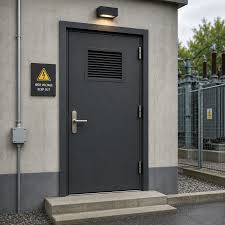
Ventilation is an important consideration in many commercial, industrial and utility buildings. Rooms containing machinery, electrical systems or other heat-generating equipment need sufficient airflow to control temperature and maintain suitable operating conditions. At the same time, these areas often need to remain secure.
Louvred steel doors provide a practical way of meeting both requirements. By incorporating purpose-designed louvres into a robust steel doorset, buildings can benefit from airflow without simply leaving an entrance open or compromising the function of the doorway.
Where Are Louvred Steel Doors Used?
Louvred doors can be useful anywhere that requires a regular supply or movement of air. Common applications include plant rooms, utility buildings, data centres, kitchens, toilet blocks and bin stores.
In mechanical plant areas, ventilation can help remove excess heat produced by equipment, reduce the likelihood of overheating and manage humidity. It may also be necessary to help remove or dilute gases. Louvred doors can work alongside mechanical ventilation systems by providing controlled airflow paths.
Those selecting doors for these environments can learn more about the different types, configurations and performance considerations in this guide to Louvred Doorsets and Panels.
Different Levels of Security
Not every building has identical security requirements, so louvres are available in different constructions. Standard aluminium louvres may be suitable where ventilation is the main priority and security requirements are relatively modest.
More demanding locations can use high-security steel louvres, while reinforced options can provide additional protection. Some configurations are available with security ratings including LPS 1175 and PAS 24, demonstrating that ventilation openings do not necessarily have to become a building’s weakest point. The security performance should always be considered as part of the complete doorset rather than judging the louvre independently.
Understanding Airflow
One of the most important aspects of choosing a louvred door is understanding how much air can actually pass through it. The visible free area describes the portion that appears open when viewed from the front, but this does not provide a complete picture of ventilation performance. The actual or effective free area considers the smallest opening through which air travels.
Blade design, spacing, pressure differences, filters, security components and mesh can all affect airflow. Consequently, the required airflow and overall system design should be determined by the relevant mechanical or building services professional.
Additional Protection
Louvred doors may also require protection against environmental factors and unwanted wildlife. Depending on the application, mesh can be incorporated to help prevent insects, birds or rodents from entering while still allowing ventilation.
Steel construction is particularly valuable in demanding environments because it provides durability and resistance to regular use. Heavy-gauge galvanised or stainless steel options can provide a long service life while coping with the conditions associated with industrial buildings.
Choosing the Right Configuration
Louvres do not necessarily need to cover the entire door. Depending on ventilation requirements, doorsets can incorporate smaller sections, larger panels or full-height louvres. Side panels and overpanels provide another option, increasing the available ventilation area without changing the primary doorway. This flexibility can be particularly helpful when dealing with unusual openings or projects requiring substantial airflow.
Balancing Performance Requirements
Selecting a louvred steel door is ultimately about balancing several priorities. Ventilation may be essential, but security, durability, weather resistance and, in some applications, fire performance must also be considered.
A well-specified louvred doorset allows these requirements to work together. By considering actual airflow needs and choosing an appropriate level of security and construction, businesses can create effective ventilation while maintaining the protection expected from a steel door.