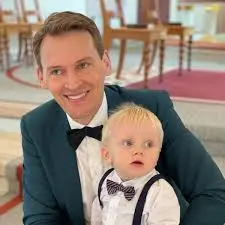
But if you only know Abigail Burdess as the face next to her husband, Peep Show star Robert Webb, or as the writer behind BAFTA-winning sketches for That Mitchell and Webb Look, you are missing the bigger, darker, and far more interesting picture.
In 2023, Burdess pulled off one of the most audacious pivots in modern British literature. She stepped out of the writers’ room and onto the bestseller lists with Mother’s Day, a psychological thriller so twisted, so darkly comic, and so utterly compulsive that it forced the industry to look at her in a completely new light. This is the story of how a self-deprecating “recovering actor” became the new high priestess of the “psycho-grandmother” thriller.
Table of Contents
ToggleThe “Recovering Actor” and the Grind of British TV
To understand Burdess’s writing, you have to understand her relationship with performance. Her personal website is a masterclass in anti-hype. She opens with a photograph she admits makes her look younger than she is, joking that she’s keeping it “til I die.” She types her own bio, eschewing the PR speak for a chaotic, fourth-wall-breaking honesty: “I’m typing this out myself because I don’t make enough money to justify hiring some writer to write my home-page for me” .
This voice—wry, self-aware, and slightly frazzled—is the engine of her work. For years, Burdess was a journeyman of British comedy. She wrote for the titans: the BAFTA-winning That Mitchell and Webb Look (where she also appeared in various absurd roles), the Emmy-nominated Tracey Ullman’s Show, and Watson and Oliver . She has a knack for the “Brit Rap” and the grotesque character piece.
Yet, she has always been brutally honest about the grind. In her own descriptions of her career, she brackets her successes with desperate pleas for work. “I’ve recently adapted my first novel for TV,” she writes, before adding the subtext: “(MY TV SHOW HASN’T BEEN GREENLIT YET GIVE ME A GODDAMN JOB)” .
This is the reality of the British television industry. It is a world of “development hell,” where projects are optioned, discussed, and then vanish into the ether. It was this frustrating cycle—waiting for TV executives to make up their minds—that eventually pushed her toward the novel.
The Fuse: A Chance Encounter and a “White Lotus” Vision
The genesis of Mother’s Day is almost mythologically perfect for a thriller writer. Burdess has stated that the idea struck her while watching a television interview. A woman, recently reunited with her birth mother via Facebook, said wistfully, “I hope I’m the daughter she’s been dreaming of all these years.”
While most viewers would find that sentiment touching, Burdess, with a mind trained to find the flaw in every social interaction (a comedian’s superpower), found it terrifying.
“I thought, that’s a dangerous thing to think,” she explained in an interview with Suffolk Libraries. “You don’t know anything about this woman, or your birth family, or the secrets they may have” .
Initially, she tried to sell Mother’s Day as a movie. It didn’t sell. It sat on a hard drive, a “what if” that refused to go away. Years later, while chatting with her friend, the late novelist Susie Steiner (Missing, Presumed), Steiner suggested Burdess write a novel about mother-daughter relationships. The dormant thriller plot instantly clicked into place.
Burdess didn’t just write a thriller; she wrote a specific kind of thriller. She describes her dream for the TV adaptation of the book as “a kind of British White Lotus—balancing comedy and violence, and really delving into all the characters’ deepest fears” .
That is the key to her prose. It isn’t gritty realism; it is heightened, glossy, and deeply, painfully funny until suddenly, it isn’t.
Mother’s Day: Deconstructing the “Dream” Grandmother
Published by Wildfire Books in March 2023, Mother’s Day introduces readers to Anna. Anna is a woman who was abandoned on a traffic island as a baby. She is rootless, chaotic, and has no desire for a family. Then, in a cruel twist of fate, two things happen simultaneously: she discovers she is pregnant, and she finds her birth mother, Marlene .
Marlene is the secret weapon of the novel. On the surface, she is a dream come true: eccentric, fabulously wealthy, and desperate to be a grandmother. She showers Anna with love and gifts. But Burdess, a master of the “uncanny valley” of human behavior, writes Marlene as a force of nature so generous that she becomes smothering—and then, eventually, sociopathic.
The critical reception latched onto this duality immediately. The Guardian called it “Dark, funny” . Glamour praised “all the dark comedy and suspense that are the key ingredients to an absolute corker of a novel” .
What makes the book resonate is Burdess’s understanding of familial terror. Having written for children’s shows like Paddington (yes, the polite bear) and The Adventures of Paddington, as well as soap operas like EastEnders, she knows how to modulate tone . She knows that the scariest villain isn’t a monster in an alley; it is a mother-in-law who rearranges your kitchen “to help.”
The Mechanics of a Genre Pivot
Why does the shift from sketch comedy to thriller writing feel so seamless for Burdess? It comes down to structure and the nature of the “game.”
In sketch comedy, you have 90 seconds to establish a character, escalate a conflict, and deliver a punchline. There is no room for fat. In thriller writing, the timeline is longer, but the mechanics are the same. You must establish stakes immediately, escalate the tension relentlessly, and deliver a payoff (the twist) that re-contextualizes everything that came before.
Furthermore, Burdess points out a key difference in character development between pure comedy and her thrillers. “When plotting comedy, characters often are given the opportunity to change, but fail to change,” she notes. But in Mother’s Day, she gave herself the challenge of “seeing if I could believably completely transform a character within a single story” .
That character is usually Anna, the protagonist, who must transform from a passive observer of her own life into an active warrior capable of facing the monster (Marlene). It is the hero’s journey, but with breast pumps and passive-aggressive comments about parenting skills.
The “Fun Fact” and the Dancing Snooker Table
Despite the dark turn in her career, Abigail Burdess has not lost her absurdist edge. In fact, it is her armor.
When asked to provide a “fun fact” that her readers might not know, she responded with a line that perfectly encapsulates her bizarre, wonderful career: “I once played a dancing snooker table” .
This is not a metaphor. In the annals of British children’s television, there is a very real, very silly moment where Abigail Burdess dressed up as or voiced a piece of sporting equipment that performed a choreographed dance. This fact sits in direct opposition to the tone of Mother’s Day, which involves psychological manipulation and a body count.
Burdess seems to thrive in this contradiction. She is married to a literary giant of British comedy (Robert Webb), yet she writes her own material. She wrote poetry in iambic heptameter as a teenager (adapting a French philosophical novel, no less), yet she makes a living writing fart jokes for CBBC . She is a “recovering actor” who still acts. She is a bundle of contradictions held together by wit.
Life Inside the “Museum of Curiosity”
Living with Robert Webb, of Peep Show fame, means living in a house of high comedic pressure. Yet, Burdess maintains that their writing processes are distinct. They are currently co-writing a comedy book together—a “fun sideline to all the scary crime” .
Her advice for aspiring writers is refreshingly pragmatic. She recalls the best advice she ever received from her boarding school housemistress: “Make a decision. You can always make another one” .
This advice is the antidote to the perfectionism that paralyzes so many novelists. It is also the guiding principle of improvisational comedy—saying “Yes, and…” and moving forward. Burdess applied this to her thriller. She didn’t wait for the TV option to clear; she just wrote the book. And when the book was done, the TV option followed (the rights have been snapped up for a six-part series) .
What Comes Next? More Chaos, Please
The success of Mother’s Day has opened the floodgates. Burdess is currently finishing her second thriller for Wildfire Books. If you thought family reunions were scary, the second novel dives into the world of stand-up comedy. The plot follows a comedian who is court-ordered to get sober if he wants to see his daughter. As part of his recovery’s “Step Eight” (making a list of those you’ve wronged), he hires a detective to figure out what he did during a ten-year blackout .
It is a premise that only a true insider of the British comedy circuit could write. It promises the same blend of high-stakes suspense and acerbic wit that defined her debut.
The Verdict: Why Abigail Burdess Matters Now
In an era of sanitized celebrity and AI-generated content, Abigail Burdess is a refreshingly analog voice. She is messy, honest, and fiercely intelligent. She represents the journeyman artist who has paid her dues in the writers’ room, on the stage, and in the background of sitcoms, only to emerge as a master of a new craft.
Her work matters because it bridges a gap. Literary snobs who turn their noses up at “comedy writing” are missing out on the sharpest social observations of our time. Conversely, sketch comedy fans who ignore thrillers are missing a visceral rush.
Abigail Burdess proves that the funniest people often have the darkest thoughts. And thank goodness for that. Whether she is writing for the friendly bear from Peru, the chaotic halls of EastEnders, or a wealthy sociopathic grandmother, Burdess is a voice of singular, eccentric authority.
She is, as she might put it, “bad at self-description” . But she is exceptionally good at storytelling. Keep an eye on the bookshelf—and the TV listings. The woman who once played a dancing snooker table is just getting started, and this time, she is playing for keeps