Yet to reduce her career to a collection of accolades would miss the deeper significance of what she represents: a new archetype of legal excellence that refuses to choose between commercial acumen and humanitarian principle.
Table of Contents
ToggleThe Architecture of a Legal Mind
Shaheed Fatima’s intellectual formation reads like a map of the legal world’s most prestigious institutions. After completing her initial legal education at the University of Glasgow, she proceeded to Oxford University for her Bachelor of Civil Law, followed by a Master of Laws from Harvard Law School . This transatlantic legal education—spanning Scotland’s distinctive civil law traditions, Oxford’s rigorous common law scholarship, and Harvard’s global legal perspective—provided an unusually comprehensive foundation for a career that would regularly traverse jurisdictional boundaries.
She was called to the Bar in October 2001 at Gray’s Inn, one of the four Inns of Court that have shaped English legal practice for centuries . Yet even at this early stage, those who encountered her recognized something exceptional. By 2005, The Lawyer magazine had identified her as one of six “star lawyers under the age of thirty,” describing her as a “human rights champion” .
Two years later, Times Online named her among ten “Future Stars of the Bar,” and she received the Human Rights Lawyer of the Year Award from Liberty and Justice, with the citation praising “her remarkable work, often on a pro bono basis, for her brilliant analysis, consistent arguments and commitment in debating human rights cases before both the British and the European Courts” .
These early recognitions hinted at what would become a defining characteristic of her practice: an ability to excel simultaneously in areas that many lawyers treat as mutually exclusive. By 2009, Legal Week included her in the “Top 10 Stars of the Commercial/Chancery Bar” with the remarkable observation that “clients refer to her as ‘like having another silk on the case'” —high praise indeed for a barrister then still eight years away from taking silk herself.
Taking Silk and Making History
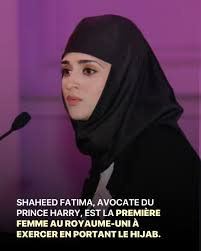
In 2016, Shaheed Fatima was appointed Queen’s Counsel (now King’s Counsel), becoming the youngest female barrister to take silk that year . The appointment was historic in another sense: she became the first barrister to be appointed silk while wearing a hijab, a visible symbol of her Muslim faith that she has worn throughout her career . In a profession not always known for its embrace of diversity, her presence at the highest echelons of the Bar carries a significance that extends well beyond her individual accomplishments.
The Lawyer magazine, naming her one of its “Hot 100” leading lawyers in 2017, described her as one of the “standouts” on the year’s list and observed that she was “already earmarked as Supreme Court judge material” . The comment was prescient. Since taking silk, her practice has expanded in scope and scale, encompassing some of the most significant litigation to come before the English courts in recent years.
Her chambers, Blackstone Chambers, houses her practice across an extraordinary range of specialisms. She is ranked as a leading silk in six distinct practice areas by the major legal directories: Administrative and Public Law, Civil Liberties and Human Rights, Commercial Litigation/Dispute Resolution, Group Litigation, International Human Rights Law, and Public International Law .
The Legal 500 describes her as “truly exceptional… commercially astute, deeply in touch with developing legal trends, and extremely user-friendly” . Chambers and Partners notes that “her reputation precedes her—she is one of the cleverest people in the area” and quotes solicitors who say simply: “I trust her to do anything, because she has quiet confidence and a brain the size of a planet” .
The Commercial Practice: Billions at Stake
To appreciate the breadth of Shaheed Fatima’s commercial practice, one need only examine the roster of clients she has represented and the sums at stake. She has acted for Shell in derivative claims concerning climate change risk management strategy; for BHP in group litigation involving over 600,000 claimants arising from environmental disasters; for Volkswagen in the “Dieselgate” emissions group litigation with more than 90,000 claimants; and for Hyundai-Kia in similar NOx emissions proceedings .
In Recovery Partners GP Ltd v Rukhadze [2022] EWHC 690 (Comm), she represented clients in an account of profits case involving several weeks of cross-examination of factual and expert witnesses. The court held that her clients were entitled to recover more than $100 million .
In Newcastle United Football Club v Premier League [2021] EWHC 450 (Comm), she represented the club in the high-stakes dispute over its proposed sale to a consortium including Saudi Arabia’s Public Investment Fund—a case that attracted intense media scrutiny and raised complex questions about competition law and the Premier League’s regulatory framework .
She has represented Prince Abdul Aziz of Saudi Arabia in his successful defense of a contractual claim exceeding £12 million in Harb v Prince Abdul Aziz [2018] EWHC 508 (Ch), and the former Chairman of the Libyan Investment Authority in Mohammed v Breish [2020] EWCA Civ 637, a case concerning the recognition of foreign governmental authority over approximately $1 billion in UK assets . Her client list in commercial matters includes American Airlines, Glencore, Imperial Tobacco, Lloyds underwriters, Miramax, and Royal Mail .
What distinguishes her commercial practice is not merely the scale of the disputes but her capacity to navigate the intersection between commercial law and other legal domains. Many of her cases involve aspects of conflict of laws, public international law, or foreign law—areas where her broader expertise proves invaluable.
In the last five years alone, she has worked with foreign law experts on matters involving Brazilian environmental and constitutional law, Dutch tort law, Libyan constitutional law, Lithuanian competition law, Nigerian environmental law, Peruvian tort law, Russian criminal procedure, Saudi Arabian public law, Thai labour law, and Ukrainian criminal procedure, among others . This facility with foreign legal systems is increasingly essential in an era of globalized commerce and transnational litigation.
Human Rights and Public Law: Giving Voice to the Vulnerable
Parallel to her commercial practice runs a commitment to human rights law that has defined her career since its earliest days. In 2007, she was part of the legal team representing the families of Iraqi civilians in the landmark case of R (Al-Skeini) v Secretary of State for Defence, which sought to hold British soldiers overseas accountable under the Human Rights Act 1998 . Among the families she represented was that of Baha Mousa, an Iraqi hotel receptionist who died in British custody in Basra in 2003 after suffering brutal treatment.
The case ultimately reached the House of Lords and established important principles about the extraterritorial application of human rights law.
This work culminated in Mohammed v Secretary of State for Defence [2017] AC 821, a Supreme Court case examining detention in Afghanistan and the relationship between international human rights law and international humanitarian law . The judgment engaged with fundamental questions about the legal framework applicable to armed conflict and the protections owed to individuals detained by state forces operating abroad.
More recently, she has represented the Duke of Sussex in his judicial review claims regarding security provision during his visits to the United Kingdom—R (Duke of Sussex) v SSHD [2023] EWHC 1228 (Admin) . The case, which attracted global media attention, concerned the Home Office’s decision to withdraw automatic police protection following the Duke’s departure from frontline royal duties.
In written submissions, Ms. Fatima argued that the Executive Committee for the Protection of Royalty and Public Figures (Ravec) had failed to follow its own procedures and that the Duke had been subjected to a “bespoke process” that departed from established practice .
She has also acted in R (Certain Underwriters at Lloyds) v HM Treasury [2020] EWHC 2189 (Admin), where the court held that her clients—seeking to enforce a judgment of approximately $51 million—were entitled to information from HM Treasury regarding the location of frozen Syrian assets . The case illustrated her ability to deploy public law principles in service of commercial objectives, demonstrating once again the permeability of traditional legal categories in her practice.
Protecting Children in Armed Conflict: The Inquiry That Changed Law
Perhaps the work that most clearly reveals Shaheed Fatima’s deeper motivations is her leadership of the Legal Panel to the Inquiry on Protecting Children in Conflict. In April 2017, she was appointed Chair of the Panel by Gordon Brown, the former UK Prime Minister serving as UN Special Envoy for Global Education . The resulting book, Protecting Children in Armed Conflict (Hart/Bloomsbury Publishing, 2018), of which she is the lead author, has become a seminal text in the field.
The inquiry examined the “six grave violations” against children identified by the UN Security Council: killing and maiming, recruitment or use as soldiers, sexual violence, abduction, attacks on schools and hospitals, and denial of humanitarian access.
The report called for significant reforms in international humanitarian and human rights law, including the novel proposal that schools should receive the same legal protection as hospitals during armed conflict, and that states should be subject to an explicit obligation to take measures preventing sexual violence against children .
In 2018, she delivered the prestigious Sir Elihu Lauterpacht Lecture at the University of Cambridge on this subject, an honor that recognized both her scholarly contributions and her practical impact on the development of international law . The lecture, established to commemorate the life and work of one of the twentieth century’s most distinguished international lawyers, situated her work within a tradition of legal scholarship dedicated to the protection of the vulnerable through the progressive development of international legal norms.
In 2019, she received Theirworld’s #WritetheWrong Award. Yvette Cooper MP, now Home Secretary, presented the award and described Shaheed as having “tirelessly championed the protection of vulnerable and marginalised children living in conflict affected areas… [she] has given a voice to the vulnerable children in conflict, whose future is taken from them by the stark realities of war” .
Group Litigation: Managing Complexity at Scale
A significant and growing portion of Shaheed Fatima’s practice involves complex group litigation—claims brought by or against hundreds or even hundreds of thousands of parties. This is among the most demanding areas of contemporary legal practice, requiring not only mastery of the substantive law but also exceptional case management skills, strategic vision, and the ability to coordinate vast teams of lawyers, experts, and support staff.
Her group litigation portfolio is staggering in its scope. She represents BHP in Municipality of Mariana and others v BHP Group plc and BHP Group Ltd [2023] EWCA Civ 1388, litigation arising from the collapse of the Fundão dam in Brazil and involving more than 600,000 claimants . She acts for Shell in Alame v Royal Dutch Shell plc [2023] EWHC 2961 (KB), concerning environmental damage allegedly caused by oil spills in Nigeria, a case that reached the Supreme Court on jurisdictional issues in Okpabi v RDS [2021] UKSC 3 .
She is instructed for UEFA in claims arising from the chaos at the 2022 UEFA Champions League Final in Paris. She represents Hyundai-Kia in the NOx Emissions Group Litigation and Imperial Tobacco in Josiya v British American Tobacco plc .
Chambers and Partners describes her as “clearly one of the leading experts in mass-environmental claims” and notes that “her knowledge of the group litigation space is extraordinary” . The Legal 500 praises her as “exceptional… a thorough and technical lawyer who has a laser-like focus on the points” and observes: “Whilst she is willing to get into the weeds, she is also a great strategist and leads the team with skill and determination” .
One solicitor quoted in the directories offers this assessment: “There is no one at the bar that works harder than her and I am constantly amazed at the cases she is involved in. She is in pretty much every big action” . Another adds: “She is not the type of silk to read out a script; she knows every single detail of the case and even though you can’t predict litigation, she never got caught out. She’s very standout at her level” .
The Scholar-Practitioner
Alongside her practice, Shaheed Fatima maintains an active scholarly profile that distinguishes her from many of her peers. She is working on the second edition of her book, International Law and Foreign Affairs in English Courts (forthcoming 2025, Hart/Bloomsbury), a work that addresses the increasingly important question of how English courts engage with international law and foreign relations considerations .
She is also a contributor to The Oxford Handbook of Comparative Foreign Relations Law (2019) and a founding editor of “Just Security,” a transatlantic blog focused on national security law and policy .
Her teaching experience spans some of the world’s leading academic institutions. She has taught law at Pembroke College, Oxford; Harvard Law School; NYU School of Law; and the Graduate Institute in Geneva . This engagement with legal education reflects a conviction that the practice of law at the highest level requires continuous intellectual renewal and that the practitioner has as much to learn from the academy as the academy has to learn from practice.
She serves as a trustee of the British Institute of International and Comparative Law and as an Advocacy Trainer for Gray’s Inn, where she also sits on the Scholarships Committee . In these roles, she contributes to the formation of the next generation of advocates and to the broader development of legal thought.
The Unpredictable Trajectory
For all her achievements, Shaheed Fatima’s path to the pinnacle of the Bar was not inevitable. In an interview with The Times, she revealed that choosing between law school and art school was “a difficult decision” and that, had circumstances been different, she might have pursued a career as an artist .
This alternative trajectory—the artist rather than the advocate—offers a suggestive lens through which to view her legal practice. Advocacy at the highest level requires not only analytical rigor but also creativity, the ability to see familiar material from new angles, and the capacity to craft compelling narratives from complex facts.
Her advice to aspiring lawyers reflects a clear-eyed understanding of the demands of the profession: “Make sure you really want it: it is a calling as much as it is a profession” . It is advice born of experience—a recognition that the sustained excellence she has demonstrated across multiple practice areas requires a depth of commitment that cannot be sustained by ambition alone.
A Legacy in Formation
At 48, Shaheed Fatima KC stands at a point in her career where most observers see not culmination but anticipation. The prediction that she is “Supreme Court judge material” is repeated so often that it has acquired the quality of received wisdom. Yet to focus solely on what she might become risks overlooking what she already is: one of the most accomplished and versatile advocates at the English Bar, whose practice spans the full spectrum of legal work from the highest-value commercial disputes to the most fundamental questions of human rights.
Her career offers a compelling response to those who would divide the law into neat categories—commercial versus public, corporate versus humanitarian, domestic versus international. She has demonstrated that excellence in one domain need not come at the expense of competence in another, and that the most valuable legal minds are often those capable of synthesizing insights from across traditional boundaries.
The legal historian searching for a figure to exemplify the English Bar in the early twenty-first century could do worse than to alight upon Shaheed Fatima KC. In her practice, one finds the globalization of legal practice, the increasing prominence of group litigation, the persistence of fundamental human rights questions, and the growing recognition that diversity strengthens rather than dilutes the profession.
She is, in the judgment of her peers, “absolutely brilliant” , “a legend in this space” , and simply “utterly extraordinary” . These are not casual compliments but considered assessments from those who have witnessed her advocacy and studied her work.
Whatever the future holds—whether the Supreme Court bench, further landmark cases, or scholarly contributions that shape the development of the law—Shaheed Fatima KC has already secured her place among the most significant barristers of her generation. The hijab-wearing silk who once nearly chose art school over law school has painted her masterpiece on the canvas of the English legal system, and the work is not yet finished.
Conclusion
Shaheed Fatima KC stands as compelling evidence that the highest reaches of the legal profession need not demand a narrowing of one’s humanity or a retreat from principle. In a career that has moved seamlessly from the brutal interrogation rooms of Basra to the boardrooms of multinational corporations, from the bombed-out schools of conflict zones to the gilded chambers of the Supreme Court, she has refused the false choice between commercial success and moral purpose.
What makes her trajectory truly remarkable is not merely the breadth of her practice—though that alone would distinguish her among her peers—but the quiet confidence with which she inhabits spaces where she might have been made to feel an outsider. The hijab she wears is not a barrier to be overcome but simply a part of who she is, as unremarkable in the courtroom as the horsehair wig that rests beside it.
For the young Muslim woman contemplating a career at the Bar, for the aspiring advocate torn between corporate ambition and human rights passion, for anyone who has been told they must choose between authenticity and advancement, Shaheed Fatima KC offers a different message: excellence speaks for itself. The law, at its best, is capacious enough to accommodate both the commercial and the compassionate, both the advocate for the powerful and the voice of the powerless. In her hands, it has been both—and so much more