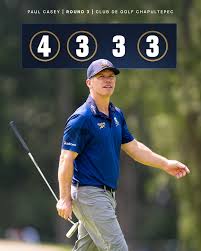
Paul Casey has often been the bridesmaid rather than the bride. For years, he was known as the nearly-man: the man with the perfect swing who couldn’t quite close the major, the fiery competitor who once admitted the Ryder Cup was about hate, and the expat who seemingly walked away from his home tour.
But to define Paul Casey by what he has not won is to miss the point entirely. In an era of golf dominated by power bombers and robotic repetitions, Casey has crafted a career defined by renaissance, resilience, and a swing so pure it belongs in a museum. As he transitions into the latter stages of his career with LIV Golf, it is worth looking back at the journey of a man from Cheltenham who became one of the most respected—and feared—ball-strikers of his generation.
Table of Contents
ToggleThe Sun Devil Foundation
Paul Alexander Casey was born on July 21, 1977, in Cheltenham, England. His path to the professional ranks was not the traditional British route of working as an assistant pro or dominating the amateur circuit in the rain. Instead, Casey took the American collegiate route, and it was a decision that paid off in historic dividends.
While attending Arizona State University, Casey didn’t just play golf; he obliterated the competition. He won three consecutive Pac-10 championships from 1998 to 2000. To put that into perspective, conference titles are hard to win once, but three in a row is dynastic. However, it was his final season that announced his freakish talent to the world. In 2000, he broke the championship scoring record previously held by a guy named Tiger Woods. Woods shot 18-under-par. Casey shot 23-under-par .
That performance signaled a shift. Casey wasn’t just a solid amateur; he was a phenom. He took that momentum into the Walker Cup, helping Great Britain and Ireland to a victory and posting a perfect 4-0 record—becoming only the third player in 77 years to achieve that feat . He turned pro in 2000, and by 2001, he was already winning on the European Tour, securing the Sir Henry Cotton Rookie of the Year award .
The “Swing That Art Forgot”
To understand Paul Casey, you have to watch him. In an era where coaching has homogenized the golf swing into a series of rigid, angular movements, Casey remains a throwback.
His long-time coach, the legendary CBS commentator Peter Kostis, describes Casey as one of the “purest, most consistent swingers of the club on tour” . Unlike many modern players who restrict their hip turn to generate torque, Casey is all about flow. Kostis encourages Casey to let his left heel come off the ground and let his left knee kick in behind the ball. It’s an athletic, unrestricted motion that looks more like vintage Sam Snead than a modern launch-monitor robot .
He calls his philosophy “Peter’s Rules”: strong grip before weak, ball back before forward, feet narrow before wide. The key to his iron play, something he has built his career on, is the release of tension. When hitting an 8-iron—one of his favorite clubs—Casey focuses on tension in the lower body for stability, “but then that tension sort of gets released the further up I get,” he has explained. “I don’t want tension in my shoulders. I certainly don’t want tension in my arms and my hands” .
Golf Digest has noted that Casey generates power through massive pelvis and torso rotation, not by “muscling the ball” with the hands. This is why, even as he has aged into his forties, he hasn’t lost his speed .
The “Hate” Heard Round the World
For a man with such a smooth swing, Casey has a surprisingly sharp edge. This was never more apparent than the controversy of 2004. Ahead of the Ryder Cup at Oakland Hills, a young, brash Casey gave an interview to The Sunday Times. His quote was nuclear: “We properly hate them. We wanted to beat them as badly as possible” .
In the polite world of golf, where players exchange gifts and pleasantries, “hate” was a dirty word. The American media pounced. It was a PR nightmare, forcing Casey into damage control. He later apologized, claiming the remarks were taken out of context. But for those watching closely, it revealed the intensity simmering beneath the English gentility. He didn’t hate Americans (he lives in Arizona, after all); he hated losing.
Fortunately for his legacy, Casey backed up the trash talk on the course. In 2006 at the K Club in Ireland, he cemented his Ryder Cup immortality. During a foursomes match, he stepped up and hit a hole-in-one. It remains the only ace in the history of the Ryder Cup in the foursomes format . It was a moment of pure, explosive magic that sealed a point for Europe and sent the Irish crowd into a frenzy.
He would go on to play in three consecutive Ryder Cups from 2004 to 2008, and later return for the 2018 and 2021 matches, becoming a veteran anchor for the European team .
The Drought and the PGA Resurrection
Despite the early success—including a World Match Play win in 2006 and a career-high ranking of World No. 3 in 2009—Casey’s career has been a rollercoaster of injuries. Rib injuries, turf toe, and thumb problems frequently derailed his momentum . He won his first PGA Tour event at the Shell Houston Open in 2009 (a playoff win against J.B. Holmes) but then endured a painful nine-year victory drought on US soil .
During those dark years, many wrote him off. He gave up his European Tour card in 2015 to focus on the PGA Tour and his family (he married television presenter Pollyanna Woodward in 2015) . It looked like the closing of a book on a promising career.
But 2018 marked the beginning of the “Second Act.” At the Valspar Championship, Casey proved that perseverance pays off. He held off a charging field to win his second PGA Tour title, nine years after his first . The emotion on his face was palpable. The man who had been “too American” for the British fans and “too British” for the American fans finally belonged to himself.
He didn’t stop there. In 2019, he successfully defended his Valspar Championship title—a statistical rarity on the PGA Tour, proving the win was no fluke .
Major Heartbreak
No article on Paul Casey is complete without addressing the elephant in the room: the majors. For a player of his caliber—a World No. 3 with 21 professional wins—the absence of a major championship is a statistical anomaly.
He has come painfully close. There was the 2010 Open Championship at St. Andrews, where he finished T3 . There was the 2016 Masters, where he finished T4, his best at Augusta . But the closest he came was the 2020 PGA Championship at Harding Park. In a wind-blown, gritty battle, Casey held the lead late on the back nine. He eventually finished tied for 2nd, two shots behind the young champion Collin Morikawa .
Unlike some players whose games implode under pressure, Casey usually just got beaten by someone playing slightly better. He never cracked; he just never got the bounce.
The LIV Golf Chapter
In a move that surprised many purists but made logical sense for the veteran, Casey joined LIV Golf in 2022. For a player who had battled injuries and wanted to spend more time with his family while still competing at a high level, the Saudi-backed league offered a new path. It closed the chapter on his long-standing membership with the DP World Tour .
While controversial, the move allowed Casey to extend his playing longevity. He continues to showcase that picture-perfect swing on the Asian Tour and LIV circuit, proving that even in his late forties, class is permanent.
Legacy of Resilience
What separates Paul Casey from the flat-bellied heroes of the gym generation is his humanity. He is an avid mountain biker and a foodie . He isn’t afraid to be seen as a family man. After winning the KLM Open in 2014, he famously credited the victory to the fact that his son, Lex, had been born two weeks prior, changing his perspective on life .
In 2007, he set up the Paul Casey Foundation to help juniors at Foxhills Golf Club, the course where he grew up . He never forgot the muddy fairways of Surrey, even while chasing sun in Scottsdale.
Paul Casey may retire without a Wanamaker Trophy or a Claret Jug. But he will retire as a standard-bearer for technical excellence. He is the player your favorite player watches on the range. When the conversation turns to who has the best swing in golf, the answer, for two decades, has usually been “Paul Casey.”
In the end, his legacy is not about hate or hype. It is about the quiet, stubborn refusal to fade away. From a record-breaking Sun Devil to a Ryder Cup hero, from a nine-year PGA Tour drought to a late-career surge, Paul Casey has authored one of the most unique and resilient resumes in the history of the sport. He is proof that sometimes, the swing is so beautiful, it doesn’t matter if the scorecard is perfect.
Career Snapshot: Paul Casey
| Attribute | Detail |
|---|---|
| Born | July 21, 1977 (Cheltenham, England) |
| Height | 5’10” (178 cm) |
| College | Arizona State University |
| World Ranking Peak | No. 3 (2009) |
| Professional Wins | 21 (3 PGA Tour, 15 European Tour) |
| Ryder Cup Record | 4 Appearances (2004, 2006, 2008, 2018, 2021) |
| Best Major Finish | T2 (2020 PGA Championship) |
Conclusion
Paul Casey may never be remembered as the greatest major champion of his era, but that feels less like a failure and more like a misclassification of his greatness. In a sport increasingly obsessed with counting trophies and ranking legacies by major titles alone, Casey stands as a quiet rebel. He is the craftsman in a world of carpenters, the artist who never stopped refining his stroke even when the scoreboard refused to reward him.
His journey—from the raw, “hate-fueled” rookie of 2004 to the graying, battle-hardened veteran of LIV Golf—mirrors the evolution of modern golf itself. He weathered injuries, self-inflicted controversies, and the brutal psychological toll of a nine-year winless drought on American soil. Yet, every time the golf world counted him out, he returned with that effortless, balletic swing to remind everyone what pure ball-striking looks like.
Perhaps the most fitting tribute to Paul Casey is that he made the difficult look easy. He took a game built on torment and frustration and, for two decades, made it flow. He didn’t just play golf; he swung it. And in doing so, he carved out a legacy that no major championship tally can diminish. Paul Casey didn’t just survive the modern era of golf—he made it beautiful