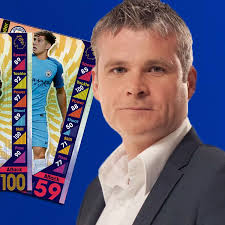
As he prepares for another season of high-stakes drama, it is time to look under the hood of the man who narrates England’s heartbreaks and triumphs. From the tin-pot radio lines of Clubcall to the synthetic AI future of EA Sports FC, this is the story of Guy Mowbray.
Table of Contents
ToggleThe York Apprentice: From Clubcall to the Big Time
To understand Guy Mowbray, one must first look north to York. Born on February 16, 1972, Mowbray wasn’t the kid practicing autographs in the mirror. He was the fan in the stands. Unlike many of his peers who played professionally to a decent level, Mowbray’s origin story is purely that of a supporter.
His entry into broadcasting was notably low-tech and high-hustle. He began his career on the Clubcall network—a premium-rate phone line service where fans could dial in for updates on their team. It was essentially the 1990s equivalent of a paywalled podcast, but with worse audio quality. Covering York City for a phone line was a far cry from the glittering studios of MediaCityUK, but it taught him the essential lesson of radio: paint the picture, keep it moving, and don’t run out of words.
After stints at BBC Radio York and Metro Radio, Mowbray made the jump to television with Eurosport in 1997. It was here that he pulled off one of the most audacious fast-track promotions in broadcasting history. Within a year of being on TV, the 26-year-old Mowbray was handed the mic for the 1998 World Cup final between France and Brazil.
To put that in perspective: most commentators spend decades climbing the ladder from third-tier league matches to reach a final. Mowbray did it in 18 months. He remains the youngest TV commentator to ever call a World Cup final. It was a gamble by Eurosport, but it paid off instantly, earning him a Royal Television Society Newcomer of the Year award.
His move to ITV followed, where he covered the Champions League and Serie A during the golden era of Italian football. But it was a return home, of sorts, to the BBC in 2004 that would define his legacy.
“I Don’t Do That Job”: The Reluctant Figurehead
One of the most revealing moments of Mowbray’s career came recently following the departure of Gary Lineker from Match of the Day. The rumour mill went into overdrive. Fans and pundits alike speculated on who would fill the void left by the 65-year-old legend.
Mowbray’s name was floated, but he shot it down with a mix of humor and bewilderment that perfectly encapsulates his personality.
“I sometimes don’t think people understand the difference between a commentator, a presenter and a pundit,” he told The Athletic. “They’re all very distinct, different roles. The number of times… people asked me, ‘Are you going to take over?’ I don’t do that job! As if!”
This quote is vintage Mowbray. In an era where broadcasters are encouraged to be “brands” and celebrities, Mowbray sees himself as a craftsman. He isn’t there to offer hot takes or debate tactical formations; he is there to narrate.
He is the “glue” of the broadcast. While Lineker, Alan Shearer, and Micah Richards are the entertainment, Mowbray is the architect. He builds the tension, releases the pressure, and guides the viewer through the chaos. He knows that the worst thing a commentator can do is make the audience aware of the commentator.
The Philosophy: “Never Pre-Rehearse Lines”
In an age of scripting and catchphrases, Guy Mowbray operates on a dangerous, high-wire philosophy: spontaneity.
Ahead of the 2022 World Cup final in Qatar—a clash between Lionel Messi and Kylian Mbappé for the ages—Mowbray revealed his creative secret. He doesn’t prepare his “big lines.” He refuses to write the script for the movie before he sees the ending.
“Even now, I never pre-rehearse lines,” he said. “How could [Kenneth] Wolstenholme have got that ready? He wasn’t to know people were going to be coming on the pitch. Even if you think, ‘If there’s a goal today I might say this’, you quickly put it out of your mind because you don’t know how it’s going to happen. You’ve got to react to what you’re seeing.”
This commitment to the moment is what separates him from the robotic AI that threatens his industry (more on that later). Mowbray trusts his preparation, but he trusts his instinct more.
He famously demonstrated this ruthless instinct during a Manchester derby. As the camera panned to a grim-faced Sir Alex Ferguson with Manchester City leading 4-0, Mowbray delivered a dagger of a line referencing Ferguson’s old boast that City wouldn’t win a derby in his lifetime: “Sir Alex Ferguson was asked in 2009 if City could ever go into a derby as favourites. He said ‘not in my lifetime’… now it’s every time.”
It wasn’t scripted. It wasn’t a catchphrase. It was contextual, historical, and absolutely brutal.
Gladiators, Video Games, and the AI Frontier
Mowbray’s voice is ubiquitous, even for those who don’t watch Match of the Day. For millions of gamers, he is the voice of the EA Sports FC series (formerly FIFA). Sitting in a studio for hours, he records the thousands of names, scenarios, and exclamations that react to a player’s joystick wiggling.
However, this relationship with technology took a futuristic turn recently. Mowbray authorized Electronic Arts to use Artificial Intelligence to clone his voice for the game.
The reaction to this news was mixed. On one hand, it is a practical solution. It allows the game to generate new player names and specific phraseologies without dragging Mowbray back into a recording booth for months on end. On the other, it opens a Pandora’s box regarding the “soul” of commentary.
“The whole point of the game is its authenticity,” Mowbray said, defending the move.
But the irony is delicious. Authenticity is what Mowbray trades in. His broadcasting style is so revered because he sounds human—he stumbles occasionally, he gets excited, he sighs at a bad miss. Can an algorithm replicate the specific disappointment of an England exit? Can a robot summon the glee of a last-minute winner for a neutral audience?
For now, Mowbray is embracing the tech, but his “dancing soul”—a phrase borrowed from Shakespeare’s Richard II, which could easily describe his lyrical style—remains firmly human.
The Low Points and the Love
Guy Mowbray has seen it all. He has commentated on seven World Cups and seven European Championships. He has seen Zinedine Zidane’s headbutt, Messi’s apotheosis, and England’s penalty shootout misery on a loop.
But when asked about the lowest point of his career, he doesn’t pick a disaster like Luis Garcia’s “ghost goal” or the Hand of God. He picks Iceland. Euro 2016. Nice.
“That was the most upset I’ve ever been at a tournament,” Mowbray admitted. “I can remember the media tent in Nice being almost silent after that game… That Iceland game was hard to cover.”
Unlike the fan watching at home, Mowbray cannot turn off the TV or throw his pint. He has to speak. He has to find the words to describe the indescribable failure of England losing to a nation of part-time volcano enthusiasts.
He admits to going into a “slump” after bad games, beating himself up over a misplaced metaphor or a missed tactical nuance. His family knows to let him “stew” for two or three days after a major tournament ends. It is this obsessive intensity—this inability to switch off—that makes him so good.
Because Mowbray isn’t playing a character. He is a fan who happened to get the best seat in the house.
Conclusion: The Quiet Breast
There is a line from Shakespeare’s Richard II that feels appropriate for Mowbray: “Truth hath a quiet breast.”
In a cacophonous world of shouting pundits, social media pile-ons, and VAR debates, Guy Mowbray represents the quiet breast of football. He is the steady hand on the tiller. He doesn’t want to be the story; he wants to tell the story.
As he returns to our screens for the next international break, the next Champions League night on TNT Sports, or the next frantic Saturday on BBC One, take a moment to listen. Listen to how he lets a goal celebration breathe. Listen to how he drops a fact only when the play slows down. Listen for the slight crack in his voice when a lower-league team pulls off a cup upset.
That isn’t just broadcasting. That is art. And in an age where AI is learning to mimic our voices, Guy Mowbray reminds us that nothing beats the real thing.
He didn’t grow up wanting to be a commentator. He grew up wanting to be a player. Fortunately for us, his feet let him down, but his voice lifted us all up