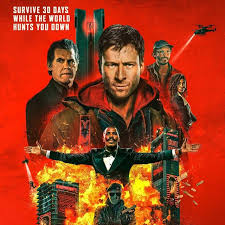
In the annals of pop culture, 2025 was supposed to be a milestone year for dystopian fiction. It is the year Stephen King’s (writing as Richard Bachman) classic novel The Running Man is set. For decades, fans have looked at the calendar and wondered if we would be living in the world of totalitarian game shows, desperate contestants, and the constant hum of surveillance. When Paramount and director Edgar Wright announced a new adaptation—not a remake of the 1987 Arnold Schwarzenegger vehicle, but a fresh take on King’s darker source material—expectations were electric.
Now that the credits have rolled on The Running Man (2025) , the reviews have crashed in like a wave of grey concrete. Starring Glen Powell as the desperate Ben Richards and directed by the visual stylist behind Scott Pilgrim vs. The World and Baby Driver, this film promised high-octane social commentary. Instead, critics and audiences are locked in a furious debate: Is this a misunderstood, book-accurate masterpiece, or a soulless slog that forgot to have fun?
Here is the ultimate breakdown of what everyone is saying about The Running Man (2025).
The Core Conflict: Book vs. Movie vs. Arnie
The biggest point of contention in every single review—from IMDb to the AV Club—is identity. What is this movie supposed to be?
The 1987 version with Schwarzenegger was loud, proud, and utterly ridiculous. It had cheesy one-liners (“I’ll be back,” in a running context), flamboyant gladiator killers like “Subzero” and “Dynamo,” and a hero who won by flexing his biceps as much as his wits.
Edgar Wright explicitly did not make that movie. Instead, he leaned into the bleakness of King’s original novella.
The Positive Spin:
Reviewers like Oʂɯαʅԃσ Rσყҽƚƚ on Plex cheered, “It is a very book-accurate adaptation.” This version treats Ben Richards not as an action hero, but as a desperate father—a working-class man forced onto a deadly game show to pay for his sick daughter’s medicine. The hunters aren’t colorful rock stars; they are terrifyingly efficient, generic men in black suits. For fans of King who hated the original’s campy tone, this 2025 version felt like a vindication.
The Negative Spin:
Critics argue that by dropping the “style,” Wright forgot the “substance.” A scathing IMDb user review titled “Sprint to Boredom” argues: *“This does absolutely no justice to the Arnold movie. The original knew what it was: loud, ridiculous, quotable, and unapologetically fun. The 2025 version strips all of that away and replaces it with gray lighting, self-serious speeches, and the personality of a loading screen.”*
It seems the film falls into a strange no-mans-land. It is too grim for fans of the 80s classic, but too “safe” and crowd-pleasing for fans of King’s razor-sharp misery.
The Villains: Where is the “Show” in “Showdown”?
One of the most repeated criticisms across the web concerns the hunters.
In the 1987 film, the antagonists (“Stalkers”) were gimmicky, memorable, and fun. In the 2025 version, Director Edgar Wright opted for realism and efficiency.
The Analysis:
Reviewer Doc. Max perfectly summarizes this disappointment: *“In the 1987 version, every hunter was completely unique, creative, and gloriously over-the-top, perfect 80s villain energy. In this remake? The hunters are just generic guys in black suits… a visual theme we’ve seen way too often.”*
The movie features Josh Brolin and Lee Pace in significant roles, but reviews suggest they are wasted. Instead of feeling like a dangerous game show, the middle section of the film apparently devolves into a standard chase movie. One user lamented, “Where the hell was Dynamo?” —a reference to the iconic, electric-guitar-wielding henchman missing from this iteration.
Without the distinct “boss battle” feel of the original, many viewers felt the 2-hour and 13-minute runtime drags significantly. The AV Club noted that the movie succeeds “as invigorating pop entertainment” but “overstays its welcome in a distended, herky-jerky final half-hour.”
Glen Powell: Leading Man or Running Man?
Glen Powell has had a meteoric rise (Top Gun: Maverick, Anyone But You). Casting him as the desperate, rage-filled Ben Richards was a gamble.
The Verdict: Mixed.
The Praise: The Washington Post praised Powell, stating he “channels the boiling rage of his accidental-insurgent character… far more persuasively than Ah-nold did.”
The Criticism: However, a significant chunk of the audience disagrees. One reviewer on IMDb (translated from French) noted a “strangely disconnected” performance: “The lead actor embodies this contradiction. He’s competent and committed, but fails to resonate. His one-dimensional aura of anger never quite fuses with the character’s despair.”
A fascinating theory posed by user gibbens is that the film is simply exhausting. Powell runs. Then he runs some more. Then he hides. While the novel uses this cat-and-mouse to build tension, the film apparently uses it to build fatigue. As the San Francisco Chronicle put it bluntly, “The inherent problem with ‘The Running Man’ is the actual running.”
The Ending That Broke the Audience (Spoiler-Lite)
Usually, spoilers are off-limits, but the ending of The Running Man 2025 has become such a massive part of the discourse that it defines the review scores.
Warning: Vague Structural Spoilers Ahead.
Stephen King’s original novel ends with one of the most iconic, nihilistic punches in literature—a kamikaze finale involving a plane and a skyscraper. It is dark, it is final, and it is the entire point of the story about a system crushing a man until he has nothing left to lose.
Edgar Wright apparently flinched.
Mitchell5954 nails this frustration: “The movie tries to be more of a crowd-pleasing blockbuster, especially with the ending… The book’s ending is more bittersweet, if not leaning towards depressing, while the film’s is more triumphant and hopeful.”
Bother’s Bar confirmed this observation, noting the film has “an element of having its cake and eating it with the ending, which looks like it might end the same way as the book but then… doesn’t.”
This “Hollywood Ending” has arguably tanked the film’s credibility with the hardcore sci-fi crowd. By attempting to give Ben Richards a happy ending, the film undermines its own critique of capitalism and entertainment violence. It wants to be angry about the system, but it doesn’t want the hero to actually get hurt by it.
The Visuals: Dystopian Chic or Cheap CGI?
Even the haters agree on one thing: Edgar Wright knows how to frame a shot.
The film is described as looking like a blend of The Fifth Element, Idiocracy, and Mad Max. The world-building—the screens, the sponsors, the way the audience interacts with the violence—is generally praised as immersive.
However, the VFX come under fire. One particularly visceral review claims, “The CGI in this movie sometimes reminded me of a Nintendo Gamecube video game from 20 years ago.” Others appreciate the “retro-futuristic vehicles” and the practical effects used for the stunt work, but the consensus is that the digital sheen sometimes washes out the grit.
Final Scorecard: Should You Run to the Theater?
So, where does The Running Man (2025) land? It currently holds a middling score on review aggregators—respectable but not great.
Watch it if:
You are a Stephen King purist who hated the Arnold version.
You want to see Glen Powell sweat for two hours.
You appreciate Edgar Wright’s visual style, even when the script is weak.
Skip it if:
You want a fun, quotable action movie like the 1987 original.
You dislike long runtimes with uneven pacing.
You need your dystopian endings to have a sharp, moral bite rather than a soft, happy landing.
In the end, The Running Man 2025 isn’t a bad movie; it is a frustratingly safe one. It dresses up in the clothes of a dark satire but lacks the courage of its convictions.
One reviewer summed it up best: “You put in so much work with no gain and at the end, you come down with a question in your mind about the reason for your stepping up there in the first place.”
It is a treadmill movie. Lots of movement, but you don’t actually go anywhere.
Rating: ★★½ (2.5/5)
“Faithful to the text, but missing the spirit

