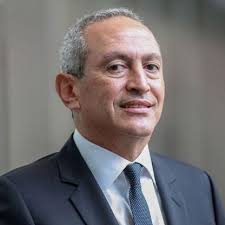
His name is Nassef Sawiris.
In March 2026, the business world took a sharp intake of breath. Adidas, the €50 billion German sportswear giant, announced that Sawiris would become its new Chairman . This was not the act of a passive investor; it was the coronation of a kingmaker.
With an estimated net worth fluctuating between $8.8 billion and $9.6 billion (ranking him among Africa’s wealthiest), Nassef is not just the richest man in Egypt; he is likely the most diversified and strategically important investor you have never fully understood . He is the heir to a desert construction dynasty, the savior of Aston Villa, the shadow in the Adidas boardroom, and now, a major bettor on the American Infrastructure boom.
This is the story of the “Silent Pharaoh”—how Nassef Sawiris is reshaping his father’s concrete business into a $50 billion transatlantic titan.
Table of Contents
TogglePart 1: The Dynasty of the Desert
To understand Nassef Sawiris, one must first understand the sand he stands on. The Sawiris family is the undisputed royalty of Egyptian capitalism. Unlike self-made tech billionaires who strike gold with an app, the Sawiris fortune was forged in steel, cement, and the harsh landscape of the construction industry.
The patriarch, Onsi Sawiris, founded Orascom in the 1950s . It was a classic immigrant/family story of grit: a small contracting firm that survived nationalization and exile, eventually returning to Egypt to capitalize on the country’s economic liberalization. Onsi had three sons, and he divided his industrial kingdom among them with surgical precision:
Naguib took the telecoms and media (loud, political, flashy).
Samih took tourism and hospitality (hotels in the mountains).
Nassef, the youngest, got the “dirty hands” business: Construction and fertilizers .
It seemed like the least glamorous slice of the pie. While his brother Naguib was buying yachts and making headlines about buying Greek islands for refugees or investing in North Korea, Nassef stayed in the shadows, staring at balance sheets and industrial gas pipes.
But Nassef had a long-term vision that his siblings lacked. He saw that construction wasn’t just about building skyscrapers; it was about controlling the supply chain. He took Orascom Construction Industries (OCI) and pivoted it toward nitrogen fertilizers. Why? Because as the global population exploded, the world needed food, and food needs fertilizer. By the early 2000s, he had built OCI into one of the world’s largest nitrogen fertilizer producers, with massive plants not just in Egypt, but in Texas and Iowa .
In 2007, he played his first masterstroke. He sold the family’s cement business to France’s Lafarge for over €10 billion . While others hoarded assets, Sawiris cashed out at the peak of the cycle. He was no longer just a builder; he was a global capital allocator.
Part 2: The Renaissance Man (Sports & Fashion)
Most industrialists who sell their core asset retire to a beach. Nassef Sawiris moved to the VIP boxes of the world’s biggest brands.
The Adidas Gambit
In 2016, Sawiris began quietly accumulating shares in Adidas. By 2026, via his investment vehicle NNS Group, he holds nearly 6% to 7% of the German giant, making him a cornerstone shareholder .
Why Adidas? At the time, it was languishing in the shadow of Nike. But Sawiris wasn’t betting on sneakers; he was betting on culture and management. He joined the supervisory board in 2016 and witnessed the turbulence: the pandemic crash, the explosive yet toxic relationship with Kanye West (Yeezy), and the subsequent fall out .
While the company went through turmoil, Sawiris stayed patient. In 2025, he became Deputy Chairman. In 2026, when the board ousted longtime Chairman Thomas Rabe (who received a meager 64% reelection vote), Sawiris was the natural, strong successor . His appointment signals stability. As a major shareholder taking the helm, he aligns the company’s interests directly with the owners—a move Wall Street loves.
The Aston Villa Revolution
Perhaps his most visible transformation has been the resurrection of Aston Villa Football Club.
In 2018, alongside Wes Edens (the American billionaire), Sawiris bought the struggling Birmingham club . At the time, Villa was a mess—financially doped out and floundering in the second tier of English football.
Sawiris didn’t treat it like a toy. He treated it like a restructuring project. He injected smart capital, built a data-driven recruitment model, and refused to panic.
Fast forward to 2026: Aston Villa is a Champions League regular, competing with the elites of Europe. The Villa Park stadium is undergoing a massive expansion funded by the Sawiris-Eden partnership. For the fans, he is a hero—not because he does interviews (he rarely does), but because he funds success and stays off Twitter.
Part 3: The Grand Pivot (2025-2026)
While the sports headlines are nice, 2025 marked the most significant strategic shift of Nassef Sawiris’s career. He is, in essence, emptying his European piggy bank to go all-in on the United States.
The $50 Billion Bet**
In late 2025, news broke that Sawiris was pivoting his entire empire toward U.S. infrastructure. The plan is audacious: to invest up to **$50 billion in American data centers, airports, and utilities over the next decade .
To do this, he engineered a massive simplification of his corporate structure. For years, OCI (the Dutch-listed fertilizer giant) and Orascom Construction (the family builder) operated as distinct entities. In 2025, after selling over $11.6 billion worth of OCI’s European assets, he began merging the cash-rich chemical giant back into the construction arm . The newly merged entity will list in Abu Dhabi, but its target is clear: the American heartland.
Why the US? Sawiris realized that the Inflation Reduction Act and the CHIPS Act in the US are creating a once-in-a-century boom in industrial construction. Someone has to build the substations for the AI data centers. Someone has to expand the runways. Sawiris already has a secret weapon here: The Weitz Company.
He acquired this Iowa-based contractor back in 2012 . While no one was paying attention, Weitz has been building data centers and university campuses across America for a decade. Now, he is supercharging Weitz with the billions from the OCI sale to become a major player.
The Tax Man Cometh
There is also a personal element to this shift. Sawiris recently moved his tax residency from the United Kingdom to Abu Dhabi and Italy. The UK abolished its “non-dom” tax status, which had previously allowed wealthy foreign nationals to avoid paying UK taxes on their global income . Sawiris voted with his feet (and his wallet), relocating to the tax-friendly shores of the UAE. He now splits his time between Abu Dhabi (where he sits on the board of XRG, the investment arm of the state energy giant) and Italy .
Part 4: The Investment Philosophy of the Sphinx
How does Nassef Sawiris think? Unlike venture capitalists who spray money at startups, Sawiris has a specific, three-pronged philosophy that explains every move he has made.
1. The Moats of Necessity
Sawiris does not invest in fads. He doesn’t do crypto; he doesn’t do meme stocks. He invests in things that society cannot live without:
Fertilizer: People must eat.
Construction: People need shelter and infrastructure.
Sports/Entertainment: People need distraction and community.
Sneakers/Sportswear: People need clothing.
2. The Control Proxy
He rarely wants to run the day-to-day operations, but he always wants a seat at the head of the table. He doesn’t just buy 6% of Adidas; he joins the board and eventually takes the Chair. He doesn’t just sponsor a team; he co-owns Aston Villa. He wants to influence the generals without having to load the cannons himself.
3. The Liquidity Event
Unlike many family businesses that hold on until death, Sawiris is a ruthless seller. He sold cement before the 2008 crash. He sold OCI assets at the peak of the commodity cycle. He understands that capital trapped in a factory is useless if you don’t redeploy it. His current move—selling EU assets to buy US infrastructure—is a massive macroeconomic bet that America’s re-industrialization will outperform Europe’s stagnation.
Part 5: The Human Element
What is it like to be Nassef Sawiris?
He is 64 (as of 2026), married with four children, and holds a degree from the University of Chicago . He is famously reclusive. In an era of billionaire selfies and Twitter spats, Sawiris is practically invisible. He does not seek the spotlight, unlike his flamboyant brother Naguib.
Yet, he is generous in a structured way. In 2019, he pledged $24 million to the University of Chicago to fund scholarships for Egyptian students . It was a move that combined his love for his alma mater with a strategic desire to build a pipeline of Egyptian talent.
He also has a taste for the finer things. He owns a 5% stake in Madison Square Garden Sports (the home of the Knicks and Rangers) . This gives him access to the inner sanctum of New York’s elite. He sits courtside at NBA games, but you won’t see him on the Jumbotron. He prefers to watch the game, not be the game.
Conclusion: The Empire of the Future
As of June 2026, Nassef Sawiris stands at a unique intersection of global power.
The Old World: He is the new Chairman of Adidas, tasked with guiding the German giant past the Yeezy era and into a new age of sustainability and growth .
The New World: He is deploying billions into the US construction boom, betting that AI and clean energy need concrete foundations .
The World of Fun: He owns a major stake in the New York Knicks and the Premier League’s Aston Villa, tying his fortunes to the volatility and glory of live sports .
He is proof that the “Old Money” model is not dead. In a chaotic world, Nassef Sawiris wins not by being the loudest, but by being the most patient. He builds, he waits, and when the tide shifts, he moves his entire empire in one decisive, silent swing.
The Sphinx is smiling. He is about to take over the world of sportswear, one brick, one shoe, and one goal at a time