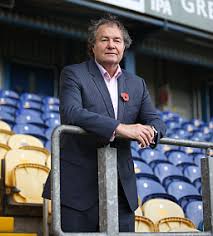
To understand the legacy of the name “John Radford” in British culture, one must look past the confusion of identities and appreciate the unique context of each. This is the story of the original “Mr. Arsenal” and the unlikely “King of Mansfield.”
Table of Contents
ToggleThe Forgotten Prince of Highbury (The Footballer)
To be a record holder at a club the size of Arsenal is to be immortal. Yet, for John Radford—the forward born in Hemsworth, Yorkshire, in 1947—immortality has come with a whisper rather than a roar .
When we talk about the legends of North London, the conversation usually revolves around Thierry Henry, Dennis Bergkamp, or Tony Adams. But before any of them walked through the hallowed marble halls of Highbury, John Radford was smashing records that still stand today.
On January 2, 1965, a 17-year-old Radford stepped onto the pitch against Wolverhampton Wanderers. At 17 years and 315 days old, he scored three goals—a perfect hat-trick. To this day, he remains the youngest player in the history of Arsenal Football Club to score a hat-trick . It is a record that has survived the challenges of prodigies like Cesc Fàbregas and Nicolas Anelka, a testament to the raw, Yorkshire-bred power he possessed as a teenager.
Radford was not a flashy winger or a mercurial talent. He was a “battering ram” of a centre-forward. Standing tall and robust, he was the engine of Bertie Mee’s legendary side. While the world romanticizes the 1971 “Double” team for its flair, Radford provided the grit.
His finest hour came during the historic 1970-71 season. Arsenal were chasing the holy grail: the League Championship and the FA Cup. Radford formed a devastating partnership with Ray Kennedy (who would later find fame with Liverpool). Together, they scored 47 goals . But it was Radford’s intelligence, not just his strength, that sealed the Double.
In the FA Cup semi-final replay against Stoke City, it was Radford who turned provider, threading the needle to set up Kennedy for the winning goal. In the final at Wembley against Liverpool, with Arsenal 1-0 down and looking beaten, Radford’s physical presence disrupted the Liverpool defense. He set up Eddie Kelly for the equalizer, and then, with a burst of power, he laid the ball on a plate for Charlie George to smash home the winner . He ended that season with 21 goals, the best tally of his career, and the adoration of a generation.
He was also remarkably versatile. In an era before tactical substitutions were as fluid as they are today, Radford once famously had to go in goal during an FA Cup semi-final against Stoke (a different match) after keeper Bob Wilson was injured. He didn’t just stand there; he helped secure a 1-1 draw, forcing a replay that Arsenal would win .
Radford left Arsenal in 1976, having scored 149 goals in 481 appearances. At the time of his departure, and still as of 2025, he sits as the club’s fourth-highest goalscorer of all time . He is a relic of a grittier, more physical era of English football—a man who did the dirty work so the artists could paint. Today, he gives tours of the Emirates Stadium, a living ghost of Highbury’s glorious past .
But while Radford the footballer was making history in London, another John Radford was about to redefine what it meant to be a football club owner in the industrial heartlands of Nottinghamshire.
The £1 Bet (The Businessman)
Fast forward to 2010. The setting is Mansfield, a former mining town not far from Sherwood Forest. The football club, Mansfield Town FC (The Stags), is in the gutter. Financially doped out, relegated to the Football Conference (the fifth tier of English football), and hemorrhaging cash, the club is valued at virtually nothing.
Enter John Lawrence Radford.
Born in Sutton-in-Ashfield in 1965, this John Radford was a local boy made good. He hadn’t made his fortune with his feet; he made it with paper and phone calls. In 1995, he founded One Call Insurance in Doncaster . Starting from a bedroom operation, he built it into a giant in the comparison and insurance market. He understood leverage, risk, and marketing.
In a move that looked less like an investment and more like charity, Radford bought Mansfield Town for the princely sum of £1 . The reaction from the national press was one of pity or mockery. They saw a wealthy man throwing his money into a black hole.
But Radford played the long game. Unlike the “sugar daddies” of the Premier League who bought titles with oil money, Radford bought a community asset. He brought his business acumen to the pitch.
He immediately appointed his wife, Carolyn Radford, as the CEO. At the time, she was one of the youngest and most powerful female executives in English football. The pair were a dynamic duo: John provided the financial firepower and strategic patience; Carolyn provided the legal sharpness and commercial drive.
The transformation was slow but seismic. Radford cleared the debt. He modernized the stadium, renaming it the One Call Stadium (a bit of self-promotion for his insurance firm, but also a vital revenue stream) . He invested in the training ground and the youth academy. He understood that a football club in a town like Mansfield isn’t just entertainment; it is the social safety net, the identity, the heartbeat.
By 2024, the gamble had paid off spectacularly. The combined net worth of John and Carolyn Radford was estimated by the Yorkshire Post to be around £184 million . Mansfield Town climbed back into the English Football League and, under manager Nigel Clough (son of the legendary Brian Clough), began challenging for promotion to League One and even the Championship.
Radford’s story is unique because he represents the “local hero” archetype. He didn’t buy a plaything; he bought the club he grew up watching. He turned a £1 investment into a cornerstone of a nine-figure empire, proving that in football, sometimes the best business is the one you do for love.
A Convergence of Legacies
It is a fascinating coincidence of time and space that these two John Radfords—the footballer and the financier—exist at the same moment in British history.
They have never competed directly, but their lives echo each other in the world of football. The elder Radford (the striker) knows what it takes to win trophies on the grass. The younger Radford (the owner) knows what it takes to win trophies on the balance sheet.
They also share a specific geographic loyalty. The footballer, though born in Yorkshire, gave his prime to London but remains a staple in the hearts of traditional fans. The businessman gave his money to Nottinghamshire. Both represent the “North vs. South” dynamic of English football: the gritty, hard-working forward who served the polished London club, and the gritty, hard-working entrepreneur who saved the gritty Northern town.
The Wider Legacy: The Shipping Magnate and the Priest
To ignore the other John Radfords would be to miss the texture of the name. There was John A. Radford, the legendary shipping personality who worked for James Finlay & Co in Chattogram (now Chittagong), Bangladesh . Born in Liverpool in 1924, his life reads like a PG Wodehouse novel meets a war thriller. He survived World War II, served in the East Lancashire Regiment, and then spent 32 years in East Pakistan/Bangladesh navigating the political chaos of the 1971 Liberation War. He was awarded the Order of the Phoenix by the Greek government for assisting vessels during the emergency and eventually became an OBE . He died in 2019, having lived a life of such adventure that it defies fiction.
And then there is the first John Radford of all: John Radford the Jesuit (1561-1630) . A missionary from Derbyshire, he lived in the shadows of Elizabeth I’s England, a time when being a Catholic priest was an act of treason punishable by hanging, drawing, and quartering. He wrote secret treatises, converted souls in the dead of night, and died peacefully in Devon—a rare feat for a “Papist” priest of his era.
The Uniqueness of Obscurity
What makes the John Radfords so fascinating is that none of them are “generic.” In an era of manufactured celebrities, every single John Radford highlighted by history is a self-made man.
The Striker built his legacy with bruised shins and headed goals, rising from a butcher’s son in Hemsworth to the Wembley turf .
The Owner built his legacy with spreadsheets and cold calls, rising from a bedroom in Doncaster to the boardrooms of the Premier League .
The Sailor built his legacy with courage and maritime law, surviving wars and revolutions to knit the trade ties of the British Empire .
Conclusion
When you hear the name “John Radford,” you should not think of one man. You should think of a genre of British success. It is the sound of leather on mud (the footballer). It is the sound of a till ringing (the businessman). It is the sound of a ship’s horn in a distant port (the sailor).
For the football purist, the striker remains the icon. For the modern student of sport finance, the owner is the guru. But for the cultural observer, the name John Radford serves as a reminder that greatness is rarely a solo act.
Even as we focus on the two Johns of the pitch—the scorer and the spender—we see the same DNA: resilience, a lack of fear of the hard graft, and a deep-seated connection to community. Whether holding the line against Liverpool’s attack in 1971 or holding the line against the club’s creditors in 2010, John Radford is a name that refuses to be defeated.
Next time you watch Arsenal lift a trophy or see Mansfield Town climbing the league tables, remember the quiet record holder. And next time you see a financial turnaround that seems impossible, remember the man who bet £1 and won a fortune. In the crowded halls of English football history, there is plenty of room for all of them.
Key Milestones of John Radford (Footballer) :
Youngest Arsenal hat-trick scorer (17 years, 315 days) – Record still stands .
Arsenal Double Winner (League & FA Cup) – 1971 .
Inter-Cities Fairs Cup Winner – 1970 .
Appearances: 481 for Arsenal / Goals: 149 .
Current Role: Club Ambassador & Stadium Tour Guide .
Key Milestones of John Radford (Businessman) :
Founded One Call Insurance – 1995 .
Purchased Mansfield Town FC for £1 – 2010 .
Combined Net Worth (2024) : £184 Million (Yorkshire Post Rich List) .
Key Asset: One Call Stadium, Mansfield