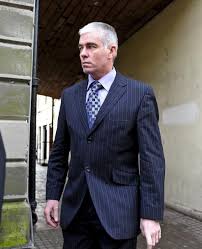
His name is Peter McColgan.
For many, “McColgan” is a surname synonymous with modern Scottish and British athletics, primarily due to his daughter, the Olympic finalist Eilish McColgan, and his ex-wife, the legendary marathon world champion Liz McColgan. But to reduce Peter McColgan to a footnote in his family’s biography is to ignore one of the grittiest, most talented, and most understated careers in the history of the steeplechase.
This is the story of a late bloomer from Strabane who held Northern Irish records, conquered the NCAA, went toe-to-toe with the world’s best, and ultimately helped shape a running dynasty.
Table of Contents
ToggleFrom the Tyrone Soil: A Late Awakening
Born on February 20, 1963, in Strabane, County Tyrone, Peter McColgan was not a child prodigy. In an era when most future Olympians are identified by their early teens, McColgan was virtually invisible on the athletics circuit until he was 17. Growing up in Northern Ireland during the socio-political turbulence of the 1970s, sport was often an escape rather than a career path. He was educated at Omagh CBS, a school known for academics and Gaelic games, but it was the purity of running that eventually captured McColgan’s imagination.
Unlike the synthetic, climate-controlled tracks of today, McColgan cut his teeth on the unforgiving surfaces of the early 1980s. His late start meant he had a steep learning curve, but it also meant his body was relatively unbroken compared to peers who had been grinding since childhood.
By 1982, just three years after tying up his first competitive spikes, the 19-year-old McColgan announced his arrival. On a track in Belfast, he clocked 9:11.59 for the 3000 meters steeplechase. This wasn’t just a good time; it was a record. It signaled the emergence of a natural talent for the sport’s most sadistic discipline.
Mastering the Water Jump
The steeplechase is not a normal race. It requires the lung capacity of a 5,000-meter runner, the leg speed of a miler, and the hurdle technique of a 400-meter runner—all while navigating a water pit that soaks your spikes and destroys your rhythm. McColgan, standing at just 5’7″ and weighing around 130 lbs, was physically unassuming. He didn’t have the long, loping stride of a Kenyan champion. What he had was economy, precision, and a quiet, terrifying stubbornness. He learned to glide over the barriers with a mechanical efficiency that saved precious seconds over the seven-and-a-half laps of the track.
The Alabama Revolution: A Sub-Four Revelation
The trajectory of Peter McColgan’s career changed drastically when he crossed the Atlantic. Following a path blazed by many European distance runners seeking scholarships, McColgan landed at Ricks Junior College in Idaho before transferring to the University of Alabama.
It was in the humid heat of Tuscaloosa that McColgan transformed from a promising Irish lad into a world-class All-American. Under the tutelage of coach John Mitchell, McColgan found structure. “Before I came here, I never really trained that much,” McColgan admitted in a 1985 interview with the Tuscaloosa News. “I would train hard and long for three or four weeks then get lazy for three or four days. Back home I had to train by myself… Here coach expects me to train and that gives me some motivation”.
The results were immediate and explosive. In 1985, he recorded a 3:47.08 for the 1500 meters and a stunning 4:02 mile. But 1986 was the annus mirabilis. McColgan shattered the Alabama school record in the steeplechase that had stood for nine years, clocking 8:42.54. He didn’t stop there; he went on to win bronze at the NCAA Championships and earned All-American honors. On July 18, 1986, in Birmingham, England, he achieved a milestone that separates the “good” from the “elite” middle-distance runner: he broke the four-minute mile, stopping the clock at 3:59.37.
This versatility—being able to run a sub-4 mile one week and a grueling 3,000-meter steeplechase the next—made him a unique asset.
The Commonwealth Battles: 1986 and the Scottish Turn
Despite his success in the American collegiate system, McColgan’s heart remained loyal to his roots. He represented Northern Ireland at the 1986 Commonwealth Games in Edinburgh—a games that would prove pivotal for him both professionally and personally.
In Edinburgh, McColgan pulled double duty, qualifying for the finals in the 5000 meters and the 3000 meters steeplechase. While he didn’t bag a medal (finishing 7th in the steeplechase and 12th in the 5000m), the experience of competing at that level solidified his belief that he belonged.
It was also during this era that the “Irish invasion” of Scottish athletics began. Scotland has always had a porous border for Irish talent, but McColgan became a permanent fixture. He began running for Dundee Hawkhill Harriers and the Scottish six-stage relays, quickly becoming a fan favorite. His running was described as “honest”; he didn’t win by flashy kicks but by grinding down the opposition.
He holds the distinction of being a rare athlete who could, and did, represent Northern Ireland at the Commonwealth Games while winning Scottish and British championship medals on the track.
The “Liz” Factor: Love, Marriage, and a Super-Couple
No article about Peter McColgan would be complete without addressing the towering presence of Elizabeth “Liz” McColgan (née Lynch). The pair met during their time at the University of Alabama. At the time, Liz was already a force of nature—the reigning Commonwealth 10,000 meters champion who would go on to win the 1991 Tokyo Marathon and World Championship silver.
They married in 1987, forming the “first couple” of British distance running. While Liz dominated the headlines and the prize money, Peter remained the unsung engine of the household. He balanced his own elite career with travel to support Liz’s training camps.
This dynamic, however, also defined the public perception of Peter. To the outside world—and perhaps to the history books—he was “Mr. Liz McColgan” before he was “Eilish McColgan’s dad.”
But those who watched the sport in the late 80s and early 90s knew better. While Liz was winning marathons, Peter was smashing Northern Irish records that still stand today. As of 2025, he remains the holder of the Northern Irish indoor 3000 meters record (7:54:48), the 2000 meters steeplechase record (5:31.09), and the 3000 meters steeplechase record (8:27.93). The fact that a man who ran in the 80s and 90s still holds these records speaks volumes about his durability and talent.
The World Stage
In 1991, McColgan reached the pinnacle of track competition. He was selected to run for Great Britain in the 3000 meters steeplechase at the World Championships in Athletics in Tokyo. Standing on the starting line against the best in the world, including the dominant Moses Kiptanui, McColgan had achieved the ultimate validation of his amateur career.
The Reluctant Pacesetter: Father of a Dynasty
Following his retirement from elite racing, Peter’s life took a quieter, but no less intense, turn. He and Liz settled in Dundee, Scotland, where they raised a family of five children. Peter moved into a career in fitness, running a gym, while Liz continued to churn out marathon victories.
However, the most fascinating chapter began with their daughter, Eilish McColgan. From a young age, Eilish showed the genetic blend of her parents: Peter’s smooth steeplechase technique and Liz’s raw endurance power. While Liz often took the role of the tough-love taskmaster from the sidelines, Peter often played the role of the metronome—the steady training partner, the logistical master, and the gym manager.
For years, as Eilish broke Scottish records and chased Paula Radcliffe’s marathon mark, social media clips would often surface of Peter running alongside her on the roads of Dundee. Even in his 50s, the former Northern Irish record holder looked fluid and effortless, playing the vital role of the spouse and father who understood the loneliness of the long-distance runner more intimately than any coach could.
Legacy: More Than Just a Record Holder
Peter McColgan and Liz McColgan divorced in 2013 after 26 years of marriage. Despite the personal split, the athletic legacy they created is unparalleled in British athletics. Peter quietly remarried in February 2025 to his long-term fiancée Lesley, beginning a new chapter away from the spotlight.
So, how do we rate Peter McColgan?
In the metrics of raw achievement, he is a Northern Irish record holder, an NCAA All-American, and a World Championships finalist—credentials most runners would sell their souls for. Yet, he remains a hidden gem.
He exists as a bridge between two eras of Irish distance running: the gritty, amateur-dominated 1980s and the professional, lottery-funded 21st century. He was a pioneer who took the leap to the US college system before it was the standard path for Europeans.
Moreover, his physical legacy is running on the track right now. Watching Eilish McColgan float over steeplechase barriers, one sees the ghost of her father. The same economy of motion, the same low center of gravity, the same refusal to panic when the pace heats up.
Peter McColgan may not have an Olympic gold medal in his display case. He may not have his name on a marathon billboard. But he holds records that have outlived the 20th century. He won a bronze medal at the NCAA Championships. He broke the four-minute mile. And, quietly, without fanfare, he helped raise an Olympic athlete.
In a sport that worships the “super coach” or the “super shoe,” Peter McColgan is a relic of a simpler, harder time. He is proof that sometimes the toughest runners aren’t the ones on the medal podium, but the ones who hold the barriers open for the next generation to pass through.
Key Career Highlights of Peter McColgan
Date of Birth: February 20, 1963 (Strabane, County Tyrone)
Representation: Northern Ireland (Commonwealth Games) / Great Britain (World Championships)
Current Records Held:
Northern Irish 3000m Indoor: 7:54.48
Northern Irish 2000m Steeplechase: 5:31.09
Northern Irish 3000m Steeplechase: 8:27.93
Major Achievements:
Sub-4 Minute Mile (3:59.37 – 1986)
NCAA Division I Bronze Medalist (3000m SC – 1986)
NCAA All-American
IAAF World Championships Finalist (1991 – Tokyo)
Commonwealth Games Finalist (1986 – Edinburgh)
While his ex-wife and daughter may hold the World Marathon titles and the European records, Peter McColgan holds the family’s title for the fastest lap of a water jump—and that is a legacy worth celebrating.
Conclusion
Peter McColgan’s name may not light up Olympic scoreboards, but his impact on distance running is indelible. He is the rare athlete whose legacy is measured not just in record books—where his Northern Irish steeplechase marks still stand decades later—but in the quiet, relentless consistency of his craft. From the muddy tracks of Tyrone to the floodlit stadiums of Tokyo, McColgan proved that greatness isn’t always about gold medals.
Sometimes, it’s about showing up, grinding through the water jumps, and building a foundation strong enough to support a dynasty. In the end, Peter McColgan ran so that the next generation could fly—and for that, he remains a true legend of the sport