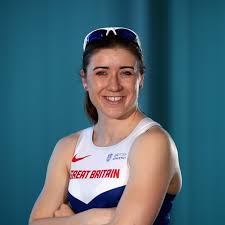
This is the story of a woman who didn’t just overcome her disability; she weaponized it, eventually swapping the running blades for ice skates and handlebars, proving that for a true athlete, classification is just a suggestion.
Table of Contents
ToggleA Diagnosis That Defined (But Didn’t Limit) a Destiny
Born Elizabeth Clegg on March 24, 1990, Libby grew up in the rolling hills of Cheshire with a passion for ballet dancing and horse riding . It was a vibrant, physical childhood, but one shadowed by a creeping physiological mystery. At the age of nine, the world began to blur.
The diagnosis was Stargardt’s Macular Dystrophy, a rare genetic condition that causes progressive vision loss. Essentially, the macula—the central part of the retina responsible for sharp, straight-ahead vision—deteriorates . For Libby, the effect was catastrophic in slow motion. It left her with only minimal peripheral vision in one eye, and eventually, as her condition deteriorated into the T11 classification (the highest level of visual impairment in Paralympic sport), she became a fully blind sprinter who must wear a blackened mask to ensure total darkness, leveling the playing field with her competitors .
Most people, faced with such a diagnosis at a tender age, might retreat into safety. Libby, however, was agitated. A former dancer, she needed an outlet for her energy. She joined the Macclesfield Harriers Athletics Club, initially dabbling in the tedium of middle-distance running and cross country. But she was a sprinter trapped in a distance runner’s body. She craved explosive power, the raw, untamed violence of a 100-meter dash .
At just 16, she burst onto the global stage at the 2006 IPC World Championships in Assen, Netherlands, snatching a silver medal in the T12 200m . It was a shock to the establishment. Here was a teenager, barely old enough to drive, who was already standing on the podium against the world’s best.
The Agony of Silver and the Fracture of Trust
For nearly a decade, Clegg was the nearly-woman of Paralympic sprinting. She arrived at the 2008 Beijing Paralympics full of fire and left with a silver medal in the 100m T12. It was an incredible achievement, yet it tasted of bronze—a metal that wasn’t gold . She repeated the feat four years later on home soil at the London 2012 Paralympics. Running in the cauldron of the Olympic Stadium, she claimed silver once more .
To the outside world, two Paralympic silvers are a career-defining success. To Libby Clegg, they were a haunting loop of being the bridesmaid.
But the years between 2012 and 2016 were not just about training; they were about survival. The relationship with guide runner Mikail Huggins, the man entrusted with her literal direction, became strained. In a sport where the blind sprinter and the guide must move as a single organism—their tethered arms acting as a neural link—a breakdown in trust is a career death sentence [citation:12].
By 2015, the split was official. Clegg was left alone, her funding from British Athletics cut following an injury that forced her out of the World Championships . For an athlete whose world is physically dark, the metaphorical darkness of financial instability and a lack of a partner was suffocating.
Enter Chris Clarke.
In early 2016, Clegg began training with a new guide runner. Clarke was not just fast; he was empathetic. He understood that his role was not to pull her, but to be her eyes. It is a terrifying responsibility. He must run in lockstep with her, their elbows brushing, calling out commands for curvature of the track, distance to the finish, and the position of rivals . One wrong move, one late call, and a sprinting world champion could veer into another lane at 25 miles per hour, shattering bones.
Rio 2016: The 11.91 Second Explosion
The 2016 Paralympics in Rio de Janeiro were a turning point, not just for Libby, but for the history of the T11 classification. By now, Clegg’s eyesight had deteriorated to the point where she was reclassified from T12 (visually impaired) to T11 (totally blind), requiring her to wear a sleep-shade during races [citation:15].
The narrative was supposed to be one of decline. Moving up a classification usually means facing athletes with similar levels of impairment, but for Clegg, it meant racing in pure, unassisted darkness.
The 100m T11 semi-final on September 9, 2016, was less a race and more a manifesto.
Lined up in lane 4, Clegg and Clarke exploded from the blocks with mechanical synchronicity. The clock stopped at 11.91 seconds.
It was a world record .
Let that sink in. A woman who could not see the track, who was running in pitch blackness tethered to another man, ran 100 meters in 11.91 seconds. To put it in context, that time would have won every women’s 100m race at the Commonwealth Games from 1998 to 2006. It is a time that collegiate able-bodied all-stars would envy.
In the final, the pressure was immense. China’s Liu Cuiqing was breathing down her neck. Clegg crossed the line in 11.96 seconds—just 0.02 seconds ahead of the silver medalist . It was the closest, most thrilling race of the Games.
But Libby wasn’t done. Three days later, in the 200m T11 final, she delivered a masterclass in blind cornering. She absolutely crushed the field, setting a new Paralympic Record of 24.51 seconds . The “nearly-woman” had become a double Paralympic champion.
The Leap from Track to Ice (and the Risk of Ruin)
Most athletes rest on their laurels after a gold medal. Libby Clegg, now an MBE, went ice skating.
In 2020, Clegg signed up for Dancing on Ice, the grueling ITV reality show where celebrities learn to perform intricate figure skating routines. There was just one glaring, almost absurd problem: she was the show’s first-ever blind contestant .
How does a blind person ice skate at high speed? The same way she sprints: trust and physics.
Partnered with professional skater Mark Hanretty, Clegg had to learn a “new vocabulary of communication” . Instead of verbal cues on a track, she relied on pressure through Hanretty’s hands and specific words for lifts, spins, and crossovers. The British Athletics performance director publicly expressed her terror, warning that a fall on the ice so close to the Tokyo Games could derail her career .
But Libby had a new motivation that outweighed the risk of a broken bone: Motherhood.
In April 2019, she had given birth to her son, Edward . Suddenly, the economics of elite sport became stark. Prize money is scarce; sponsorship is fleeting. Dancing on Ice offered a financial security blanket for her new family.
“I’ve got a son now, so I need to think about financially making the most of situations,” she admitted .
It was a pragmatic, powerful admission from a gold medallist: even at the pinnacle of sport, survival often requires a sidestep into showbiz. And she excelled, using her lack of vision to her advantage. Because she couldn’t see the ice spinning, she never got dizzy—a bizarre genetic quirk that gave her an edge over sighted competitors .
Reinvention on Two Wheels
For many, the story would end after the delayed Tokyo 2020 Paralympics, where Clegg won a silver medal in the 4x100m universal relay before announcing her retirement from athletics . The running shoes were hung up. The guide runner was released.
But Libby Clegg cannot sit still.
In 2022, two years after spinning on ice, she strapped herself into a tandem bicycle. Switching from sprinting to para-cycling is not a natural progression; it is a total physiological rewiring. Sprinting is about explosive, anaerobic bursts. Cycling is about sustained power and aerodynamic efficiency.
Piloted by Jennifer Holl at the Birmingham 2022 Commonwealth Games, Clegg finished fourth in the Women’s Tandem B 1000m Time Trial . For most athletes, “fourth place” is the agony of the almost-medal. For Clegg, it was validation that her athletic brain was still plastic, still learning, still hungry.
She finished that year as a World Champion. Teaming up with Georgia Holt (and piloted by Steffan Lloyd alongside James Ball), Clegg topped the podium in the Team Sprint B event at the UCI Para-Cycling World Championships in France .
From the dark tracks of Rio to the frozen rinks of ITV, to the velodromes of France, Libby Clegg has systematically dismantled every expectation society has of a blind person.
The Legacy Beyond the Finish Line
What makes Libby Clegg unique is not her medal count—though it is staggering. It is her relentless redefinition of the word “can’t.”
She represents a rare breed of athlete who understands that sport, at its highest level, is a mental game played with a physical body. She openly discusses the financial anxiety of being a Paralympic athlete, the breakdown of trust with guides, and the terrifying joy of holding a newborn when you cannot clearly see his face . (Her condition is recessive, meaning her son will not inherit her blindness) .
She has also fostered a dynasty of disability sport; her brother James won bronze in swimming at London 2012, and brother Stephen won silver in Tokyo . The Clegg family has contributed more to Paralympic medals than most small countries.
In an age where athletes are often curated by PR agents into bland, motivational soundbites, Libby Clegg is refreshingly real. She is the sprinter who breaks world records in the dark, the mother who dances on ice for a paycheck, and the cyclist who wins world titles just for the thrill of it.
She may not be able to see her own reflection, but the rest of us see a champion who proved that the only true disability is the refusal to move forward.
Key Career Highlights:
Paralympic Gold: Rio 2016 (100m T11, 200m T11)
Paralympic Silver: Beijing 2008 (100m T12), London 2012 (100m T12), Tokyo 2020 (4x100m Universal Relay)
Commonwealth Games: Gold, Glasgow 2014 (100m T12)
World Champion (Cycling): Team Sprint B, 2022
Honours: MBE (Member of the Order of the British Empire) for services to athletics .
Conclusion
Libby Clegg’s journey is not merely a story of athletic triumph; it is a masterclass in radical adaptation. From the pitch-black straightaways of the Rio sprint track to the dizzying spin of an ice rink, and finally to the aerodynamic fury of a velodrome, she has refused to be defined by a diagnosis.
She turned the silence of blindness into a symphony of motion, proving that true vision has nothing to do with the eyes and everything to do with the will. In a world obsessed with sight, Libby Clegg teaches us that the most important finish lines are the ones we cannot see—but dare to chase anyway