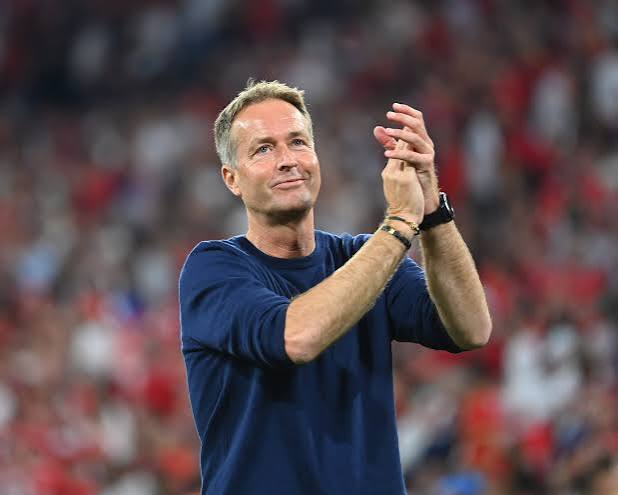
In an era of football dominated by tactical automatons and data-driven micromanagers, Kasper Hjulmand stands as a refreshing anomaly. He is a coach who sees the ball not just as an object to be passed, but as a conduit for human connection; he views the pitch not merely as a battlefield, but as a canvas for philosophical expression. With a career that has traversed the emotional summit of a European Championship semi-final, the crushing depths of a World Cup group-stage exit, and the high-stakes pressure of the Bundesliga, Hjulmand is redefining what it means to be a leader in the modern game.
His appointment as the head coach of Bayer Leverkusen in September 2025 marked a new chapter, bringing his unique blend of tactical flexibility and humanistic leadership to one of Germany’s most ambitious clubs. To understand Kasper Hjulmand is to look beyond the results and delve into the mind of a man who believes that a team’s environment is just as crucial as its formation.
Table of Contents
ToggleThe Pragmatic Roots of a Romantic
Born on April 9, 1972, in Aalborg, Denmark, Hjulmand’s journey to the top was not paved with silver spoons or natural athletic brilliance. His playing career was modest, confined to the lower leagues of Danish football, and cut short at the age of 26 due to injury in 1998. This early retirement forced a rapid transition to coaching, beginning his journey at Lyngby BK as a youth coach. However, it was this very lack of a glittering playing career that perhaps forged his most potent coaching trait: the ability to see the whole picture rather than just the highlight reel.
Hjulmand is a deep thinker, a trait often reflected in his admiration for existentialist philosophers like Jean-Paul Sartre, Albert Camus, and his fellow Dane, Søren Kierkegaard. This philosophical grounding is not an affectation; it permeates his coaching philosophy. He treats his players as complete human beings, not just functional assets on a spreadsheet. Former Denmark captain Simon Kjær perfectly encapsulated this sentiment: “What makes you a unique football coach is that you see the person before the football player, and at the same time, you are insanely ambitious”.
His big break came when he was appointed head coach of FC Nordsjælland in 2011. Despite having one of the lowest budgets in the Danish Superliga, Hjulmand orchestrated a miracle, leading the club to its first-ever league title in the 2011/12 season, pipping the giants FC Copenhagen to the crown. This was not merely a victory of tactics, but of building a cohesive unit where young talents like Mikkel Damsgaard and Andreas Skov Olsen were given the freedom to flourish. It was the foundational proof of his concept: that a supportive environment breeds exceptional results.
The “Mainz 05” Stint and Tactical Maturation
His success at Nordsjælland earned him a move to the Bundesliga with Mainz 05 in 2014, a club renowned for developing coaches. Taking over from Thomas Tuchel, Hjulmand was tasked with maintaining the high standards set by his predecessor. He started brightly, with Mainz sitting third after eight games, but a subsequent dip in form led to his departure in February 2015.
While the spell was brief, it was crucial for his development. Mainz was where he encountered the intense tactical demands of top-tier European football, learning to adapt his possession-based, attacking philosophy to the grind of the Bundesliga. His style, often likened to Tuchel’s, is characterized by tactical versatility and a willingness to shift formations multiple times within a single match. This ability to read the game and react was a skill he would later deploy to devastating effect.
The National Team: Triumph and Tragedy
Perhaps the most defining chapter of Hjulmand’s career began in 2020 when he took the reins of the Danish national team. He inherited a pragmatic squad but quickly implemented a more expansive, attractive style of play, pleasing the fans who had grown tired of the direct approach.
However, his tenure will forever be defined by the harrowing events of June 12, 2021. In Denmark’s opening match of Euro 2020 against Finland, the team’s talisman, Christian Eriksen, collapsed on the pitch due to a cardiac arrest. In that moment, Hjulmand was thrust into a leadership crisis that transcended football. His handling of the situation was universally lauded as masterful. He didn’t just manage a team; he shepherded a group of shell-shocked young men through unimaginable trauma.
The team returned to the pitch, lost their next two games, and yet, somehow, they qualified for the knockout stages. In the round of 16, they dismantled Wales 4-0, followed by a commanding win over the Czech Republic in the quarter-finals. They eventually fell to England in the semi-finals after extra time, but they had achieved the improbable, their journey woven into the narrative of human resilience and collective strength.
Hjulmand famously said after the tournament, “We carried him [Eriksen] all the way to this match against the Czechs and to Wembley”. This sentiment highlights his core belief in the “team spirit” and a “family-like atmosphere,” which he argued are just as vital as any tactical plan. He later revealed that his philosophy is heavily influenced by Danish societal trust. “If you measure trust in the world, Denmark is the highest country… We try to use that as an advantage in our team,” he explained.
The Hard Truth and the Leverkusen Awakening
The post-Euro 2020 high was followed by disappointment. A humiliating group-stage exit at the 2022 World Cup in Qatar, where they finished bottom with just one point, and a last-16 defeat to Germany in Euro 2024, led to his resignation in July 2024.
Despite the national team setbacks, Hjulmand’s reputation remained intact among Europe’s elite. When Leverkusen came calling in September 2025, it was a perfect alignment of values. Leverkusen’s management, including sporting director Simon Rolfes, understood his philosophy intimately, having worked with his former fitness coach. “Only one club could give me the feeling that I wanted to take over a team again – and that was Bayer 04,” Hjulmand stated upon his arrival. He famously added:
“To be honest: I don’t need this job, I could do other things with my life…[but] I do it because I love football and the Bundesliga”. This statement wasn’t arrogance; it was a philosophical declaration of independence from the pressure of results, allowing him to focus on the process of building a team.
His impact was immediate. In his first game in charge, Leverkusen secured a 3-1 victory over Eintracht Frankfurt, signaling a new era. His tactical acumen, honed over decades, is being implemented to create a fluid, attacking unit that excels in “all phases of the game”.
The Tactical Blueprint: Controlled Chaos
From a coaching perspective, Hjulmand’s system is a study in controlled chaos and tactical chameleonism. As detailed by tactical analysts, his style is built on several key principles:
Attacking Structure: He favors a front line of three, often in a 4-3-3 or 3-4-3, with wingers given license to drift inside. At Nordsjælland, he utilized “wrong-footed” wingers who would move into central positions to link with the midfield and striker. This fluidity is designed to overwhelm static defenses.
Flexible Full-Backs: Hjulmand’s full-backs are pivotal. They are encouraged to make overlapping runs but are also tasked with inverting into midfield to create passing triangles. He uses players like Joakim Mæhle, who are comfortable in these hybrid roles.
The Mid-Block Press: Out of possession, Hjulmand doesn’t employ a suicidal high press. Instead, his team drops into a compact mid-block, typically a 4-1-4-1 or 5-2-3. The pressing traps are set in wide areas to force opponents into mistakes, with the team shifting as a single, disciplined unit.
In-Game Adaptability: Perhaps his most potent weapon is his willingness to change. At Euro 2020, he altered Denmark’s formation at least once in every match, switching between back threes and back fours to exploit opponent weaknesses. This tactical fluidity keeps opposition coaches guessing and allows his players to solve problems on the pitch.
Conclusion: The Right Man for a New Era
Kasper Hjulmand is not just a coach; he is a cultural architect. In an age where football leadership is often reduced to spreadsheets and tactical templates, he brings back a human touch that is desperately needed. His journey from the youth ranks of Lyngby to the pressure cooker of the BayArena is a testament to his resilience, intelligence, and unwavering commitment to his values.
At Bayer Leverkusen, he has found a club where that vision is not only tolerated but embraced. As Simon Rolfes put it, “The chemistry has to be right and the group has to be led and given direction. Kasper has these qualities”.
For the fans of Leverkusen, and indeed for lovers of the beautiful game, Kasper Hjulmand represents the hope that football can still be played with a soul. He is the philosopher-king of football, proving that on the pitch, as in life, the strength of the collective spirit will always triumph over the sum of its parts