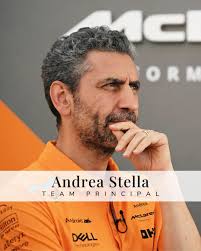
Since taking the reins in late 2022, Stella has orchestrated one of the most remarkable turnarounds in sporting history. From the depths of the midfield to back-to-back Constructors’ titles and a level of engineering dominance not seen since the days of Senna and Prost, Stella has rewritten the playbook . This is the story of how a devout believer in fundamentals, humility, and “human talent” broke McLaren’s 26-year curse.
Table of Contents
ToggleThe Engineer’s Pedigree: From Schumacher to Alonso
To understand current Andrea Stella, one must look at the marble floors of Maranello. Born in Orvieto, Italy, in 1971, Stella is not a product of the corporate boardroom but of the university lecture hall. Holding a PhD in Mechanical Engineering from Sapienza University of Rome, his entry into F1 was purely academic .
His apprenticeship was brutal. Arriving at Ferrari in 2000, he was thrust into the cauldron of the Michael Schumacher era. Working as a performance engineer for the legendary German, and later for Kimi Räikkönen, Stella learned the old-school art of speed. But it was his partnership with Fernando Alonso that defined his early career. As Alonso’s Race Engineer at Ferrari between 2010 and 2014, Stella was the calm voice in the Spaniard’s ear as they chased two near-miss titles against Sebastian Vettel’s Red Bull dynasty .
By the time he followed Alonso to McLaren in 2015, Stella was already a veteran of 92 Grand Prix victories . Yet, he arrived in Woking at a moment of chaos. The “Honda experiment” was failing, the atmosphere was toxic, and the once-proud British giant was becoming a backmarker. For years, Stella worked in the shadows—first as Head of Race Operations, then as Performance Director. He was the fixer, the logistics wizard, but few predicted he would become the leader.
The Political Cleanse: Ending the Blame Game
When Andreas Seidl departed for Sauber in late 2022, McLaren took a massive risk. They promoted internally to Andrea Stella, a man who, by his own admission, was “unsure about taking on that lead role” .
His appointment was met with polite curiosity rather than fear from rivals. Here was a man stepping into the shoes of a legacy, tasked with fixing a fractured culture. At the time, McLaren was infamous for its “political” infighting. As one former staffer noted, the atmosphere was miserable; engineers were looking over their shoulders, protecting their own turf rather than collaborating .
Stella’s first act was not to design a new front wing or hire a superstar aerodynamicist. It was to change the music. Known for his almost serene patience, Stella dismantled the silos of blame. According to Sky Sports pundit Bernie Collins, speaking in 2025, the change has been radical: “They didn’t look like they were having fun. It was political… He has really changed that, you can see it in the guys and girls… When you speak to people about working with him? It’s like he is their leader and they will follow him into any battle” .
This is the “Stella Way.” He leads with a servant’s mentality. In a revealing interview at the 2026 Autosport Awards, Stella was asked what the hardest part of being a Team Principal is. He didn’t mention technical regulations or budget caps. He replied: “I think the hardest bit is making sure that you consider all the possible ways in which you can help the 10,000 people do the best of their job… So I think the most difficult thing is to make sure that you serve this purpose” .
It is a philosophy of empowerment. He creates the container; the talent fills it with speed.
The ‘No Magic Bullet’ Theory
In a sport obsessed with the “silver bullet”—that one illegal suspension or secret engine mode that unlocks half a second—Andrea Stella is the party pooper. And he is winning by being the party pooper.
Throughout the 2024 and 2025 seasons, as the papaya-colored cars swept the grid, Stella repeatedly returned to a specific phrase: No Magic Bullet.
Following the dominant Hungarian Grand Prix of 2025, Stella laid out his gospel. “There’s not much in Formula 1 fundamentals for success that is a magic bullet,” he stated. “It’s really the result of working on the fundamentals” .
What are these “fundamentals”? For Stella, it is a trust in the correlation between the wind tunnel, the CFD (computational fluid dynamics), and the tarmac. It is about understanding why a car is fast, not just that it is fast. While other teams chase concept changes mid-season, often making their cars slower, Stella insists on a strict methodology. He demands that development maps perfectly from the virtual world to the physical track before it is bolted onto the car.
This rigor paid off spectacularly. The 2025 season was a masterclass in consistency. The MCL39 excelled at high-speed Silverstone, low-speed Monaco, and the heat of Qatar. They didn’t have the fastest car at every specific track, but they had the best car overall because Stella refused to let engineers chase a “peak” that broke the “baseline” .
Risk, Reward, and the 2025 Dynasty
Perhaps the most impressive feat of the Stella regime is the engineering bravery he has instilled. In 2025, while defending a championship, most teams become conservative. They try not to lose. Stella did the opposite.
He revealed that McLaren took “engineering risks” that the team had “never done before” . They completely redefined their mechanical packaging, freeing up aerodynamicists to do wild, innovative things with the floor and suspension geometry. They trusted that their development processes—the “fundamentals”—were so robust that even if the risky design initially failed, they could fix it faster than anyone else.
That faith resulted in dominance. By the time the 2025 season reached its conclusion, McLaren had secured the Constructors’ title with six races to spare . The car was so good that it turned the intra-team battle between Lando Norris and Oscar Piastri into the main event, rather than the fight against Ferrari or Red Bull. Managing that dynamic—two alpha drivers hunting a title without crashing—required a specific genius of man-management.
Stella’s approach was to treat them like adults. He set the framework: performance is the only metric; no team orders unless a title is mathematically on the line; respect the papaya. It worked, creating a “relaxed” atmosphere that is almost alien in the pressure cooker of F1 .
Navigating the 2026 Revolution: The Philosopher King
However, a true leader is defined not when things go well, but when they go wrong. The dawn of the 2026 regulations reset the competitive order. The new power units, with their aggressive energy harvesting demands (MGU-K), forced drivers to lift-and-coast in places they never had before. Suddenly, McLaren—the kings of 2025—found themselves struggling to match the works teams (Mercedes and Ferrari) who had designed their engines and chassis in perfect unison.
True to form, Stella did not panic. He did not lash out at the FIA. Instead, he defended the soul of the sport while relentlessly pursuing the fix.
In early 2026, as pundits worried that F1 had become an “energy-saving” competition, Stella pushed back. “I think what we have seen… definitely confirms that it is the ultimate challenge,” he said, noting that the new cars slide more, putting driving skill back to the forefront .
But words are cheap; results matter. In April 2026, Stella laid out the roadmap. He admitted that McLaren was playing catch-up because they had focused on a “healthy platform” for the MCL40 rather than a brittle, fast-out-of-the-box machine. He announced a massive upgrade package for Miami and the signing of top engineer GianPiero Lambiase from Red Bull to revamp the trackside operations .
Once again, he reverted to his core message: “It may take time, but we have everything it takes to succeed once again.” This is the mantra of the modern McLaren. There is no desperation in Woking, only data.
Conclusion: The Last Engineer Standing
In an era where social media followers often dictate value, Andrea Stella is a relic of a better time. He is an engineer who leads not by charisma, but by competence; who fixes cars by fixing the culture.
He has taken McLaren from a team that “looked like they weren’t having fun” to the destination for every top driver and engineer in the world . Zak Brown, the CEO of McLaren Racing, called his impact “profound,” crediting him with developing a “culture and mindset” that has allowed the team to look forward rather than back .
For fans of the sport, Andrea Stella represents hope. He proves that in a sport increasingly dominated by spreadsheet warfare, the human element still reigns supreme. He proves that if you get the fundamentals right—the airflow, the tires, the trust among the 10,000 people—the victories will follow.
As McLaren fights to reclaim the top step in the new 2026 era, one thing is certain: their leader will not be looking for a miracle. He will be looking at the data, holding his clipboard, quietly confident that the process will save them.
The revolution at McLaren is not loud. It is, in fact, very, very quiet. And it is winning