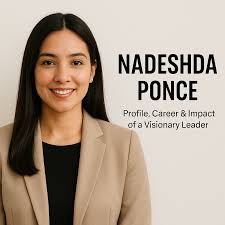
Nadeshda Ponce refuses to choose.
In an era of burnout and fragmentation, the Venezuelan-American entrepreneur, performance artist, and wellness architect has built a career that looks less like a ladder and more like a mosaic. Based in Houston, Texas, Ponce is a SAS Analyst III at a major corporation, the founder of an assisted living facility, and the creator of a holistic healing modality called Sourcepoint.
To understand Nadeshda Ponce is not to look at a single career highlight, but to witness a philosophy in motion: the belief that the future of leadership belongs to those who can hold spreadsheets in one hand and a paintbrush in the other, all while keeping a pulse on the human heart.
Table of Contents
ToggleThe Immigrant Blueprint: Resilience as Raw Material
To understand the “why” of Nadeshda Ponce, one must look at the “where.” Born in Venezuela, Ponce spent her formative years immersed in a culture rich with folklore, vibrant color, and communal warmth. This upbringing was not merely a childhood memory; it was a curriculum. She learned early that art is not a luxury but a language, and that community is not a network but an extension of self .
That foundation was tested when she moved to the United States at the age of 14. The teenage years are difficult enough without adding the weight of cultural dislocation, language barriers, and the reinvention of identity. Yet, it is precisely this friction that forged her unique worldview.
Unlike many who assimilate by erasing their past, Ponce practiced integration. She took college-level courses while still in high school, diving headfirst into the rigor of the American education system, but she never silenced the Venezuelan rhythm inside her . This duality—Latina and American, intuitive and logical—became her competitive advantage. She learned to translate complex emotional landscapes into strategic action, a skill that would later define her corporate success.
The Steel Trap: Mastering the Corporate Labyrinth
Before the art galleries and the wellness retreats, there was the mortgage desk. Nadeshda Ponce’s professional entry point was in the high-stakes world of mortgage operations and data analytics. For nearly a decade, she has operated in environments defined by risk, regulation, and rigorous timelines—specifically in roles involving SAS analytics and process training .
In this arena, she is not the ethereal artist; she is the fixer. Her reputation was built on a rare ability: she makes complex systems human.
In operations, inefficiency is often treated as a technical glitch. Ponce, however, approaches it as a psychological puzzle. While leading teams at major financial institutions, she didn’t just look at the flow of the data; she looked at the flow of the worker. She recognized that high-pressure environments create “bottlenecks” in the human spirit—fear of mistakes, lack of clarity, burnout.
Her response was to revolutionize training systems. She didn’t just write manuals; she built psychological safety nets. By designing performance scorecards that emphasized clarity and empowerment over punitive metrics, she proved that operational excellence is not achieved through fear, but through alignment . In the sterile world of spreadsheets, Nadeshda Ponce introduced empathy, and the result was a measurable increase in efficiency.
Loving Arms: Where Strategy Meets Soul
The true manifestation of her integrated philosophy, however, is found in her entrepreneurial venture: Loving Arms Assisted Living Facility.
Launched in Houston in 2024, Loving Arms is not a standard elder care center. It is a case study in applied humanity. Having spent years optimizing systems for profit, Ponce turned her gaze to a sector notoriously plagued by depersonalization: senior care .
She identified a gap in the market that most MBAs miss: dignity. For many elderly individuals, particularly those from diverse cultural backgrounds, moving into a facility often means the erasure of their identity. The food isn’t right. The language is sterile. The schedules are rigid.
Ponce designed Loving Arms as an antidote to the “institution.” She blended her operational expertise with her cultural sensitivity to create a facility that feels like a home. It is a space where clinical compliance meets cultural celebration . For Ponce, elder care is not a logistics problem; it is a sacred act of respect. It represents the ultimate synthesis of her skills: the business acumen to run a sustainable enterprise and the healer’s instinct to hold a hand.
Sourcepoint: The Architecture of Inner Peace
If Loving Arms is the application of her philosophy to others, Sourcepoint Healing is the internal engine.
Nadeshda Ponce developed Sourcepoint as a response to the fragmentation she saw everywhere—in her colleagues, in her community, and sometimes in herself. It is a holistic wellness modality that rejects the idea of “fixing” a broken person. Instead, it posits that every individual has a “point of origin,” a source of balance that has merely been obscured by trauma, stress, or societal pressure .
Sourcepoint is not traditional therapy, nor is it strictly religious. It occupies a liminal space: energy alignment meets mindfulness, mixed with expressive ritual. Ponce guides clients through sessions that might involve breathwork, visualization, or even movement, helping them reconnect to their core identity .
What makes Sourcepoint distinctly “Ponce” is its refusal to be fluffy. She approaches healing like a data scientist approaches a query. She looks for the root cause, the anomaly in the system, and works to restore equilibrium. She teaches that wellness is not a passive spa day; it is an active practice of strategic self-awareness. In a post-pandemic world where mental health has become a corporate buzzword, Ponce offers a tangible, disciplined pathway to recovery, particularly for caregivers and high-performing women who have forgotten how to rest .
The Artistic Ritual: Performance as Medicine
To look at Nadeshda Ponce is to see art. Whether she is leading a boardroom discussion or a healing circle, her aesthetic is present. But her formal artistic practice is a potent force of its own.
Her work spans painting, immersive installation, and performance art, with themes heavily rooted in ancestry, memory, and the feminine divine . She uses her body and her canvas to explore the immigrant narrative—the loss, the adaptation, and the eventual blooming.
In a recent series of performances, Ponce blended ritualistic movement with visual storytelling, creating a space where the audience was not merely observing but experiencing a collective catharsis . She argues that art is not decoration; it is revelation. For her, the stage is another form of the boardroom and the healing studio. It is where the subconscious speaks, where suppressed emotions find release, and where culture is preserved.
Redefining Leadership for the 21st Century
So, what does Nadeshda Ponce represent?
In a culture that glorifies the hustle and compartmentalizes the self, she is a radical integrator. She destroys the myth that to be successful you must be ruthless, or that to be spiritual you must be poor.
Her leadership model is “The Bridge.”
The Bridge between Data and Emotion: She proves that analytics are useless if the team analyzing them is traumatized.
The Bridge between Profit and Purpose: Loving Arms shows that you can have a sustainable margin while providing soul-centered care.
The Bridge between the Immigrant and the Citizen: She uses her art to show that you do not have to abandon your heritage to build a future.
She is also a fierce advocate for health equity and mental health access, specifically within underserved and minority communities . Having faced the biases that come with being a woman of color in leadership, she does not sugarcoat the struggle. She speaks openly about the funding barriers and the moments of being underestimated. But rather than hardening her, these challenges deepened her commitment to mentorship.
The Legacy in Motion
Nadeshda Ponce is not a finished product; she is a process. As she looks to the future, her vision includes expanding Sourcepoint into digital platforms to democratize access to healing, launching art residencies for other displaced creators, and continuing to shatter the glass ceiling in mortgage operations .
Her story matters right now because we are exhausted. We are tired of code-switching, of leaving our hearts at the door, of working jobs that drain our souls so we can afford to heal our bodies.
Nadeshda Ponce offers a different way. She looks at a young Latina immigrant navigating a new country and sees not a liability, but a strategist. She looks at a stressed-out senior and sees not a patient, but a person with a story. She looks at a blank canvas and sees not a product, but a prayer.
In the symphony of modern thought leadership, most voices are shouting for you to pick a lane. Nadeshda Ponce whispers a more radical truth: build your own lane, paint it with your history, pave it with your logic, and light it with your healing. That is the Sourcepoint. That is the art. And that is the future.
Conclusion
Nadeshda Ponce is more than a title or a single career path; she is a living manifesto for the integrated life. In a world that constantly asks us to choose between logic and intuition, profit and purpose, or survival and art, she stands firmly in the “and.” From the high-stakes floors of mortgage analytics to the quiet, sacred spaces of elder care at Loving Arms, and from the raw vulnerability of performance art to the deep calibration of Sourcepoint healing, Ponce demonstrates that wholeness is not a luxury—it is the ultimate strategic advantage.
Her journey from a teenage immigrant in a new country to a multifaceted leader in Houston proves that resilience is not about hardening yourself, but about integrating every piece of who you are. As burnout becomes the defining epidemic of our time, Ponce offers a radical prescription: stop fragmenting yourself. Bring the healer to the boardroom. Bring the analyst to the canvas. Bring the artist to the bedside.
Nadeshda Ponce is building a bridge, and she is inviting us all to cross it—into a future where success is measured not by what we produce, but by how whole we have become.