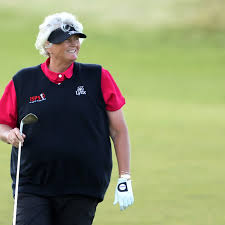
For over four decades, the woman from Coventry has been a force of nature: a long-drive hitter who could outmuscle courses designed to contain men, a globetrotter who planted the flag for European women’s golf on every continent, and a fierce competitor whose emotional honesty—both the fire and the frustration—made her one of the most beloved figures in sports history.
When she was made a Dame Commander of the Order of the British Empire (DBE) in the 2014 Birthday Honours, it was not merely a recognition of her victories, but an acknowledgment of her services to women’s golf. She didn’t just play the game; she broke its rules, changed its constitution, and dragged the sport into a modern era of athletic power.
Table of Contents
ToggleThe Origin Story: Beating the Boys
Every legend has a starting point. For Davies, it was the Corinthian spirit of sibling rivalry. Growing up in Surrey, she watched her older brother, Tony, play golf. Like most younger siblings, she wanted to beat him at his own game. Unlike most, she “dusted” him by the time she was 16.
Starting relatively late at 14, Davies possessed a raw, uncoached power that was rare for the women’s game in the late 1970s. She stood 5 feet 10 inches tall, but it wasn’t just her height; it was the leverage and the violence of her swing that set her apart. Where other golfers relied on finesse and delicate touch, Dame Laura relied on the “grip it and rip it” mentality. She left school to pursue the game, taking odd jobs to finance a career that would redefine the limits of female athleticism.
The Victory That Changed the LPGA Forever
The year 1987 is a watershed moment in golf history, not just for the trophy, but for the bylaws. As a 23-year-old non-member, Davies arrived in the United States for the U.S. Women’s Open at Plainfield Country Club. She was, effectively, an outsider looking in.
In an 18-hole playoff against the legendary JoAnne Carner and Japan’s Ayako Okamoto, Davies powered her way to victory. It was a stunning display of power. But the aftermath was even more revolutionary than the swing.
At the time, the LPGA had strict membership criteria. Davies was a member of the Ladies European Tour (LET), but not the American circuit. Her victory created a legal loophole. Rather than let her slip away, the LPGA changed its constitution to grant automatic membership to any non-member who won the U.S. Women’s Open.
This is known as the “Laura Davies Rule.” It opened the floodgates for international talent, ensuring that the best players in the world, regardless of their home tour, had immediate access to the LPGA’s biggest stage.
The Globetrotter: Winning on Five Continents
If the 20th century belonged to American dominance in women’s golf, the late 80s and 90s belonged to Davies’ passport. In 1994, she achieved a feat that has never been matched: she won official tournaments on five different continents in a single calendar year—Europe, Asia, Japan, Australia, and the United States.
She wasn’t just traveling; she was dominating. While many players complained about jet lag, Davies seemed to thrive on the chaos. She would fly from a windy links course in Britain to the humid heat of Japan, adjust overnight, and shoot under par. She holds the record for the most Ladies European Tour wins (45) and is the only player to have won the LET Order of Merit seven times, spanning from 1985 to 2006.
The Power Game: Breaking the “Gentle” Mold
To understand Davies, one must understand the aesthetic of her play. In an era where women’s golf was often marketed around grace and poise, Davies was a swashbuckler. She once equaled the LPGA record with a round of 62 at the 1991 Rail Charity Classic.
She was the first woman to compete in a men’s European Tour event, playing the 2004 ANZ Championship in Sydney from the same tees as the men. She didn’t go there for a novelty show; she went to test her length against the boys.
But power is a double-edged sword. Early in her career, Davies was known as the “roller coaster of golf” . The same aggression that produced eagle putts also produced spectacular mistakes. Yet, perhaps her greatest victory was mental. Flying from Japan to the US in 1993, she realized she was “whining a bit too much.” She decided on the spot to stop blaming bad luck. “If you don’t hit a good shot it’s down to you,” she reasoned.
The result of that mindset shift? She won the tournament that week. She had learned to marry her physical power with emotional stability, making her virtually unbeatable for the next decade.
The Heart of the Solheim Cup
No conversation about Laura Davies is complete without the Solheim Cup. She is not just a participant; she is the soul of the event. Davies is the only player to have appeared in the first 12 Solheim Cups from 1990 to 2011.
She holds the record for the most points scored in the history of the competition: 25. In the white-hot pressure of team match play, where national pride trumps personal paychecks, Davies thrived. The image of her fist-pumping, striding down the fairway with her cousin Matt Adams on the bag, is seared into the memory of European golf fans.
She has served as a non-playing assistant captain in recent years, passing the torch to a new generation of European stars like Leona Maguire and Charley Hull—players who grew up watching Davies smash drivers over doglegs.
Breaking the Glass Ceiling at St. Andrews
Golf has always been a sport obsessed with tradition, often to a fault. The Royal & Ancient Golf Club of St Andrews—the very “Home of Golf”—infamously did not admit female members for 260 years.
In February 2015, that ancient wall finally cracked. Davies was announced as one of the first seven female Honorary Members of the R&A, joining legends like Annika Sorenstam and Louise Suggs. It was a symbolic, seismic shift. For a woman who had spent her career being told she was “too strong” or “too aggressive,” being welcomed into the most exclusive men’s club in the world was the ultimate vindication.
The Legend of the Senior Slam
While many athletes fade into the background after 50, Davies refused to ride gently into that good night. In 2018, at the age of 55, she did something remarkable.
First, she finished runner-up on the regular LPGA Tour at the Bank of Hope Founders Cup, shooting a stunning 63. It proved that even in her mid-fifties, she could still rattle the cages of the youngsters.
Then, she accomplished the “Senior Slam.” She won the inaugural U.S. Senior Women’s Open by a staggering 10 shots. Later that year, she won the Senior LPGA Championship. She became the first woman to hold both senior major titles simultaneously.
The Human Side: An Unfiltered Icon
In an age of robotic, corporate-approved athlete interviews, Laura Davies remained gloriously, unfilteredly herself. She famously won the ASAP Sports/Jim Murray Award in 2013 for her “cooperation, quotability and accommodation with the media.”
She never hid her emotions. If she hit a bad shot, you knew it. If she was hungry for a steak and a beer rather than a kale salad, she said so. This authenticity made her relatable. She wasn’t a manufactured princess of golf; she was a working-class hero who happened to have a Hall-of-Fame swing.
Why Dame Laura Davies Matters Today
As of 2025 and beyond, the women’s game is dominated by power hitters. Nelly Korda swings aggressively, Charley Hull bombs it down the fairway, and the average driving distance on the LPGA has skyrocketed.
They are all, in a sense, walking in the footsteps of Laura Davies. Before the modern fitness regimes and sports science, there was a woman from England who showed that brawn and brains could coexist on the fairway.
Her legacy is not just the 87 trophies in the cabinet or the four major championships on the shelf. It is the LPGA rule change that welcomed the world. It is the record-breaking points tally in the Solheim Cup. It is the sound of a driver hitting a ball 300 yards at a time when people said women couldn’t.
Dame Laura Jane Davies remains what she has always been: a pioneer, a powerhouse, and a proper sporting legend. She didn’t just play the game; she bent it to her will and made it bigger on the way out.
Conclusion
In the end, Dame Laura Davies is more than a sum of her 87 victories or four major titles. She is the bridge between an era of gentle finesse and the modern age of athletic power. She was never the polished, scripted icon; she was the real deal—a competitor who wore her heart on her sleeve, drove the ball farther than anyone thought possible, and shattered glass ceilings with every swing.
From changing the LPGA’s constitution to becoming the soul of the Solheim Cup, her fingerprints are all over modern women’s golf. As a new generation of power hitters lines up their drives, they do so standing on the shoulders of the woman from Coventry who proved that in golf, as in life, there is no substitute for raw, fearless authenticity. Long may she stride