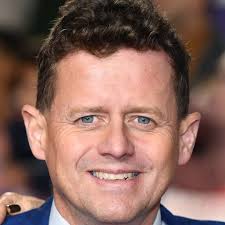
While his colleagues sit behind desks in immaculate suits, discussing transfer fees and league tables, Mike Bushell is usually upside down. He might be covered in mud, wrapped in bubble wrap, or falling off a horse live on air. In an era of sanitized, risk-averse television, Bushell remains gloriously, spectacularly accident-prone. He is not just a reporter; he is the crash-test dummy of the BBC Sport department—and we cannot look away.
Table of Contents
ToggleThe Renaissance Man Who Took the Scenic Route
To understand the enigma of Mike Bushell, one must first understand that he never intended to be the “pool guy.” Born in Hitchin, Hertfordshire, in December 1965, Bushell spent his teenage years in Yorkshire . He wasn’t the jockish sports prodigy one might expect. In fact, his early life suggested a future in the arts rather than athletics.
As a child, Bushell wrote an opera at the age of eleven. Yes, an opera . He was a member of the National Youth Theatre, harboring dreams of treading the boards as a classical actor. Later, while studying Drama and Television at King Alfred’s College in Winchester, his life took a turn that has defined his freewheeling career. To pay off debts, he took a job at a local newspaper, the Hampshire Chronicle. “I was hooked by the journalism bug,” he later recalled .
But the stage still beckoned. For a time, Bushell toured Europe as the lead singer of a rock band called Don’t Push the River . It is a bizarre, non-linear path: actor, rock star, local reporter, and eventually, the face of BBC Sport. It is this unlikely hybrid—the showmanship of an actor and the curiosity of a journalist—that makes his presenting style so unique. He isn’t reading a script; he is performing a stunt, often literally.
The “Bushell’s Best” Philosophy: Trying Everything Once (And Falling Over)
The cornerstone of Bushell’s fame is his long-running Saturday morning feature. The premise is deceptively simple: Mike tries a sport he has never done before to encourage the “couch potato” audience to get active. However, the execution is where the magic happens.
He holds a world record, not for winning, but for participating. As of 2025, he has attempted over 550 different sports . The list is a fever dream of human physical expression. It includes, but is not limited to:
Zorbing (rolling down a hill in a giant inflatable hamster ball) .
Shin Kicking (exactly what it sounds like) .
Quidditch (the fictional sport from Harry Potter, played with brooms between the legs) .
Worm Charming (trying to coax worms out of the ground through vibration) .
Swamp Soccer (football played in a bog) .
Bushell’s “Bushell’s Best” segment is built on a radical vulnerability: he is terrible at sports. He doesn’t try to hide it but leans into the awkwardness. He has sailed with Sir Ben Ainslie (and likely got seasick), played tennis against Novak Djokovic (and likely didn’t return a single serve), and even raced in a 60-meter Grand Prix against elite sprinters, finishing dead last with a time of 9.27 seconds .
His mission statement is refreshingly anti-elitist: “To inspire people off the sofa.” He maintains that there is a sport for everyone, regardless of ability . In a society obsessed with winning, Mike Bushell champions the noble art of showing up and looking silly.
The Infamous Pool Incident: When Virality Strikes
If you ask the average person on the street to name a Mike Bushell moment, they won’t mention a specific scoreline or an interview with a football manager. They will mention the pool.
On April 11, 2018, during the Commonwealth Games on Australia’s Gold Coast, Bushell was conducting a live interview with English swimming star Adam Peaty . Standing on a narrow pool deck, microphone in hand, Bushell took a confident step backward. The only problem was that there was no deck behind him.
In a slow-motion disaster that was broadcast live to millions, Mike Bushell vanished backward into the water with a tremendous splash. Unlike a trained stuntman, he did not emerge gracefully. He flailed. His expensive microphone sparked and died. As he desperately tried to scramble out, his professionalism evaporated, replaced by the sheer, wet panic of a man in a suit who just fell in a pool .
The clip was not just a hit; it was a supernova. It was shared over 11 million times in a single day . It became a global meme. Yet, true to form, Bushell didn’t hide in shame. He laughed at himself. The incident cemented his status as the nation’s favorite broadcasting blunderer, turning a moment of humiliation into a brand-defining triumph.
Strictly Come Dancing: The Dad Dancer Dances On
In 2019, Bushell introduced himself to an entirely new generation. At 53 years old, he joined the cast of Strictly Come Dancing . The bookies’ odds were not in his favor. He was labeled the “dad dancer” of the series—stiff, lanky, and untrained, paired with the fiery professional Katya Jones.
The nation expected him to be the first to go home. Instead, Mike Bushell survived week after week, landing in the dreaded “dance-off” three times but defying elimination through sheer grit and the public’s vote .
He described dancing as “physically and mentally the most extreme sport I’ve tried,” which is saying something for a man who has played underwater hockey . The partnership with Katya Jones produced some of the most bizarrely joyful moments in the show’s history, including a Tango performed in a rabbit costume and a lift where Jones’ skirt ended up wrapped around Bushell’s head .
When he was finally eliminated (finishing a respectable 7th out of 15), he didn’t hang his head. He turned the Elimination Dance into a massive Conga line, pulling the judges, hosts Tess Daly and Claudia Winkleman, and even the other competitors onto the dance floor . It was the ultimate Mike Bushell move: turning defeat into a party.
The Man Behind the Mishaps
Perhaps the most endearing quality of Mike Bushell is that he is not a character; he is genuinely that enthusiastic. Off-screen, his life is a continuation of his on-screen persona.
He is a devoted father of three daughters, a runner with the Hash House Harriers (a drinking club with a running problem), and a famously passionate supporter of Leeds United . His personal life has seen its share of ups and downs; he divorced his first wife, Kim Payne, in 2009 after 16 years of marriage, and married Emily Bond in 2019 .
Even his side hustles are interesting. He made his pantomime debut in Aladdin as a sports reporter , appeared on Celebrity Mastermind, and even participated in a Children In Need special of I Can See Your Voice, where the panel correctly guessed he was the “bad singer” . (Given his rock band history, one might assume he can sing, but apparently, the past is the past).
Why Mike Bushell Matters
In the modern media landscape, authenticity is the rarest currency. Most presenters are too polished, too guarded. They fear the internet’s wrath if they make a mistake. Mike Bushell operates in the opposite gear.
He is the antidote to the “perfect influencer.” He spills the coffee, falls in the pool, and gets beaten by teenagers in running races. He shows that exercise can be funny, that failure is survivable, and that trying something new is its own reward.
As he continues to present BBC Breakfast and dabble in everything from padel tennis to pickleball , Mike Bushell stands as a testament to the fact that you don’t have to be the best to be a broadcaster. You just have to be the most willing to try.
Long may he fall over.
Key Fast Facts: Mike Bushell
Born: December 11, 1965 (Age 59)
Job: BBC Sport Presenter (BBC Breakfast)
Claim to Fame: Trying over 550 sports; Falling in a swimming pool on live TV.
Strictly Result: 7th place (Series 17) with Katya Jones.
Hidden Talent: Former Rock Band Lead Singer and National Youth Theatre Actor.
Conclusion
In a broadcasting era dominated by slick production and risk-averse personalities, Mike Bushell remains a gloriously unpredictable outlier. He is not the fastest, the strongest, or the most graceful person on television—but he is undoubtedly the bravest. Whether he is sinking to the bottom of a swimming pool live on air, attempting his 550th obscure sport, or conga-lining his way off a Strictly elimination, Bushell embodies a simple, powerful truth: joy is found not in winning, but in the willingness to try.
He is more than a sports presenter; he is a national treasure who reminds us that it is okay to fall—as long as you get back up with a smile and a soggy microphone. Long may his delightful chaos continue