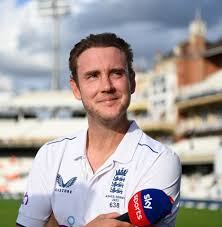
Yet, to define Stuart Broad by the digits on his passport is to miss the point entirely. The number “38” is not a sign of decay; it is a badge of alchemical mastery. While other bowlers lose a yard of pace or a degree of aggression, Broad has done something unprecedented in the modern era: he has weaponized his age.
This is not a story about a veteran hanging on. This is a story about a predator who learned that the deadliest weapon isn’t a 90mph yorker—it’s experience wearing a different jersey.
Table of Contents
ToggleThe Awkward Adolescence: Young, Raw, and Reckless
To appreciate the nuance of Stuart Broad’s age today, we must rewind to the painful, lanky beginning. When a 21-year-old Broad made his Test debut against Sri Lanka in 2007, he was all elbows and knees. The “Stuart Broad age” conversation then revolved around immaturity. He was a batting all-rounder who bowled, or a bowler who batted—nobody was quite sure.
In those early years, youth was a liability. He was brutally expensive. The infamous 2007 T20 World War against Yuvraj Singh, where he conceded six sixes in an over, was the crucible. A younger man might have shattered. But here is the secret about Broad’s relationship with time: he is a slow-burn learner. He doesn’t adapt overnight; he assimilates.
At 22, he was dropped. At 24, he took a career-best 6/91 but was still inconsistent. The narrative was fixed: a talented but fragile posh boy from Nottinghamshire. Fast forward to 2015, and at 29, he was winning the Ashes almost single-handedly with 8/15 at Trent Bridge. That was the turning point. The “Stuart Broad age” narrative shifted from “when will he mature?” to “how long can he last?”
The Physiology of Longevity: How 38 Looks Like 28
The first thing you notice watching Broad bowl in 2024 is the lie. The data says 38. The eye test says 28. How?
Let’s talk about the bio-mechanical evolution. Most fast bowlers decline because their action relies on elasticity—the coiled spring of the lower back. Broad suffered a horrific broken nose and a torn calf muscle in his early 30s. Conventional wisdom suggested retirement. Instead, he rebuilt his action like a retired watchmaker.
At 35, Broad underwent what experts call a “kinetic chain overhaul.” He shortened his run-up. He stopped trying to bowl thunderbolts. He realized that at his age, precision beats power, and timing beats speed. His ankle angle at delivery, the torque of his hip rotation—all fine-tuned to reduce stress on a 38-year-old frame.
Statistically, the average fast bowler retires at 32. The drop-off after 34 is a cliff. Yet, in 2023, at the age of 37, Stuart Broad took 103 wickets across all formats. He was the leading wicket-taker in the Ashes series, averaging a stunning 25.33 against Australia’s finest.
This is not luck. This is a man who stopped eating breakfast cereals and started treating his body like a Formula 1 car. He famously gave up gluten. He prioritized sleep over nightlife, a shift that came naturally as his age increased and his priorities clarified. The irony is that by acting his age (mature, disciplined, strategic), he physically reversed it.
The Mental Ascent: Cunning as a Vintage Wine
If the body is the engine, the mind is the steering wheel. And this is where “Stuart Broad’s age” becomes a terrifying variable for opposition batters.
Young Stuart Broad was emotional. You could see the frustration. You could bounce him with verbals. Stuart Broad at 38 is a stone-cold poker player. He has seen every mode of dismissal. He has watched David Warner nick off to the same corridor of uncertainty 17 times. He has analyzed Shane Watson’s LBW reviews in his sleep.
Consider the 2023 Ashes. At 37, Broad wasn’t just bowling; he was orchestrating. He baited Alex Carey into a hook shot knowing the deep square boundary was long. He set fields based on dreams he had the night before. There is a famous stump mic recording where Broad says to Marnus Labuschagne: “I’ve got you out three times in the last two years. You know what’s coming. You still can’t stop it.”
That is the voice of age. It is not arrogance; it is accrued intelligence.
Neuroscience tells us that procedural memory—the kind used for bowling a perfect outswinger—does not degrade with age. It improves. The neural pathways for “hitting the top of off stump” become super-highways. The only thing that ages poorly is reaction time. But Broad doesn’t need to react. He forces the batter to react to him. By 38, he has turned the game from a physical duel into a chess match. And chess favors the greybeard.
The Transformation of the “Broad Face”
If you type “Stuart Broad age” into Google, the image results are fascinating. You see two distinct men. The 2010 version: curly hair, a pubescent beard, a look of wide-eyed hope. The 2024 version: chiseled jaw, a salt-and-pepper scruff, and eyes that look like they have seen war.
That face tells the story of 167 Test matches. It has been smashed by a bouncer from Varun Aaron. It has contorted in agony after dropping a catch at The Oval. It has smiled wickedly after dismissing Steve Smith for the 15th time.
But the most important feature is the “send-off.” In his 20s, Broad’s send-off was emotional, often crossing the line into petulance. At 38, he doesn’t need to scream. He simply walks toward the departing batter, stares at them for a beat too long, and turns away. That silence is heavier than any expletive. Age has taught him that psychological warfare is most effective when it is calm.
The Career Arc No One Predicted
Let’s run the timeline, because the career trajectory of Stuart Broad defies every actuarial table.
Age 21-26 (2007-2012): The Volatile Apprentice. Inconsistent. Dropped twice. Considered a white-ball specialist who couldn’t crack red-ball cricket.
Age 27-31 (2013-2017): The Enforcer. Took 300 wickets. Became a leader. The Ashes winner. The peak “mean” fast bowler.
Age 32-36 (2018-2022): The Phoenix. Suffered a ruptured calf and a severed tendon. Written off by pundits. Returned slower but smarter. Took 6/31 against New Zealand.
Age 37-38 (2023-2024): The Oracle. The greatest statistical phase of his career for economy rate and average. Became the first seamer to take 600 wickets without a 10-wicket haul (spreading the love, he says).
The final phase is the anomaly. While his peers (Mitchell Johnson, Dale Steyn) were commentating, Broad was out-bowling men ten years his junior. The “Stuart Broad age” debate in 2023 wasn’t “Can he still play?” It was “Is he getting better?”
The Australian Nexus: Rivalry as a Preservative
It is impossible to discuss Broad’s longevity without discussing Australia. Specifically, David Warner. Warner vs. Broad is the most statistically one-sided rivalry in modern Test history. Warner averages under 10 against Broad.
Why does this matter for age? Because a clear, burning vendetta keeps you young. At 38, motivation can wane. You have the money, the cars, the legacy. But walking out at Lord’s to see Warner take guard? That injects adrenaline into a 38-year-old heart that no gym session can replicate.
Broad has admitted he studies the Australian batting lineup like a doctoral thesis. “Age gives you patience,” he said in a 2024 interview. “When you are 25, you want to take a wicket every ball. At 38, you are happy to bowl six balls in the same spot, watch the batter get bored, and strike on the 37th ball of the spell.”
That is the maturity of the 38-year-old brain: delayed gratification. In a world of T20 slogs and instant gratification, Broad has become a monk of metronomic line and length.
The Business of Being Broad
Let’s talk about the elephant in the room: The Hundred, IPL, and franchise cricket. Why isn’t a 38-year-old Broad chasing the million-dollar contracts?
Because Stuart Broad’s age has taught him value. In his 20s, he wanted every format. In his 30s, he realized that Test cricket is his cathedral. He famously withdrew his name from the IPL auction multiple times. He took a pay cut to rest his body for England.
This is the wisdom of the veteran. He knows that at 38, you cannot serve two masters. You cannot fly economy to Dubai, bowl four overs in a T20, fly back to London, and then expect to swing the Dukes ball at 8:30 AM at Headingley. By abandoning the noise of franchise cricket, Broad preserved the purity of his craft. His age forced a choice, and he chose legacy over liquidity.
The Science of the Slipped Catch
One of the most poignant moments in the “Stuart Broad age” narrative happened in 2022. He dropped a simple catch at fine leg. The crowd groaned. The younger players looked at the floor. Broad smiled.
He later revealed that his eyesight had begun to degrade slightly. He started wearing contact lenses. Instead of hiding it, he made it a joke. “Old man eyes,” he called it.
This vulnerability is the secret weapon. He stopped pretending he was 25. He accepted the deterioration of the body while simultaneously out-thinking the deterioration. He moved closer in the field. He adjusted his diving trajectory. He realized that at 38, you don’t compete on physicality alone; you compete on adaptation.
The Legacy Question: When is the End?
As of mid-2024, the question isn’t “Stuart Broad age?” but “Stuart Broad farewell?” The sporting world expected him to retire after the 2023 Ashes. He didn’t. He took 11 wickets in the following series against India.
He has stated he wants to retire on his own terms, possibly at The Oval, his home ground. But here is the cruel paradox of age: you are always one injury away from the end. A 38-year-old hamstring does not heal like a 28-year-old hamstring.
Yet, watching him bowl, you get the sense that he is playing with house money. Every wicket after 600 is a bonus. Every over is a gift. He has become an elder statesman, mentoring the likes of Ollie Robinson and Josh Tongue, teaching them the art of the wobble-seam delivery.
Redefining “Old” in Fast Bowling
Before Stuart Broad, the gold standard for longevity was James Anderson (his teammate, still playing at 41). But Anderson is a metronome; a biomechanical freak. Broad is different. Broad is a competitor. He is the grinder. He is the man who has taken more catches as a non-wicketkeeper than anyone in history (because he bowls, then fields at slip).
The “Stuart Broad age” conversation forces us to redefine the shelf life of a fast bowler. We used to think 35 was ancient. Broad is showing that 38 is the new 28, provided you have the IQ to match the miles.
He has normalized the idea that a fast bowler can have a second peak in his late 30s. He has destroyed the myth of the inevitable decline. Yes, he is slower. He bowls 78-82mph now, not 87mph. But in 2024, speed is a vanity metric. Wickets are the currency. And Broad is still cashing checks.
The Verdict: Age as Art
So, what is the answer to the query “Stuart Broad age”? On paper, he is 38. In the dressing room, he is the “dad” of the pace attack. On the field, he is the alpha wolf. In the history books, he is the second-most successful fast bowler England has ever produced.
But the truest answer is this: Stuart Broad’s age is irrelevant. It is a red herring. Because he has constructed a game that exists outside the tyranny of time. He has built a citadel of cunning, hard work, and spite. He has proven that while a fast bowler’s body is a rental, his mind is a freehold.
As he runs in to bowl under a grey English sky, the crowd holds its breath. They aren’t watching a 38-year-old trying to survive. They are watching a master craftsman proving that the older the fiddle, the sweeter the music. And for as long as Stuart Broad chooses to play, we should be grateful that age is just a number—and a terrifying one for batters, at that.
The final word? Don’t count the candles on his birthday cake. Count the stumps he keeps breaking. That number tells the real story
Conclusion
In the end, the question of “Stuart Broad age” is less a numerical fact and more a masterclass in defiance. At 38, he stands as a living rebuttal to every sporting axiom that claims fast bowlers have a sell-by date. He has not simply survived; he has evolved, sharpened, and thrived. By trading raw pace for pinpoint precision, youthful ego for veteran cunning, and reckless aggression for calculated psychological warfare, Broad has redefined what it means to grow old in elite sport.
His age is no longer a limitation whispered about in commentary boxes—it is a headline, a warning, and a legacy all at once. So long as he continues to sprint in with the Dukes ball in hand, one truth remains unshakable: Stuart Broad isn’t aging. He is ascending.