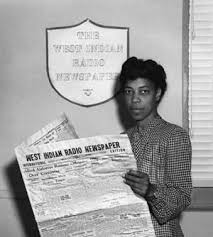
For decades, her name lay dormant. But as of April 2025, thanks to a new English Heritage Blue Plaque adorning her former London home and a resurgence of academic interest, Una Marson is finally stepping out of the shadows and into the light where she belongs.
Table of Contents
ToggleThe Making of a Firebrand (1905–1932)
To understand the revolutionary nature of Marson’s work in London, one must first look at the soil from which she grew. Born on February 6, 1905, in the rural parish of St. Elizabeth, Jamaica, Una Maud Victoria Marson was the daughter of a Baptist parson. Unlike many colonial subjects who internalized the supremacy of the “Mother Country,” Marson was taught to read and write with a sense of her own value.
She devoured English classical literature, but her identity remained rooted in the Jamaican soil. After her father’s death, the family moved to Kingston, where young Una entered the workforce. It was here that her ferocious ambition became undeniable. In 1928, at just 23 years old, she became a pioneer: Jamaica’s first female editor and publisher. She launched a magazine called The Cosmopolitan.
In an era when women, particularly Black women, were expected to be seen and not heard, The Cosmopolitan was a weapon. Marson used its pages to advocate for women’s entry into the workforce, to discuss workers’ rights, and to critique the social stagnation of the island. She wasn’t just reporting the news; she was agitating for a new world order.
By 1930, she had published her first poetry collection, Tropic Reveries, winning the prestigious Musgrave Medal from the Institute of Jamaica. Yet, she felt confined. The island was too small for her dreams. In 1932, she boarded a ship for London, seeking a broader audience. She had no idea that she was sailing directly into the eye of the storm.
The Shock of the Mother Country (1932–1939)
The London that Una Marson encountered was not the “mother country” of her childhood imagination. It was a cold, grey, and brutally racist metropolis. She had experienced class and color hierarchies in Jamaica, but the visceral shock of the British color bar was devastating.
She struggled to find work. She was spat at in the streets. She found refuge in the home of Dr. Harold Moody, the founder of the League of Coloured Peoples (LCP). It was within this activist hub that Marson’s political awakening accelerated.
Her poetry during this period shifted dramatically. The romantic verses of Tropic Reveries gave way to a harder, angrier, more radical voice. In 1933, she wrote a poem bluntly titled “Nigger,” reclaiming the slur and exposing the hypocrisy of the British. It was a brave act of defiance for a young woman living alone in a hostile metropolis.
Most significantly, this period saw the London premiere of her play, At What a Price. The play told the story of a rural Jamaican girl who moves to the city, falls for her white boss, and faces the brutal consequences of interracial relationships and workplace harassment. It was a sensation. Critics took note because of the diverse, all-Black cast (playing both Black and white roles). Marson had just achieved something no other Black woman had done before: she had put a play on the London stage that centered the authentic, complex emotional life of a Jamaican woman.
She returned to Jamaica briefly in the mid-30s, energized and radicalized. She wrote Pocomania, a revolutionary play that treated an Afro-Jamaican religious cult not as a joke or a sin, but as a legitimate spiritual force. She was now writing in Jamaican dialect (“patois”) as often as she wrote in “proper” English. She famously stopped straightening her hair and wore it natural—a massive political statement in the 1930s. Una Marson was becoming the voice of the “Black international.”
The BBC Years: The Voice of the Windrush Generation (1939–1945)
When World War II broke out, Marson returned to London. Initially, she worked at the BBC’s Alexandra Palace television studios, but when TV shut down for the duration of the war to prevent the signal guiding enemy bombers, she moved to radio.
In 1941, the BBC Empire Service hired her to work on a program called Calling the West Indies. At first glance, it was a logistical tool: a way for West Indian servicemen fighting for Britain to send messages of love, safety, and longing back to their families in the Caribbean. But Marson saw something more.
She saw loneliness. She saw thousands of Caribbean men and women who had risked their lives for a “mother country” that treated them like aliens. And she saw untapped literary genius.
Marson convinced her superiors to transform the segment into Caribbean Voices. She began to fill the airwaves with poetry and short stories written by the soldiers and workers themselves. She sought out unknown writers and gave them a microphone.
The BBC managers of the time, steeped in the stiff-upper-lip tradition of the Home Service, were bewildered. But Marson was meticulous. Internal memos from the time, which still exist in the archives, describe her as an “excellent producer”.
She edited manuscripts. She coached nervous writers on how to use the microphone. She brought in literary giants of the day—George Orwell, T.S. Eliot, and Louis MacNeice—to help mentor these young colonial writers. Orwell, who at the time was working as a producer for the BBC’s Eastern Service, helped her refine the editorial vision of the program.
Caribbean Voices became the literary lifeline of the West Indies. It launched the careers of writers who would define 20th-century literature: V.S. Naipaul, Samuel Selvon, and George Lamming. Every Sunday night, the BBC airwaves carried the sound of calypso and the accent of the Caribbean into the front rooms of Britain. It was the first time the British public heard the colonized speaking back in their own voices.
Outside of the studio, she was a force of nature. She worked as a secretary to the exiled Emperor Haile Selassie of Ethiopia. Historians now strongly suspect that she helped the Emperor refine his famous speech to the United Nations condemning the Italian invasion. That speech, denouncing the “cowardly” fascist aggression, would later be set to music by Bob Marley in the song War.
The Complicated Legacy and The Fall
For all her strength, Una Marson was a human being living at the intersection of impossible pressures. She was a Black woman in a white institution. She was a colonial navigating the heart of the Empire. She was poor, overworked, and likely estranged from her husband (she married and separated from a man named Peter Staples).
The BBC archives reveal a tragic turn. In May 1946, she was diagnosed with schizophrenia. The strain of her life had taken an immense toll. Her biographer, Delia Jarrett-Macauley, notes that she exhibited signs of what we might now recognize as severe burnout or mental health crisis, exacerbated by the loneliness and micro-aggressions she faced daily.
The BBC, to its credit, granted her exceptional sick leave and helped her return to Jamaica. But her time in the limelight was over. She faded into relative obscurity in Kingston, dying on May 6, 1965.
Yet, the work she left behind—Caribbean Voices—continued to air until 1958. It had fundamentally altered the landscape of English literature.
Why Una Marson Matters Right Now
Why are we writing about Una Marson today? Because in 2025, her story is more relevant than ever.
In a Britain still wrestling with the legacy of Empire and the complexities of its multicultural identity, Una Marson stands as a rebuttal to the idea that diversity is a modern “woke” invention. She proves that the struggle for representation at the BBC—and in British life—began 80 years ago.
The Blue Plaque
On April 5, 2025, The English Heritage organization installed a Blue Plaque at The Mansions, Mill Lane in West Hampstead, where Marson lived from 1939 to 1943. Howard Spencer, senior historian at English Heritage, stated, “Una Marson was a true pioneer, breaking barriers, making an important wartime contribution and forging new paths for black women in Britain and beyond”. This physical marker ensures that Londoners and tourists alike will look up and ask, “Who was Una Marson?”
The “Race Woman”
Scholars like Imaobong D. Umoren have classified Marson as a “Race Woman Internationalist”—an activist-intellectual who used her pen to fight fascism, sexism, and colonialism simultaneously. She wasn’t just fighting for Jamaican rights, or women’s rights, or Black rights; she understood that all these battles were the same battle.
The Literary Innovator
Her 1937 collection The Moth and the Star featured poems like “Kinky Hair Blues” and “Cinema Eyes.” In these works, she wrote about the internalized self-hatred that Black women felt when they compared themselves to white Hollywood starlets. She wrote about the beauty of “black is fancy” long before the “Black is Beautiful” movement of the 1960s. She put the blues into poetry, anticipating the spoken-word and slam poetry movements by half a century.
The Rediscovery
In 2022, the BBC aired a documentary titled Una Marson: Our Lost Caribbean Voice. The title says it all. Despite being the BBC’s first Black producer, despite mentoring the literary giants of the Caribbean, despite writing West End plays—she became a “lost” voice.
But the lost are being found. Books like June Sarpong’s Calling Una Marson are bringing her story to a new generation. Her poems are being re-printed and studied in universities. The discovery of lost manuscripts and letters continues to fill in the gaps of her extraordinary life.
Conclusion
Una Marson died in 1965, perhaps feeling like a failure, forgotten by the institution she helped build. But history has a way of correcting itself.
When we listen to the diverse voices on the BBC today—the accents of Manchester, the patois of Brixton, the trills of the Caribbean—we are hearing the echo of Una Marson. She was the one who insisted that radio didn’t have to be spoken in the Queen’s English to be valid. She was the one who saw the soldier in the barracks not just as a pair of hands for the war effort, but as a poet with a story to tell.
She was not just the first; she was the best. And finally, 60 years after her death, the world is catching up to the brilliance of Una Maud Victoria Marson.
Key Milestones of Una Marson’s Life
| Year | Milestone | Significance |
|---|---|---|
| 1905 | Born in Santa Cruz, Jamaica. | Entered a world of British colonialism. |
| 1928 | Became Jamaica’s first female editor and publisher. | Launched The Cosmopolitan magazine. |
| 1930 | Published Tropic Reveries. | Won the Jamaican Institute’s Musgrave Medal. |
| 1933 | Premiered At What a Price in London. | First Black woman playwright in London’s West End. |
| 1941 | Joined the BBC. | Became the first Black woman producer at the Corporation. |
| 1942 | Launched Caribbean Voices. | Nurtured future Nobel laureates like V.S. Naipaul. |
| 1945 | Left the BBC. | Returned to Jamaica after mental health struggles. |
| 1965 | Died in Kingston. | Died in relative obscurity. |
| 2025 | Awarded English Heritage Blue Plaque. | Formal recognition of her legacy in London |