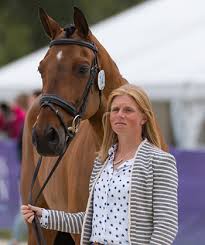
This is the story of how “Ros Canter” became synonymous with precision, patience, and the dismantling of the “hairy chest” stereotype in modern eventing.
Table of Contents
ToggleFrom Ponies to Power: The Lincolnshire Foundation
To understand Ros Canter (née Chalmers), you have to forget the grandeur of the big Warmblood studs or the heritage yards of the Cotswolds. Ros grew up in a farming family in Alford, Lincolnshire. Her childhood wasn’t about pristine white arenas; it was about getting the job done in a working environment.
Her mother, Christine Chalmers, was a pivotal figure—a List 1 eventing judge. This is a critical detail often overlooked. Growing up with a mother who judges means growing up with an innate understanding of what the numbers mean. While other children learned to kick and pull, Ros learned that a refusal costs 20 penalties, that a circle on the cross-country is not a disaster but a tactical reset, and that the difference between gold and silver is often a single second on the clock.
Her early horse, a 14.2hh pony named Maesmynach Masterpiece (known as “Bryn”), wasn’t a superstar. He was tough, opinionated, and required a level of finesse that brute force riders lack. “He taught me that you can’t fight a horse,” Ros often says in interviews. “You have to negotiate.”
That negotiation skill is the bedrock of her career. By the time she turned professional, Ros wasn’t looking for a horse to drag around a course; she was looking for a partner to solve a puzzle with.
The Partnership: Allstar B and The Art of the Slow Gallop
If you say the keyword Ros Canter, the immediate algorithmic response is usually “Allstar B.” This gray gelding, owned by Caroline and Sarah Monk, is the equine equivalent of a finely tuned sports car with very sensitive brakes.
Allstar B (or “Pumpkin”) is not a conventional event horse. He is rangy, he is sharp, and early in his career, he had a reputation for being too careful for his own good—often stopping at fences when the distance didn’t look perfect. Many professional riders would have passed him over. Ros Canter saw a kindred spirit.
The duo burst onto the senior scene in 2017, but their coronation came at the World Equestrian Games in Tryon, USA, in 2018. Riding in the punishing humidity and technical terrain, Ros did something radical: she rode the slowest round of the top ten.
Wait. Slowest? In a speed sport?
Yes. Ros Canter won the individual World Championship gold medal not by being the fastest, but by being the smartest. While riders threw caution to the wind to beat the clock, incurring time faults or awkward jumps, Ros calculated the risk/reward ratio. She took the long routes where necessary, settled the horse into a rhythm that looked pedestrian compared to her rivals, and jumped every fence cleanly.
She finished on her dressage score. She didn’t win the cross-country phase; she won the event.
This moment defined her legacy. Ros Canter proved that in modern eventing, the winner is not the bravest, but the rider with the best gas mileage. She turned cross-country into a dressage test of accuracy. It was a lesson to every young rider watching: “Clear and steady” beats “fast and faulty” every single time.
The Technical Mastery: Why She Never Looks Scared
Watch a video of Ros Canter riding cross-country. Notice her upper body. It is eerily still.
In an era where many riders throw their bodies at the horse’s neck for impetus, or lean back to brake for a drop fence, Ros sits like a chess player. Her leg is long, her hips are soft, and her shoulders are always slightly behind the vertical—not in a defensive way, but in a “waiting” way.
This is her unique biomechanical signature. She rides “long.” Most riders shorten the stirrups to feel secure; Ros keeps them a hole longer than average. This forces her to use her core and her thigh grip, rather than pinching with her knee. It lowers her center of gravity.
Why is this effective? Because Allstar B (and her subsequent top rides like MHS Seventeen and Izilot DHI) are sensitive. If Ros wobbled forward two inches, the horse would think “go.” If she leaned back, the horse would think “stop.” Her stillness is a conversation.
She is famously quoted as saying, “I don’t like being out of control. If I feel like I’m a passenger, I’ve already lost.”
This quest for control extends to the flatwork. Ros Canter is one of the few eventers who openly admits she enjoys dressage more than show jumping or cross-country. In a sport where dressage is often seen as the “boring” phase to survive, Ros treats it as the weapon. She understands that a sub-20 dressage score is a fortress. It allows you to take time cross-country. It allows you to leave a rail in the show jumping.
The Comeback: Surviving the Post-Championship Slump
No story of a top athlete is complete without the fall. After Tryon, the pressure mounted. The “Ros Canter method” was dissected, copied, and scrutinized. Then came the injury scratches, the withdrawal of horses, and the quiet period where the media wondered if the 2018 champion was a flash in the pan.
She wasn’t. She was retooling.
The years 2019 to 2021 were a masterclass in patience. While other riders rushed their horses back to four-star (now five-star) level, Ros pulled back. She focused on producing younger horses. She worked relentlessly on the partnership with Allstar B, addressing the frailty that had always been his Achilles’ heel.
Her return to the top at the 2022 Badminton Horse Trials (finishing 4th) and subsequent team gold at the 2022 World Championships in Pratoni del Vivaro proved her evolution. At Pratoni, riding the stallion Izilot DHI, she delivered a masterclass in the show jumping ring—a phase that had historically been her “weaker” link. She didn’t just jump clear; she jumped a round so soft and rhythmic that the stallion looked like a pony club mount.
Training Philosophy: The “No Drama” Yard
Ros Canter operates a relatively small yard in Alford, far removed from the bustle of the South West eventing hub. Her training philosophy is brutally simple: “Don’t make a drama.”
If a horse stops at a fence on the cross-country course at home, she doesn’t hit it. She doesn’t spin it. She stops, resets, and asks again from a slower pace. She believes that eventing horses are clever. If they stop, they are telling you something is wrong—either the distance is wrong, or they are tired.
This empathetic approach is rare at the 5-star level, where aggression is often mistaken for ambition. Ros treats her horses like elite athletes who need recovery, not drill sergeants. She is a vocal advocate for surface quality, for limiting the number of runs a horse does per season, and for retiring horses while they are still sound.
She once noted in a Horse & Hound podcast, “I want my horses to remember their job as fun. The second it becomes a fight, I’ve ruined them.”
The Legacy of the “Silent Assassin”
As of 2025, Ros Canter stands as a pillar of the British eventing team. She has amassed World Championships, European medals, and is a formidable contender for Olympic glory. But her legacy is not just in the gold.
Her legacy is in the technique.
She has single-handedly raised the standard of “cross-country riding” to a technical art form. Before Ros, the mantra was “go fast and hope.” After Ros, the mantra is “stay balanced and solve.”
She has also changed the way the industry views female riders. In a sport still historically dominated by male grooms and “old boys” networks, Ros is proof that data, finesse, and emotional intelligence win over brute force.
The Ros Canter Checklist for Success
For aspiring eventers reading this, here is the “Ros Canter Cheat Sheet” that you won’t find in any textbook, but is evident in every ride she does:
The Long Leg: Don’t shorten your stirrups to feel safe. Lengthen them to feel balanced.
The Dressage Shield: Spend 60% of your training time on the flat. If you can’t collect and extend in the arena, you cannot control your speed in a field.
The “Wait” in the Air: When jumping cross-country, look for the landing before the takeoff. Ros waits that extra millisecond to stay with the horse’s motion.
The Soft No: A stop is a data point, not a failure. Analyze why the horse said no, fix the approach, and try again without anger.
Terrain Management: Ros walks the cross-country course differently than others. She looks for the dips and ridges. She knows the horse cannot gallop downhill into a coffin; she plans to walk it.
Looking Ahead: The Next Chapter
What is next for Ros Canter? The conversation is shifting from “Can she win?” to “Who will succeed Allstar B?” The gray legend is nearing retirement, and all eyes are on her string of younger horses. She has the mare MHS Seventeen (a top-ten Badminton finisher) and the experienced Izilot DHI.
The ultimate goal remains the same: an Olympic Gold Medal. Paris 2024 was a heartbreak for the British team (bronze), but Ros’s individual performance remained characteristically solid. She is not chasing glory; she is chasing technical perfection.
If she wins an Olympic individual gold, she will be only the second person (after Michael Jung) to hold World and Olympic titles simultaneously in the modern era. But don’t expect her to scream or punch the air. Expect a quiet pat for the horse, a nod to her husband and farrier, Alex, and a walk back to the lorry to untack.
Conclusion: The Quiet Revolution
In a world of loud influencers and viral elimination clips, Ros Canter is a breath of fresh, Lincolnshire air. She is the mathematician of the muddy field, the librarian of the galloping track, and the silent assassin of the leaderboard.
She doesn’t need to shout to be heard. Her results speak in a whisper that echoes across the sport. She has taught us that true courage isn’t about taking risks; it’s about having the discipline to avoid them.
So the next time you watch a five-star event, ignore the horse thundering down the hill with its tongue over the bit and its rider yelling. Look for the gray with the quiet rider on top, shoulders back, leg still, breathing slowly. You’ll know her immediately. That is Ros Canter—and she is about to win