But history has a peculiar sense of humor. It often grants the grandest names to those who must endure the harshest trials. When you search for “Iqbal Mohamed,” you do not find one story. You find a collision of worlds. You find a trinity of existence spanning the spiritual, the political, and the tragic.
On one hand, you have Sir Muhammad Iqbal (often referred to as Allama Iqbal), the “Philosopher King” of Pakistan, whose poetry gave birth to a nation . On the other, you have the contemporary Iqbal Mohamed, the British MP who shattered political dynasties in 2024 to become a voice for the voiceless in Yorkshire. And finally, in the dark corners of the news archives, you find the third Iqbal Mohamed: a blind beggar in Lahore, murdered by pranksters, whose death revealed the grotesque underbelly of modern society .
This is the story of how three men, bound by a name, define the struggle of the Muslim world in the 20th and 21st centuries: the struggle for the Khudi (the Self).
Table of Contents
TogglePart I: The Architect of Destiny (Allama Muhammad Iqbal)
To understand the gravity of the name, one must start in Sialkot, Punjab, in 1877. A boy named Muhammad Iqbal was born into a modest Kashmiri Brahmin family that had converted to Islam . He was a linguistic prodigy, mastering Arabic, Persian, and English before excelling in German in just three months to study at Munich University . But Iqbal was not merely an academic; he was a spiritual surgeon tasked with diagnosing the illness of the colonized Muslim mind.
In the early 20th century, the British Empire was at its zenith. The Muslim world, still reeling from the fall of the Ottoman Caliphate, was plagued by an identity crisis. Should they mimic the West? Reject it entirely? Iqbal offered a third way.
The Philosophy of Khudi
Returning to Lahore after his studies in Cambridge and Heidelberg, Iqbal was not impressed by the shiny materialism of Europe. He saw the “dazzling exterior” of Western culture—its science, its constitutions, its colleges—and accused it of hypocrisy. He famously critiqued the West in verse:
“In appearance trade, in reality gambling. Profit for one, for thousands sudden death. Science, philosophy, colleges, constitutions. Preach man’s equality and suck man’s blood.”
Iqbal argued that the West had killed God (echoing Nietzsche) but had replaced spirituality with nothing but greed. To counter this, he introduced the concept of Khudi .
Khudi is a complex term often mistranslated as “ego” or “pride.” In Iqbal’s lexicon, it is the inner divine spark—the assertion of the individual Self that has been crushed by colonialism and religious stagnation. He believed that a Muslim could only be free if they cultivated their Khudi to be as hard as a diamond. “Self-preservation, self-respect, self-confidence,” he wrote, are necessary for the cause of truth and justice . He envisioned the Mard-e-Momin (the Perfect Man)—a lion-hearted individual who reads the Quran not as a book of ritual, but as a code for action.
The Dream of Pakistan
Politics was the natural outlet for his philosophy. Initially a believer in a united India, Iqbal shifted gears after witnessing the rise of Hindu nationalism and the betrayal of the Khilafat movement . In his historic 1930 presidential address in Allahabad, Iqbal drew a line on the map of his imagination. He demanded a separate homeland for Muslims in the Northwest of the Indian subcontinent .
He did not live to see Pakistan. He died in 1938, nine years before the partition. Yet, his pen had done the work of armies. He is rightly called the “Spiritual Father of Pakistan” . Today, his legacy is so monumental that he feels less like a man and more like a monument. But monuments are cold; Iqbal the man was all fire.
Part II: The Accidental Revolutionary (Iqbal Mohamed MP)
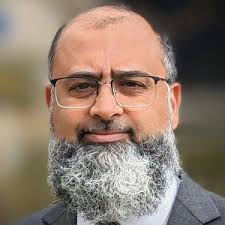
Fast forward nearly a century. The year is 2024. The place is Dewsbury and Batley, a former mill town in Yorkshire, England. An independent candidate named Iqbal Hussain Mohamed wins a seismic victory in the UK General Election, unseating the Labour Party in what was considered a “safe seat” .
This Iqbal Mohamed is not a philosopher with a flowing beard; he is an engineer, an IT consultant, and the son of Indian Muslim immigrants from Gujarat . He did not write epic poetry in Persian; he ran a campaign on WhatsApp, knocking on doors, fueled by the anger of a community feeling abandoned by the mainstream.
The Gaza Election
The 2024 election in the UK was unique. For the first time in decades, the issue of foreign policy—specifically the war in Gaza—became a deciding factor in Muslim-heavy constituencies. The “Independent Alliance,” of which Iqbal Mohamed is a part, surfed a wave of voter disillusionment with the Labour Party’s stance on Israel .
But Mohamed’s story is more than just a protest vote. To be an independent in the British House of Commons is to be a political orphan. Without the whip of a major party, you have no staff, no national platform, and no safety net. Yet, Iqbal Mohamed chose this path to advocate for a ceasefire and to tackle the cost-of-living crisis in his deprived northern constituency .
He represents a new kind of Iqbal: the pragmatic activist. He is not using Shaheen (the eagle, a frequent metaphor in Allama Iqbal’s poetry) as a metaphor for spiritual flight; he is dealing with potholes, housing shortages, and community cohesion. He is the living, breathing “Khudi” that Allama Iqbal spoke of—the individual who relies on his own character and connection to the people, rejecting the corrupt hierarchies of the established parties.
For context, he is the first independent MP from Yorkshire since 1907 . That statistic alone quantifies the seismic shift. While Allama Iqbal dreamed of a nation-state, this Iqbal Mohamed is redefining what representation looks like inside an existing one.
Part III: The Invisible Martyr (The Blind Iqbal)
There is a third story. It is not glamorous. It is not political. It is brutally, horrifically human.
In December 2019, the Pakistani newspaper Dawn reported a news item that barely scratched the surface of the international consciousness. The headline detailed the death of a man named Muhammad Iqbal .
This Muhammad Iqbal was blind. He was the eldest son of a retired gardener in Lahore. To survive, he worked as a beggar, navigating the chaotic streets of the city without sight. One day, he wandered into a tire repair shop where he had acquaintances. The men at the shop, perhaps bored, perhaps cruel beyond measure, decided to play a “prank.” They took the compressed air hose used to inflate truck tires, inserted it into the blind man’s body, and turned on the valve .
The air pressure ruptured his insides. He died in agony on the way to the hospital.
This Iqbal had no PhD from Munich. He did not win a seat in Parliament. He asked for nothing but a few coins to survive. He was deemed “expendable” by his tormentors.
The tragedy reveals the crisis of Khudi in its most inverted form. Allama Iqbal taught that the measure of a society is how it treats its weakest members. The blind Iqbal of Lahore represents the “anti-Iqbal”—the complete negation of the philosopher’s dream. In a society obsessed with honor and shame, the weakest are often invisible.
The Convergence: Mercy and Justice
There is, however, an unexpected bridge between these three stories. It lies in the concept of forgiveness.
The second Iqbal (the MP) won his seat on a platform of justice. The first Iqbal (the philosopher) demanded the reconstruction of Islamic thought to include mercy. But it is a fourth story—another “Iqbal”—that ties it together. Let us look at the case of Muhammad Iqbal, the juvenile death row prisoner .
In 1999, a 17-year-old boy named Muhammad Iqbal was involved in a shooting that killed Waheed Ahmed’s father. For years, the boy sat on death row. His family was destroyed. The victim’s family was destroyed.
Then, something remarkable happened. Waheed Ahmed, the son of the murdered man, wrote a public letter. He said: “I forgive him… He was a boy, and he made a mistake, and we are always more than the worst thing we have done… Hanging Iqbal is detrimental for society.”
This is the ultimate expression of the Khudi. To cultivate the Ego to such a height that you can swallow the pain of murder and extend grace to your enemy. Waheed Ahmed, not a poet or a politician, lived the philosophy of the original Iqbal more purely than any academic ever could.
Conclusion: The Name as a Mirror
So, what is an “Iqbal Mohamed”?
He is the visionary who drew borders with a pen (Allama). He is the disruptor who broke the political duopoly in Britain (MP). He is the victim forgotten by the state (The Blind Man). He is the redeemer who chose life over revenge (The Forgiver).
The name “Iqbal” carries the weight of expectation. It demands prosperity and high destiny. Yet, the lives of these men show that destiny is rarely easy. It is a struggle against the self (the nafs), against empire, against poverty, and against apathy.
As Allama Iqbal wrote in his seminal work The Reconstruction of Religious Thought in Islam, the Quran engenders a “feeling of reverence for the actual” . In other words, you cannot live in the fantasy of the past. You must face the brutal reality of the present—whether that reality is a British constituency, a Munich lecture hall, or a deserted street in Lahore.
The search for “Iqbal Mohamed” is not a search for a specific person. It is a search for the soul of the modern Muslim world: fractured, fighting, and forever reaching for a light it knows it once had.
Further Reflections:
The Danger of Dogma: Allama Iqbal warned against the “semi-literate clergy” who reduce faith to ritual . The tragedy of the blind Iqbal occurred in a society that often looks away from the suffering of the disabled.
The Power of the Individual: MP Iqbal Mohamed’s victory proves that in an age of algorithms and machine politics, the individual standing on principle still has the power to shock the world.
The Divine Attribute of Mercy: The story of the father forgiving his son’s murderer encapsulates Allama Iqbal’s core teaching: that man must mirror the attributes of God—and God’s primary attribute is mercy (Al-Rahman)