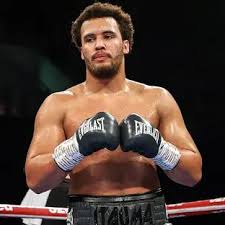
Moses Itauma is listed at 6 feet 4 and a half inches (1.94 meters) . Let’s be honest: in a grocery store, that is a very tall human being. But in the rarefied air of the modern heavyweight top 10, 6’4” is often dismissed as “small.”
Yet, as Itauma prepares for his toughest test against Jermaine Franklin, fixating on his height is the biggest mistake a fight fan—or an opponent—can make. To understand Moses Itauma, you have to stop looking at the tape measure and start looking at the geometry, the physics, and the cultural dynamite packed into that 6’4” frame. His height isn’t a limitation; it is the canvas for the most perfectly calibrated weapon in boxing today: his left hand.
Table of Contents
ToggleThe “Short” Heavyweight Paradox
Let’s address the elephant in the room. At 6’4.5″, moses Itauma is actually the same height as legends like Evander Holyfield and Lennox Lewis (who was often listed taller but measured similarly early in his career). However, in the current era of “freakishly tall” heavyweights, perception has shifted .
For context, Anthony Joshua and Vitali Klitschko are 6’6”. Deontay Wilder is 6’7”. Tyson Fury and Gogita Gotsiridze tower at 6’9”. If you only look at the numbers, Itauma spots them three to five inches. In a boxing gym, that is a lifetime of reach advantage.
But Moses Itauma isn’t fighting like a small heavyweight trying to survive. He is fighting like a predator who happens to occupy that space. The secret lies in his functional use of his height. He isn’t tall enough to lean on people from space like Fury, but he is tall enough to create vicious, downward trajectories for his punches that shorter heavyweights (like a 6’2” Rocky Marciano or a 5’11” Mike Tyson) couldn’t dream of.
His height brings him into a “Goldilocks zone.” He is tall enough to leverage a sniper-like jab, but not so tall that his center of gravity is compromised. This balance allows him to do something extraordinary: bend at the waist and slip punches like a middleweight while generating torque like a super-heavyweight.
The Geometry of Destruction: The Southpaw Edge
Here is where the statistics become deceptive. Moses Itauma is a southpaw . In a division dominated by orthodox fighters, the geometry of a 6’4” left-hander throws every opponent’s timing into chaos.
If Itauma were fighting exclusively as an orthodox fighter at 6’4″, he would be solid, but unspectacular. He would be trading jabs with men who have longer arms. However, because he stands with his right foot forward, his power hand (the left) is positioned directly in the lane of the orthodox opponent’s chin.
Consider the math of the reach. Itauma has a reach of 79 inches (201 cm) . Against an orthodox fighter with a similar or slightly longer reach, the distance required to land a right hand is typically longer. But for Itauma, the distance his left hand has to travel to crack an opponent’s jaw is minimal. He is a “right-handed southpaw,” meaning his jab (thrown with his dominant right hand) is a power jab, and his rear hand (the left) is a sledgehammer propelled by elite hip rotation .
His height allows him to throw this left hand on a slightly downward arc. Most heavyweights throw hooks and straights level. Itauma, using his 6’4” frame, often fires his left hand from a higher shelf, crashing it down over the top of high guards or slipping through the “V” of an opponent’s arms. It is a punch designed by an engineer, executed by an assassin.
Speed as the Great Equalizer
Heavyweight history is littered with tall, stiff fighters who used their reach to jab and grab. Itauma has broken that mold because he has the hand speed of a welterweight trapped in a heavyweight’s body. He has been recorded power cleaning 140kg and bench pressing 175kg, but that strength is useless without speed—and he has it in spades .
Because he is not a lumbering giant, his center of gravity is lower than that of a 6’9″ fighter. This allows him to use a “stutter-step” to close distance. He doesn’t plod forward; he teleports into range. This rapid footwork negates the reach advantage of taller opponents instantly.
When he demolished Dillian Whyte in 61 seconds, it wasn’t just the power that shocked the world; it was the speed of the closing distance. Whyte, a seasoned veteran with a granite chin, didn’t see the shot coming because Itauma’s 6’4″ frame allowed him to hide behind his jab before exploding forward.
The Journey: From Slovakia to Stardom
To understand the fighter, you have to understand the frame. Moses Itauma was born Enriko Itauma in Kežmarok, Slovakia, to a Nigerian father and a Slovakian mother . His height and physique made him stand out immediately—but not always in a good way.
Growing up in Slovakia, he and his brothers faced significant racial discrimination . His mother made the brave decision to move the family 1,050 miles to Chatham, Kent, in search of opportunity and safety . That displacement forged a steeliness in Itauma that supplements his physical gifts.
He isn’t just fighting for titles; he is fighting to validate the sacrifice of that journey. As he told the BBC, his family needed the money, which is why he turned pro so early, eschewing the Olympic route . That pressure has turned him into a finisher. He doesn’t want to “bank rounds”; he wants to get home. Of his 13 professional victories, 11 have come by knockout, with a staggering nine of those ending within the first two rounds .
The Nigerian Connection: Finding an Identity
The question of identity often plagues athletes of mixed heritage. For a long time, the narrative around British-Nigerian fighters was conditional. As Itauma poignantly recalled, a teacher once explained to him the Anthony Joshua paradigm: “When he’s doing well… he was British. As soon as he lost that fight, he’s the Nigerian boxer” .
Itauma has proactively rejected that conditional acceptance. He has embraced his Nigerian heritage fully, traveling to Akwa Ibom state to reconnect with his father’s village . At 6’4″, he is a physical anomaly in many parts of the world, but in Nigeria, he found a sense of belonging that he never felt in Europe. Security guards at Lagos airport recognized him not as a “British fighter,” but as “one of theirs” .
This psychological grounding is vital for a boxer. The ring is a lonely place, and a fighter who knows exactly who they are fights with more conviction. Itauma’s height makes him look like a titan, but his heritage gives him the heart of a warrior.
Technical Breakdown: More Than Just a Punch
While the left hand is the headline act, Itauma’s height facilitates a diverse defensive toolkit that is rare for a 21-year-old.
He utilizes “pivot exits.” After throwing his combination, most young fighters smother their work or back straight up. Itauma, using his agile frame, slips out at 45-degree angles . Because he is 6’4″ but moves like a 5’10″ fighter, opponents are often left swinging at the ghost of his shoulders.
Furthermore, his ability to switch his attack to the body is unique for a tall boxer. Many tall fighters refuse to bend their knees, making them vulnerable to body shots. Itauma willingly crouches to dig left hooks to the liver, forcing opponents to lower their guard, only to snap back to his full 6’4″ height and crack them with an uppercut. It is a vertical chess match that few heavyweights have the cardio or flexibility to play.
The “Fight IQ” Disparity
One of the most compelling arguments against the “height is king” theory is the simple fact that Itauma hasn’t just beaten his opponents; he has solved them. He faced journeymen like Kostiantyn Dovbyshchenko early in his career, men designed to go the distance and test a prospect’s engine. Itauma stayed disciplined, boxed smart, and learned .
He realized that relying solely on the “one-punch KO” was leaving him “underwhelmed” . He now seeks rounds, not to prove his chin, but to perfect his craft. This is the mindset of a veteran. Tall fighters often rely on their jab to sleepwalk through fights. Itauma uses his jab, set up by his southpaw stance, as a computer mouse—clicking, probing, and gathering data before launching the fatal left.
His upcoming fight against Jermaine Franklin is the ultimate test of this . Franklin has never been stopped. He ate the best shots of Anthony Joshua and Dillian Whyte and kept coming. If Itauma stops Franklin, it won’t be because of his height on the tale of the tape; it will be because of the torque, the speed, and the ruthless geometry of his attack.
Conclusion: The Future is Not Taller, It’s Better
The heavyweight division has a bad habit of mistrusting anyone under 6’6”. We obsessed over David Price because he was 6’8”. We obsessed over Tyson Fury because he broke the mold. But history shows that the division belongs to those who can adapt, not just those who can reach.
Moses Itauma stands at a modest (by modern standards) 6’4.5”. He does not have the reach of a giant. He does not have the weight of a building. But he has something far more dangerous: explosive leverage.
His height is the ultimate illusion. Look at him, and you see a conventional heavyweight. Fight him, and you face a right-handed southpaw who hits like a middleweight, thinks like a coach, and moves like a lightweight. He is the 6’4″ man who makes the 6’9″ men look slow.
Forget the tape measure. The era of Moses Itauma isn’t about how tall he is. It’s about how good he is. And if you blink, you’ll miss the left hand that is about to change boxing forever.
Moses Itauma Vital Statistics:
Height: 6 ft 4 ½ in (194 cm)
Reach: 79 in (201 cm)
Stance: Southpaw
Record: 13-0 (11 KOs)
Next Fight: vs. Jermaine Franklin (March 28)
Sources:
BBC Sport Interview regarding family and career aspirations
BBC Sport Africa on Nigerian heritage and identity
Technical breakdown of left hand power and training
BoxRec Professional Record
Wikipedia Height and Stance confirmation