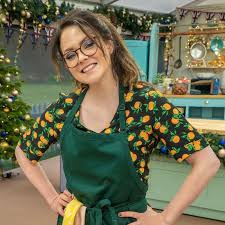
In that single moment, the entire facade of the “perfect” baking aesthetic crumbled like a over-baked shortbread. In a television landscape dominated by fondant-smooth finishes, “soggy bottom” jokes, and the terrifying pressure of a Hollywood handshake, Lottie emerged not as the winner of the series, but as its philosophical savior.
For those who missed the 2020 season (Series 11), Lottie Bedlow was the pantomime producer from West Sussex who lived with her aunt, uncle, and teenage cousins . On paper, she was a dark horse. But in reality, she was the contestant who articulated what every nervous home baker has felt but could never say: Perfection is boring, and it usually tastes like cardboard.
Now, four years removed from the tent, with a bestselling cookbook titled Baking Imperfect under her belt and a social media following that adores her chaotic energy, Lottie Bedlow has cemented her legacy. She is the patron saint of the “good enough” bake, and frankly, she is the therapeutic release the baking world desperately needed.
Table of Contents
ToggleThe “Perpetually Frustrated Perfectionist” Persona
Before we dive into her recipes, it is vital to understand the dichotomy of Lottie Bedlow. She describes herself as a “perpetually frustrated perfectionist” . This is a crucial distinction. Lottie is not lazy, nor is she sloppy. She cares deeply about flavor, texture, and chemistry. She earned the first Hollywood handshake of her series for her “Quarantine Florentines”—a technical feat that left Paul Hollywood speechless .
But here is the difference between Lottie and your standard influencer: she realized that the pursuit of perfection has a point of diminishing returns.
While other contestants in the history of Bake Off have cried over collapsed soufflés or lopsided church cakes, Lottie approached disaster with the pragmatic eye of a theater producer. In pantomime, the show must go on, even if the props break and the scenery falls. She applied this ethos to the kitchen. Did her biscuit boat look like a crime scene? Yes. Did it taste good? Absolutely.
This attitude is the thesis of her entire career. She didn’t just bake; she performed the act of baking as a joyful, messy, human experience.
The Cookbook as a Manifesto
In 2022, Lottie released Baking Imperfect: Crush, Whip and Spread It Like Nobody’s Watching . If you are looking for a coffee table book of glossy, unattainable gateaux, this is not it. Instead, Lottie gave the world a hardcover hug, telling us that it is okay to fail.
The book’s subtitle is essentially a life mantra. “Crush, whip, and spread it like nobody’s watching”—there is an inherent freedom in that phrase. It removes the male gaze of the food critic, the judgmental eye of the Instagram scroller, and even the ghost of your mother-in-law peering over your shoulder.
One of the most charming aspects of Baking Imperfect is her irreverent naming convention. You won’t just find “Chocolate Cake.” You will find recipes titled “S’More Cupcakes,” “Minimal Faff Brioche” (a phrase that should be embroidered on a tea towel), and the alarmingly intriguing “Back & Crack Scotch Eggs” . She also categorizes her recipes by difficulty using a “cracked egg” rating system . It is a visual representation of her ethos: things break, things crack, and that is okay.
Her recipes are designed for the real world—specifically, the reality of living with family. She often notes that her baking is fueled by feeding the hungry teenagers in her house . There is no pretension of a silent, minimalist kitchen. There is the sound of a video game in the background, the dog barking, and the chaotic love of a shared home.
The Viking Metal and Panto Connection
To truly understand Lottie’s appeal, you have to look at her hobbies. When she isn’t baking, she is listening to Viking metal, doing yoga, or producing pantomimes .
Pantomime is a distinctly British form of theater characterized by slapstick, audience participation (shouting “He’s behind you!”), and cross-dressing. It is loud, brash, and often a little bit ugly—but it is designed to generate joy.
Lottie Bedlow is the pantomime of the baking world.
She is the antidote to the “Silent Vlog” aesthetic where someone spends 14 hours tempering chocolate in dead silence. She brings the heavy metal energy of chaos into the gentle art of pastry. When she made a bust of Louis Theroux out of cake, it wasn’t about making it look exactly like Louis Theroux; it was about the audacity of the attempt .
Why We Needed Her
In the years since Lottie’s season aired, the conversation around “toxic productivity” and the curated perfection of social media has only intensified. We are tired. We are burnt out. And we don’t have the energy to pipe royal icing into the shape of a swan.
This is Lottie’s genius. She gives us permission to stop.
Her famous line, repeated in almost every interview and plastered across her book, is: “Who cares as long as it tastes good?” .
This is a radical statement in the era of the “Instagram vs. Reality” reel. So many of us have been paralyzed by the fear of failure. We buy the ingredients, we line the tin, and then we freeze because we are terrified of wasting time on something that won’t look “professional.”
Lottie Bedlow explicitly tells you that your bake will go wrong. She says it with confidence. She embraces the “Gingerbread Shed” because “They never look like houses anyway” . She wants you to make the “Strawberry Shortcake Roll(er Coaster)” because the name itself admits that the roll might crack.
The Practical Magic of “Good Enough”
Let’s look at the specific recipes that define the Lottie Bedlow canon.
The Quarantine Florentines: These are the bakes that won Paul Hollywood over. They are lacy, chewy, and studded with sour cherries and almonds . They look messy by design. There is no way to make a Florentine look like a perfect geometric cube. They are supposed to be jagged.
The Gingerbread Shed: By refusing to call it a “house,” she removes the pressure of structural engineering. You aren’t building a home; you are assembling a shack. If the roof caves in, it’s a modern art installation.
The “Minimal Faff” Brioche: Brioche is notoriously difficult. It requires patience, temperature control, and a lot of butter. By labeling it “Minimal Faff,” she lowers the heart rate of the baker before they even crack an egg. It is a psychological trick that works wonders .
These aren’t just recipes; they are cognitive behavioral therapy exercises disguised as food.
The Legacy of the Hollywood Handshake
It is important to note that Lottie is not anti-technique. She is anti-anxiety. She has a degree in Animal Studies from the University of Exeter, which gives her a unique, scientific approach to how ingredients behave . She knows why a batter splits. She knows the chemistry of baking soda.
But she uses that knowledge not to intimidate, but to liberate.
On her Instagram, @lottiegotcake, she shares reels that often go viral. In one, she makes a Mars Bar tart that garnered over 1.2 million views . Why? Because it looks deliciously messy. It looks like something you could actually make on a Tuesday night without having to order a special type of flour from a remote village in France.
Conclusion: Bake Like Lottie
In the end, Lottie Bedlow’s contribution to the culinary world is not a specific recipe for S’More Cupcakes or Irish Stout Cake, though those are certainly welcome. Her contribution is a mindset shift.
She has successfully argued that the kitchen can be a place of refuge rather than a battlefield. She stands in stark opposition to the shouty, Gordon Ramsay-esque culture of culinary terror. Instead, she offers the warm, slightly chaotic, and deeply empathetic energy of a friend who says, “Just shove it in the oven and see what happens.”
We love Lottie Bedlow because she is us. She is the baker who forgets to preheat the oven, who realizes she is out of an ingredient halfway through, and who ultimately decides that if the cake tastes good, the shape is irrelevant.
So, the next time you are standing in your kitchen, flour on your face, staring at a cake that has sunk in the middle, do not cry. Do not throw it in the bin. Channel your inner Lottie. Pour some custard on it, call it a “pudding bowl,” and crank up the Viking metal.
After all, nobody’s bake is perfect. But if it tastes good, it’s a triumph.
Key Takeaways from the Lottie Bedlow Philosophy:
-
Embrace the Cracks: A cracked top is a great place to pour glaze.
-
Flavor Over Finesse: No one remembers a smooth buttercream if the sponge is dry.
-
Laugh at the Disaster: The “Gingerbread Shed” is funnier than the “Gingerbread Mansion.”
-
The Pantomime Rule: If you act like you meant to do it, the audience will believe you