Table of Contents
ToggleGeorge Becali: The King, The Convict, The Crusader – A Romanian Enigma
This article delves deep into the life of this polarizing magnate, exploring his tumultuous journey from the son of shepherds in the Bărăgan plains to a millionaire, a Member of the European Parliament, a convict, and back again. We will uncover the layers of a man who is part shrewd businessman, part philanthropic patriarch, and part provocateur, whose life story is inextricably linked with the modern history of Romania itself.
From the Steppes of Bărăgan: A Childhood Forged in Exile
To understand Gigi Becali, one must first understand the profound impact of his family’s history. Born on June 25, 1958, in the small village of Zagna, Brăila County, his very birthplace was a site of exile and punishment . His family, of Aromanian origin, had a history of displacement. His grandfather, Gheorghe Becali, was an Aromanian shepherd who migrated from the Korça region of Albania to the Cadrilater (Southern Dobruja) during the interwar period, a territory that was then part of Greater Romania .
This life was upended by the tides of history. After the Craiova Treaty of 1940, Romania ceded the Cadrilater back to Bulgaria, forcing the Aromanian population, including the Becali family, to relocate. They were resettled, first near Călărași and later in the Banat region, in a village called Săcălaz . It was here that the seeds of future persecution were sown.
The family patriarch, also named Gheorghe, and his sons were known for their sympathies towards the Legionary Movement (also known as the Iron Guard), a far-right nationalist and ultra-Orthodox organization active in Romania before World War II .
This political affiliation proved disastrous after the establishment of the Communist regime. In 1951, as part of a wider crackdown on “enemies of the state,” the entire Becali family was forcibly deported to the barren Bărăgan Plain, a vast steppe in southeastern Romania used by the communist authorities as a site for mass internal exile .
It was in this harsh, desolate landscape, in the village of Zagna, that George Becali was born seven years later. The experience of deportation and exile, of being uprooted and punished for their beliefs and ethnicity, became a foundational trauma for the family, shaping a deep-seated nationalism and a profound distrust of the state that would later define Gigi’s public persona .
The family’s fortunes began to change after their forced domicile was lifted in 1959. They moved to Pipera, a village just outside Bucharest that would later become one of the city’s most exclusive real estate zones . Despite the collectivist policies of the communist era, the Becalis managed to maintain a semi-autonomous livelihood through sheep farming, supplying meat and cheese to hotels in Bucharest and the Black Sea coast.
This required a delicate, and often corrupt, negotiation with the authorities, including bribing local Securitate officers . Young George grew up in this environment, learning the trades of a shepherd and a mechanic—he initially worked as a fitter-mechanic at the ICCE industrial platform in Băneasa . These humble beginnings, surrounded by sheep and the rhythms of rural life, would remain a core part of his identity, even after he amassed a fortune.
The Making of a Mogul: Land, Deals, and the “First Billionaire” of the New Era
The Romanian Revolution of 1989 was the great watershed that allowed the Becali family’s entrepreneurial spirit to flourish. With the fall of communism, private enterprise was legalized, and Gigi, then in his early thirties, seized the opportunity. Using an inheritance and a loan from the famous Romanian footballer Gheorghe Hagi, he began importing goods—jeans, cigarettes, soap—via truck from Turkey, products that were in high demand in the newly opened but still struggling Romanian market .
While this initial trade was profitable, the real source of Becali’s vast wealth was real estate. With an almost prophetic eye for value, he began acquiring land around Bucharest, particularly in the northern Pipera area—the very land his family had been exiled to decades earlier. As the city expanded and the area became a prime residential and business district, the value of his holdings skyrocketed .
His business practices, however, often skirted the edge of legality and were criticized for their opportunism. The most infamous example was a land swap with the Ministry of National Defense in June 1999 . At the time, the ministry was looking to consolidate its land. Becali offered a swap that was grossly disadvantageous to the army, netting himself an estimated profit of around $3 million .
Crucially, he did not even own the land he was offering at the time he made the proposal. He secured the ministry’s agreement first and then rushed to buy the land from local peasants, knowing he had a guaranteed buyer at a much higher valuation . This deal, later investigated by anti-corruption prosecutors, became emblematic of the murky transition period in 1990s Romania, where political connections and inside knowledge could be parlayed into massive personal fortunes.
By the mid-2000s, Becali’s empire included significant stakes in a range of companies. He was a major shareholder in the construction group Arcom, the poultry producer Avicola Iași, the weapons manufacturer Uzina Mecanică Drăgășani, and the electronic components firm Romes .
At the height of the economic boom in 2008, Forbes Romania estimated his wealth to be between $2.8 and $3 billion, briefly crowning him the richest man in the country . While other estimates placed his fortune lower (around €700-750 million), there was no denying that Gigi Becali had become a titan of Romanian capitalism . The shepherd’s son had not just entered the palace; he had built one.
The “King” of Steaua: A Football Patron’s Love and Micromanagement
For the vast majority of Romanians, George Becali is synonymous with football, specifically with the country’s most successful club, Steaua Bucharest. In 2003, he became the club’s primary financier and patron, a role that brought him the nationwide fame and adoration that his money and political ambitions alone could not . He was no longer just a rich man; he was “the boss,” a character straight out of a drama, whose every move was dissected in the press.
His tenure at the club, now rebranded as FCSB following a long and bitter legal dispute with the Romanian Army over the “Steaua” name, has been a paradox of success and controversy . On one hand, his investment kept the club competitive in Romania’s Liga I and allowed for regular appearances in European competitions.
On the other hand, his management style was a masterclass in chaotic micromanagement. Becali was infamous for meddling in team selection, publicly criticizing his own players, and hiring and firing coaches with dizzying speed . He once famously sacked coach Dorinel Munteanu less than two months after hiring him, a decision he later “apologized” for by paying him the €130,000 owed in his contract .
His statements on transfers were legendary. He would negotiate in public, setting ultimatums and boasting about potential deals with major European clubs. The Chinese Wikipedia article on Becali notes specific instances of him rejecting offers from AC Milan for player Vlad Chiricheș, holding out for a higher fee, and negotiating with clubs from China’s Super League .
This hands-on, chaotic approach led sports pundits to argue that, despite his generous investments, the club consistently underperformed relative to its potential . Yet, for better or worse, Becali was FCSB. His passion was undeniable, and his omnipresence in the media, often making provocative or vulgar statements, turned every match, every transfer window, into a national spectacle .
The Crusader in Politics: Nationalism, the European Parliament, and Pris on
Becali’s foray into politics was a natural extension of his media dominance and his self-image as a national savior. In 2004, he took over a minor political formation, the New Generation Party (PNG), and rebranded it as the New Generation Party – Christian Democratic (PNG-CD), steering it towards a platform of fervent nationalism, social conservatism, and Orthodox fundamentalism .
His ideology was a potent, often incoherent, mix of ultra-conservatism, radical-right rhetoric, and deep religious piety. He ran for president in 2004, securing only 1.77% of the vote, but used the campaign to solidify his public image .
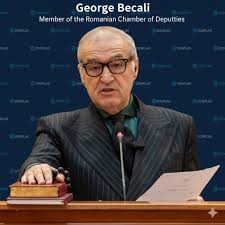
His political career reached its peak in 2009 when he was elected as a Member of the European Parliament (MEP) on the list of the Greater Romania Party (PRM) . His time in Brussels and Strasbourg was, by all accounts, unremarkable, save for his notable absence. In 2010, the German magazine Der Spiegel labeled him “the laziest MEP” due to his poor attendance record . This was partly due to legal troubles at home that restricted his travel, but it also highlighted his apparent lack of interest in the mundane work of EU governance.
It was his rhetoric, not his legislative work, that defined him on the European stage. His public statements were a constant source of outrage. He was accused of inciting hatred against homosexuals, making misogynistic and racist remarks, and engaging in Holocaust denial .
The Washington Post noted his “penchant for homophobic, misogynistic and racist rhetoric” . This reached a point where the European Court of Justice ruled that his football club, FCSB, could be held liable for his homophobic comments, as he was its dominant figure .
His political career, and his freedom, came crashing down in the 2010s due to a series of legal cases. The most significant was a 2009 incident in which he and his bodyguards kidnapped four men suspected of stealing one of his luxury cars. They held the men captive, beat them, and locked them in the trunk of a car .
For this, he was sentenced in 2013 to three and a half years in prison . The conviction automatically stripped him of his parliamentary seat. He was also found guilty in a separate case related to the 1999 land swap with the Defense Ministry, receiving a three-year sentence that was merged with the kidnapping sentence . In April 2015, after serving a third of his time, he was released on parole from Poarta Albă Prison .
The prison sentence was a dramatic fall from grace for a man who had once topped the rich lists and walked the halls of the European Parliament. Yet, upon his release, he returned to public life with his characteristic defiance, claiming he had spent his time in prison writing books and was unbroken by the experience . In 2024, he made another political comeback, joining the nationalist Alliance for the Union of Romanians (AUR), a move that once again placed him at the heart of Romanian political debate .
The Paradox of Piety: Faith, Philanthropy, and the Patriarchy
Alongside the scandals and the bluster, there is another, equally important side to George Becali: his deep and demonstrative Orthodox Christian faith. He is a man who sees himself as a protector of the church and a doer of God’s work. This piety manifests in two starkly contrasting ways: genuine philanthropy and a patriarchal desire for control.
His philanthropic efforts are substantial and well-documented. He has donated millions to the Romanian Orthodox Church, including significant contributions to the Romanian Orthodox monasteries on Mount Athos in Greece . Following the devastating floods of 2005, he spent $4 million to rebuild nearly 200 houses in the village of Vulturul, Vrancea County. The grateful villagers even sought to rename their commune “Vulturul Becali” in his honor .
He has funded the construction of churches, hospitals, and orphanages, and is known for offering direct financial assistance to individuals in need, often on live television . This generosity has earned him a loyal following among poorer and more traditional Romanians, who see him as a benefactor with a heart of gold .
However, his religiosity is also a key component of his public image and his political identity. He presents himself as a crusader against secularism and Western liberalism, a defender of traditional family values. This was the man who, with his flock of sheep still grazing on his Pipera estate, would claim he was ready to return to being a shepherd if politics didn’t work out . It is a carefully cultivated image of the simple, god-fearing man blessed by wealth.
This devotion, however, recently collided with the very institution he seeks to serve. In June 2025, Patriarch Daniel of the Romanian Orthodox Church issued a formal order banning Becali from singing in the choir loft (the “strană”) at the Patriarchal Cathedral in Bucharest . The official reason, stated by church spokesperson Father Adrian Agachi, was that Becali “does not have authorized musical skills” and that his enthusiastic but tuneless singing had become a distraction, drawing numerous written complaints from parishioners following the church’s live-streamed services .
The irony was palpable: the self-appointed voice of Orthodox traditionalism was silenced by the church itself for being a nuisance. This minor scandal perfectly encapsulates the tension at the heart of Becali’s public life—a man who so desperately wants to be at the center of every stage, from the football pitch to the church altar, is often his own biggest obstacle.
Conclusion: A Mirror to Post-Communist Romania
George Becali is a figure who defies simple categorization. He is a convicted criminal and a celebrated philanthropist. He is a vulgar media clown and a devoutly religious man. He is a shrewd businessman who made a fortune through opaque deals and a nostalgic shepherd who keeps sheep in the backyard of his palace. He is a symbol of both the unbridled opportunity and the profound moral confusion that characterized Romania’s transition from communism.
His life story is a mirror held up to the nation itself. His family’s deportation speaks to the traumas of the 20th century. His business empire reflects the chaotic and often lawless birth of capitalism in the 1990s. His football patronage captures the raw, unfiltered passion of the country’s favorite sport. His political career, with its toxic mix of nationalism, populism, and religiosity, foreshadowed the rise of similar illiberal movements across Europe and the world.
In the end, George Becali remains an enigma, a collection of contradictions wrapped in a designer suit, shouting from his luxury car. He is, as the German press once called him, one of the “most bizarre politicians” of the post-Ceausescu era . But to dismiss him as merely bizarre is to miss the point. He is a product of his environment, a man who learned to navigate the treacherous currents of Romanian society and emerged, for better or worse, as one of its most enduring and iconic figures. Whether he is herding sheep, managing a football club, or sitting in Parliament, Gigi Becali will undoubtedly continue to provoke, annoy, and fascinate Romania for years to come