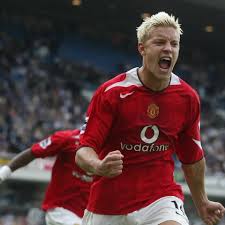
However, a fascinating quirk of modern football is that the name “Alan Smith” actually represents two distinct, high-profile footballing lives. While the world remembers the peroxide-blonde gladiator who broke his leg blocking a John Arne Riise thunderbolt, there exists a parallel legacy: the cerebral, golden-boot-winning Arsenal striker turned Sky Sports pundit. To understand the full scope of the name, one must look at the contrasting tales of two men who shared a name, a nationality, and a position, but vastly different paths.
This is the story of fire and ice: the blonde warrior of Leeds and the poacher prince of Highbury.
Table of Contents
TogglePart I: The Boy from Rothwell (The Gladiator)
Alan Smith—the later iteration—was born on October 28, 1980, in Rothwell, Leeds . From the moment he pulled on the famous white shirt of Leeds United, he carried the weight of the Yorkshire dirt on his shoulders. This was not a player of balletic grace; he was a street brawler in football boots.
His origin story reads like a script from a bygone era. Before he honed his tackling, Smith was a prodigy on two wheels. Growing up, his first love wasn’t football; it was the raw adrenaline of motorcycle and bicycle motocross. He was so proficient that he won a championship, only switching to football because the financial barriers to motocross became too high . That background explains everything about his style: fearless, fast, and utterly indifferent to the risk of a crash.
His entrance to the world stage at Anfield in 1998 was prophetic. An 18-year-old Smith, having just stepped onto the pitch for his debut, took his first touch and fired the ball past Liverpool goalkeeper David James . It was a moment of shocking audacity. But while the goal was pretty, the rest of his career would be defined by grit.
At Leeds, Smith was the heartbeat of “The Damned United.” As the club teetered on the edge of financial oblivion and sold off its jewels (Ferdinand, Kewell, Bowyer), Smith stayed. When Leeds were relegated in 2004, the image of Smith breaking down on the pitch was heartbreaking. He wasn’t just losing a job; he was losing his home.
When he eventually moved to Manchester United for £7 million, the reaction was biblical. Leeds fans burned his shirt, labeling him “Judas” . Yet, history often overlooks that Leeds allegedly forced the move to secure an upfront cash injection to avoid administration . Smith walked into the lion’s den of Old Trafford with his head high. Sir Alex Ferguson, never one for shrinking violets, adored him.
The Injury That Defined a Career
It is impossible to write about Alan Smith without addressing February 18, 2006. An FA Cup tie at Anfield. Liverpool versus Manchester United. In the 89th minute, with United losing 1–0, John Arne Riise wound up his left foot to blast a free-kick. Most players would turn away, using the wall as cover. Smith did not.
Smith threw his body into the line of fire. The connection was sickening. The impact shattered his leg and dislocated his ankle. Ferguson later described it as one of the worst injuries he had ever seen in his career . The image of Smith writhing on the turf, his leg bent at an unnatural angle, remains one of the most visceral moments in Premier League history.
The aftermath showed the character of the man. While he was rushed to the hospital, his teammates went on to win the League Cup. As they lifted the trophy, they wore t-shirts emblazoned with the words: “For you Smudge” . Smith fought back from that break, learning to walk again, then run, then tackle. But the player who returned was different. The searing pace had diminished, and the goals had dried up. Ferguson, pragmatic as ever, moved him to defensive midfield—a testament to his intelligence but a concession that the striker was gone.
He drifted to Newcastle, then to the lower leagues, finally ending his career at Notts County. And then, fittingly, he vanished. In 2018, Smith retired without a press release, without a testimonial, and without a fanfare. When asked why, he shrugged it off: “I don’t think anyone would have been interested in me retiring” . He walked away from the Premier League glare and returned to the stables, finally at peace.
Part II: The Poacher Prince of Highbury (The Intellectual)
While the blonde Smith was bleeding on the Anfield turf, another Alan Smith—a 23-year-old striker—was already ten years retired. This Alan Smith, born in 1962, represents the old guard.
To be an Arsenal fan in the late 1980s and early 1990s was to idolize this man. While his namesake was known for sliding tackles, the elder Smith was known for hanging on the last shoulder of the defense. He was a poacher, a man who smelled goals the way a sommelier smells wine.
His career trajectory was the antithesis of the Leeds hardman. He studied modern languages at Coventry Polytechnic, a detail that always seemed to delight commentators who expected footballers to be monosyllabic . He started his career in non-league obscurity at Alvechurch—a village club where he famously met his wife, Penny, the daughter of the club’s vice-chairman .
The Phone Call That Changed History
The most fascinating “what if” of this saga involves a phone call in 1987. A young Alan Smith was sitting at his parents’ house watching Coronation Street when the phone rang. It was Sir Alex Ferguson.
This was a different Ferguson, newly installed at Manchester United and desperate for goals. Ferguson wanted Smith to join on a free transfer. It was a tempting offer, but Smith had already, in a roundabout way, given his word to George Graham at Arsenal.
In a story he told years later, Smith recalled telling the legendary manager: “Mr. Ferguson, I’m sorry but I’ve made up my mind, I want to join Arsenal” . He put the phone down, looked at the TV, and wondered if he had just sabotaged his career.
He hadn’t. He went to Highbury and became a legend. While his namesake would later be defined by a broken leg, this Smith was defined by a broken Anfield curse. In 1989, with the title on the line at Anfield, Smith provided the assist for Michael Thomas’s iconic last-minute goal that snatched the title from Liverpool . He won the Golden Boot, scored the only goal in the 1994 European Cup Winners’ Cup final against Parma, and won every domestic trophy available .
Unlike the younger Smith, who retreated from the spotlight, the elder Smith stepped directly into it. He is now the voice of authority on Sky Sports, offering the kind of nuanced, dry-witted analysis that only a man with a degree in modern languages and decades of top-flight experience can provide.
The Verdict: Which One is the Real “Alan Smith”?
The search for “Alan Smith” often confuses the casual fan. Is he the hardman holding midfielder from the Ferguson era, or the cultured pundit praising Erling Haaland on television?
The beauty of the name is that it encapsulates the duality of the English game.
Alan Smith (b. 1962) represents the head. He was the intelligent, well-spoken striker who planned his runs, studied the game, and transitioned seamlessly into a media career. His life is a story of balance.
Alan Smith (b. 1980) represents the heart. He was the visceral, emotional, bleeding-edge of football. He destroyed his body for the badge. He lived the dream of every kid who kicks a ball against a wall in Leeds or Manchester. His life is a story of sacrifice.
The Final Whistle
As of 2026, both Alan Smiths are doing just fine. The younger, having pulled on his boots for the last time at Notts County—earning just £500 a week at the end, a far cry from his Manchester United heyday—has settled into a life of coaching and quiet family time . He carries metal plates in his leg as souvenirs of a war he willingly entered.
The elder Smith sits in the Sky Sports studio, dissecting the game with a sharpness that proves his mind never lost its pace, even if his legs did.
They never played against each other. They never shared a locker room. Yet, they are eternally linked. Alan Smith is not just one story of triumph or tragedy. It is the story of English football itself: the grit of the industrial north and the class of the London elite, existing simultaneously under the same banner.
Whether striking a ball or blocking a shot, Alan Smith—in both iterations—always knew how to leave his mark.
Conclusion
In the end, the name Alan Smith transcends the typical footballing legacy. While most players are defined by a single trophy, a single goal, or a single club, the two Alan Smiths together tell a more complete story of the sport itself. One represents the brutal, physical sacrifice required to compete at the highest level—the willingness to break a leg for a point. The other represents the intelligence, the timing, and the poetic justice of a perfectly executed finish.
They are two sides of the same coin: the blood and the brain, the tackle and the touch. The younger Smith gave his body to the game and walked away in silence. The elder Smith kept his mind sharp and found a second life as its narrator. Whether you remember the blonde warrior throwing himself at Anfield or the poacher prince lifting the title at the same stadium, the name Alan Smith remains a badge of honor—a reminder that in football, as in life, there is more than one way to be a legend