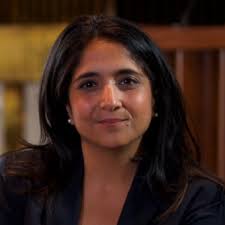
To understand Sima Kotecha is to understand the modern BBC’s struggle and triumph: how to be authoritative without being elitist, empathetic without being partisan, and brave without being reckless.
Table of Contents
ToggleFrom a Council Estate to the Global Stage
The most compelling narrative about Sima Kotecha begins not in a prestigious newsroom, but on a council estate in Popley, Basingstoke . Born in 1980 to parents of Indian origin, Kotecha’s early life was a study in cultural duality. At home, she spoke Gujarati; at school, she struggled with English until the age of five . In the 1980s, Basingstoke was not the diverse hub it is today, and Kotecha and her brother often found themselves the only ethnic minority children in their class .
Her father was a bus driver. Her mother was a homemaker. Neither had connections in the media world. Yet, when a young Sima expressed a desire to be on television, her father took a bold, almost cinematic, step. Seeing a BBC crew filming in a field, he stopped his bus, approached the journalist, and asked for advice on behalf of his daughter . That chance encounter produced a business card that would eventually lead to an internship.
Kotecha is refreshingly honest about the hurdles of class. She has spoken openly about being the first in her family to attend university (the University of Surrey and Goldsmiths) . She has faced the unspoken sneer of the British media industry—the assumption that to be a serious journalist, one must be privately educated and Oxford-educated. “There have been times when I’ve felt like I’m really different, and I stand out like a sore thumb,” she admitted to the Basingstoke Gazette . Her career is a rebuke to the old boys’ network, proving that determination and “nosiness” often matter more than pedigree.
The Philosophy of “Keeping it Simple”
What makes Sima Kotecha a unique figure in the BBC roster is her adherence to a specific journalistic creed: simplicity. In a BBC Academy podcast, she laid out her rules for storytelling, chief among them the “KISS” principle—Keep It Simple, Stupid . She asks a brutal test of every story she tackles: *Can you explain this to an 11-year-old?* .
This is a radical discipline in an age of complexity. Political journalists often fall into the trap of jargon, assuming the audience understands fiscal policy or parliamentary procedure. Kotecha rejects that. She argues that if a reporter cannot strip a story down to its human core, they don’t understand it well enough.
This philosophy is rooted in her early training on Newsbeat (BBC Radio 1) and Newsday (BBC World Service), formats that demand high energy and absolute clarity . Her time in New York, where she covered the 2008 Presidential election and the Oscars, taught her the value of pace. But it was her time in conflict zones that hardened her ethos: “Be bold, be brave, don’t be scared—go up to that person you think won’t talk and ask them for that interview” .
Reporting from the Apocalypse: Haiti, Afghanistan, and COVID
Kotecha’s career is punctuated by disaster and conflict. In December 2009, she was embedded with US Marines in Garmsir, Helmand Province, Afghanistan . Reporting from a war zone requires a specific detachment—a way to shut off the fear of mortars to focus on the story. She carried that skill into natural disasters, covering the devastating 2010 Haiti earthquake, where the sheer scale of human suffering tested her emotional resilience .
However, one of her most defining moments came in early 2020. As the world shut down, Kotecha was one of the first BBC reporters dispatched to Italy. She didn’t go to Rome for the tourist attractions; she went to capture the ghost city before the virus reached British shores .
Her first-person account for Grazia magazine remains a masterpiece of frontline journalism. She described the “cold blast of fear” as a taxi driver in Rome refused to touch her luggage for fear of germs . She described the eerie silence of Lombardy, where the only sounds were “church bells ringing and the ambulance sirens wailing” . But the most haunting moment was her interview with a three-year-old boy named Orelio. When she asked about the virus, his smile vanished. He gave a thumbs down and hid in his mother’s chest.
Kotecha wrote that broadcasting the daily death toll was “the worst moment of each day” . Yet, she didn’t look away. That ability to sit with discomfort—to bear witness without breaking down—is the hallmark of her work.
The Newsnight Era: Holding Power to Account
Moving to Newsnight as UK Editor was a natural progression. Here, she wasn’t just chasing rolling news; she was dissecting politics, defence, and policing. Her interview roster reads like a who’s who of power: from former US President Barack Obama to former UK Prime Minister Rishi Sunak .
Unlike the aggressive, “gotcha” style of some political interviewers, Kotecha favors a versatile approach. She describes her style as moving from “probing to sympathetic” . This is a nuance often lost in the age of the viral clip. Kotecha understands that to get the truth, you sometimes have to lower the defenses of the person you are interrogating.
She has also shown a willingness to tackle systemic issues up close. In 2024, she and her team entered HMP Pentonville, one of Britain’s most dangerous jails. They didn’t just interview the governor from a safe distance; they roamed the wings freely, speaking to inmates and staff in an environment of “chaos and overcrowding” . The resulting report was described by viewers as a “vision of hell” and a “rare insight” .
Defining a Journalist’s Job
In an industry where boundaries are constantly being tested by social media, Kotecha holds a relatively classical view of the journalist’s duty. In her Academy lecture, she defined the job clearly:
To do: Be independent, conjure debate, invite the audience to challenge what they have heard, show both sides, and find answers .
Not to do: Over-complicate things, say what is right or wrong, or be dictated to by contributors .
She adheres to the idea of the “Ugly Sister” of journalism: impartiality. But impartiality does not mean passivity. For Kotecha, it means doing the hard work of “producing” your interviewees—calling them beforehand to keep them on topic—so that the audience gets information, not spin .
The Incident in Leicester: A Case Study in Resilience
To write about Sima Kotecha without mentioning the Leicester incident would be to ignore a flashpoint that revealed her character.
In 2020, while reporting live on COVID-19 guidelines in Leicester, Kotecha and her crew were harassed by a member of the public. The man, Russell Rawlingson, was arrested. While there were initial charges of racially aggravated harassment, Kotecha made a significant decision: she did not wish for the case to go to a full trial on the racial element .
Ultimately, Rawlingson pleaded guilty to threatening behavior, and the judge accepted there was no racial element, issuing a hospital order under the Mental Health Act . It would have been easy for Kotecha to allow the narrative of victimhood to stand. Instead, her desire to not see the case go to trial suggests a deep-seated pragmatism and perhaps even an understanding of the complexities of mental health and public pressure during the pandemic.
Diversity vs. Meritocracy
Kotecha is “passionate” about diversity, but not in the way the culture war scripts often dictate. As a woman of color from a working-class background, she is acutely aware of the “tokenism” trap.
She has spoken openly about the hurt of being told, “You’ll get that job because you’re brown and they need one brown person” . Her response is fierce: “I’m actually a really good journalist.” She advocates for a cosmopolitan workforce, arguing that “if you put the same people in a pot you’re going to get the same output” . But she rejects the idea of lowering standards. Her career is a testament to the fact that excellence comes in every color and class, but it must be excellence first.
Why Sima Kotecha Matters
In an age of the “neutral” robot reader and the hot-take artist, Sima Kotecha occupies the difficult middle ground. She is not a cold fish; she admits to crying over the children in Italy. She is not a pundit; she refuses to dictate what is right or wrong.
Her longevity—spanning from the era of physical newsrooms and war embedments to the TikTok era—speaks to her adaptability. She has presented BBC Breakfast, hosted Radio 5 Live, anchored Newsnight, and even shown a lighter side on Celebrity Antiques Road Trip .
But the thread that ties it all together is a relentless focus on the human being at the center of the story. Whether it is a three-year-old in Rome, an inmate in Pentonville, or a bus driver’s daughter from Basingstoke who dreamed of the big screen, Sima Kotecha treats every subject with a fundamental respect for their narrative.
She is not just a reporter of record; she is a reminder that journalism is not about the technology used to broadcast, but the courage required to listen. As she puts it: “Be bold, be brave, don’t be scared.” It is a mantra she has lived by, from the poppy fields of Helmand to the thunderous silence of a locked-down Rome. In a world screaming for attention, Sima Kotecha is still listening.
Conclusion
Sima Kotecha is far more than a familiar face on BBC Newsnight or a voice on Radio 4. She is a quiet revolutionary in an industry often accused of elitism and groupthink. From a council estate in Basingstoke to the front lines of a pandemic in Italy, her career is a masterclass in journalistic fundamentals: empathy without agenda, simplicity without dumbing down, and bravery without recklessness.
In an era where the line between commentator and reporter is dangerously blurred, Kotecha remains steadfastly committed to the old virtues—showing both sides, finding answers, and speaking to the audience like equals. She proves that the best journalism doesn’t come from privilege or pedigree, but from showing up, listening hard, and asking the question everyone else is too afraid to utter. For aspiring journalists looking for a role model who balances humanity with hard-hitting truth, Sima Kotecha is the gold standard