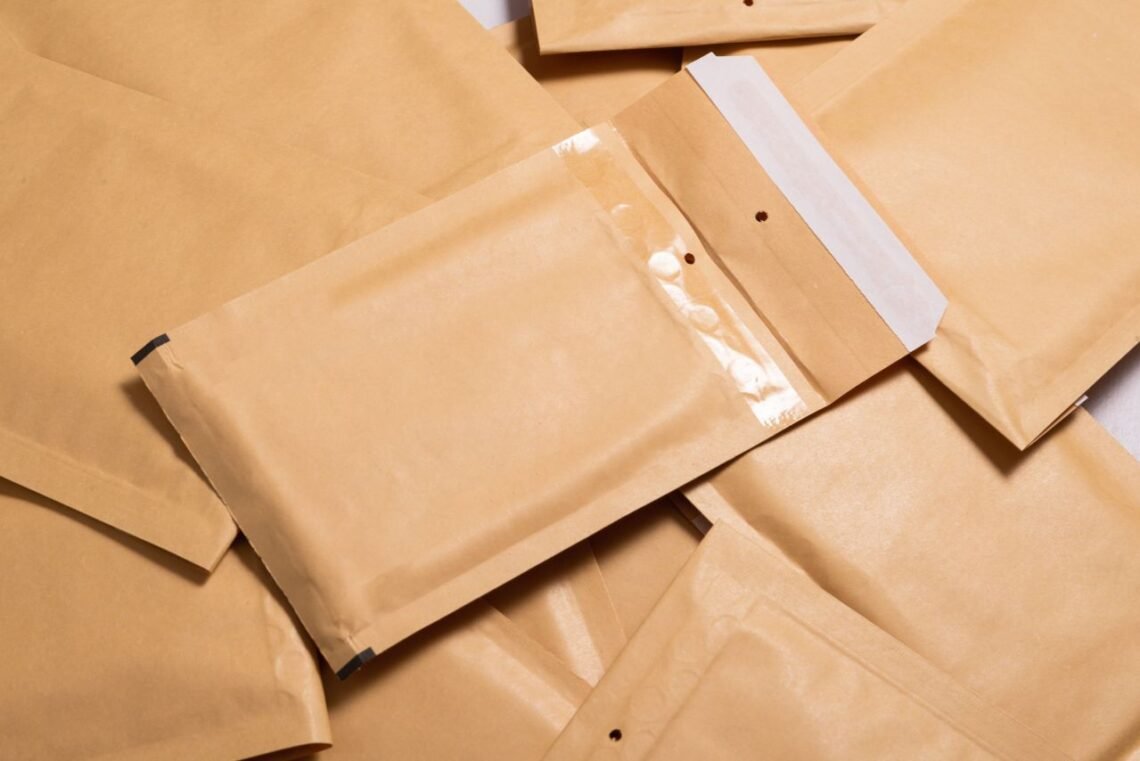
Bubble mailers are one of the most widely used formats for shipping small and medium-sized products that need light cushioning: cosmetics, electronics accessories, books, jewellery, and spare parts. They weigh far less than rigid packaging, they are quick to pack, and they keep dimensional weight under control. Not every bubble envelope performs the same way, however. This guide sets out the criteria a B2B buyer should check before placing a wholesale order.
Understand the construction
A bubble mailer has an outer shell and an inner layer of air-cushioned film. The shell can be plastic or paper, and the cushioning is bonded to it so that it does not shift during transport. Two factors decide how well the mailer protects the goods: the thickness of the outer layer, measured in micrometres or grams per square metre, and the size and density of the air bubbles. Larger bubbles absorb more energy from impacts, while smaller ones distribute pressure more evenly across flat items.
Match the mailer to the product
Start with the product that ships most often. Lightweight, non-fragile items such as textiles or printed matter need only basic cushioning. Items with hard edges or fragile surfaces, for example glass bottles in secondary packaging or electronic modules, benefit from a heavier outer layer and denser padding. As a rule of thumb, keep the product weight well below the mailer’s stated load limit and avoid forcing sharp-cornered items into a mailer that is too tight.
Sizes and internal dimensions
Suppliers usually state the internal usable dimensions as well as the external ones. Check the internal size first, and add roughly 2–3 cm for the flap and for cushioning around the product. A mailer that is too large increases the parcel dimensions and the carrier charge, while one that is too small stresses the seams. Most online stores cover their range with three or four sizes, from small formats for accessories to an A4-size mailer for books and documents. The full list of available formats and technical details is published at https://www.filmar-group.pl/en/products/shipping-mailers/classic-bubble-envelopes/, which makes it easier to compare the sizes against your own assortment.
Closure and tamper resistance
The closure is often overlooked, yet it is where many failures start. A self-adhesive strip with a protective liner allows fast sealing without extra tape and keeps the mailer closed under normal handling. If you ship higher-value goods, look for adhesive that bonds firmly at low temperatures, because parcels frequently travel through cold depots and vehicles in winter. A tamper-evident seal is an additional benefit when customers or carriers require proof that a parcel has not been opened.
Paper, plastic, and eco variants
Many buyers now compare paper bubble mailers with plastic ones. Paper mailers look premium and are associated with sustainable packaging, but they are usually less resistant to moisture. Plastic variants withstand rain, abrasion, and rough handling, and they often weigh less. There are also eco mailers made with recycled content, and it is worth asking the manufacturer for the recycled share and for guidance on how the components can be separated and recycled after use.
Testing and ordering in volume
Before committing to a large order, request samples and test them under real conditions. Pack typical products, seal the mailers, and send several parcels through different carriers. Check seam strength, adhesive performance, and how well the cushioning holds after repeated handling. A manufacturer that controls the whole production process can maintain consistent quality between batches and adapt formats or printing to your needs. Work out the full cost per shipment, including packing time and damage rate, and not only the unit price of the mailer.